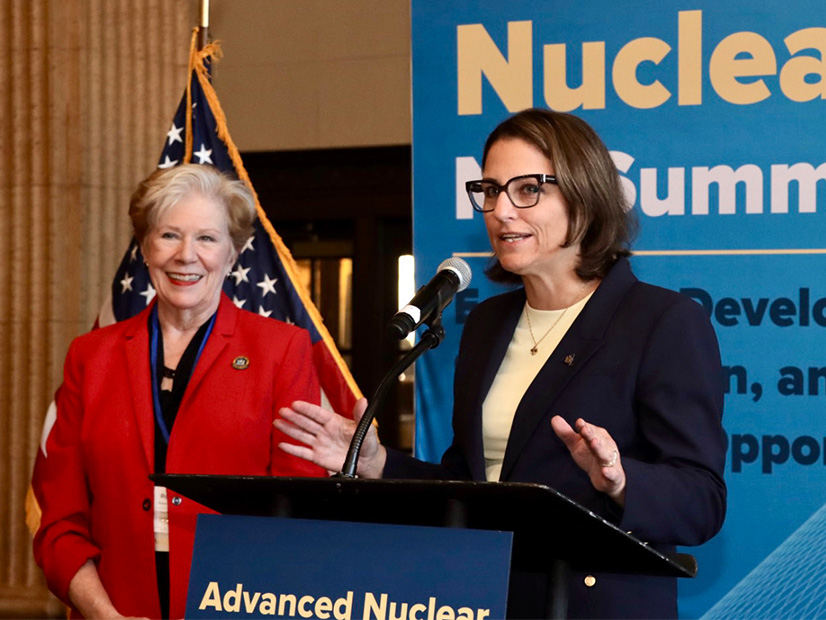
A state-sponsored summit sought to position New York to benefit from next-generation nuclear power and design the ecosystem to support it.
The Sept. 30-Oct. 1 event in Syracuse reflects the state’s growing interest in advanced nuclear technology and its promise of emissions-free baseload power.
The event was a follow-up to 2024’s Future Energy Economy Summit, and one need only look at the title of this year’s edition — Advanced Nuclear NY Summit — to see the state’s evolving focus.
It is a focus that would have seemed unlikely in the Democratic-led state just a few years ago. Even now, there remains significant opposition to extending the operating life of existing nuclear plants in New York or building new ones. A contingent of protesters parked itself outside the 2025 summit, just as in 2024.
But with construction of other emissions-free power generation lagging behind state goals, the aging of existing fossil generation and expectations for steadily increasing load on the New York grid, Gov. Kathy Hochul (D) and her regulatory/policymaking agencies are emphasizing new nuclear power more as part of the solution.
Earlier in 2025, Hochul directed the New York Power Authority to develop at least 1 GW of new nuclear generation. And the state is setting the stage for continued subsidies to prevent retirement of four aging commercial reactors that supply about one-fifth of the state’s power and two-fifths of its carbon-free power.
The New York State Energy Research and Development Authority was created in 1975 when the state reconstituted its Atomic and Space Development Authority; 50 years later, NYSERDA remains the state’s liaison to the U.S. Nuclear Regulatory Commission, and it is leading the state’s advanced nuclear initiative.
On the eve of the summit, NYSERDA President Doreen Harris spoke with NetZero Insider about the state’s goals and progress. The interview has been edited for brevity.
Q: What is NYSERDA’s role in moving New York forward with nuclear energy?
A: All state agencies are involved, but NYSERDA’s major directive is to advance the master plan and take the lead as the coordinator. “Our job is to really look at the broader needs, not just the outcome of a project, or projects, but also the broader ecosystem necessary to get from here to there.” That includes everything from community acceptance to workforce development to technology advancement.
Q: Will NYSERDA take a direct role in technology development?
A: Not supporting prototype development — that is usually through the national laboratories. NYSERDA’s role is more to assess the technologies being developed, then help push to standardize and scale them. Toward this end, New York is a co-lead in the Advanced Nuclear First Mover Initiative of the National Association of State Energy Officials. NYSERDA does have an innovation portfolio that can assist with some aspects of technology development.
Q: New York is pursuing an early role with advanced nuclear; does that carry a high technological or financial risk?
A: Not if the state pursues it correctly. “That’s exactly the whole point of this, the First Movers Initiative being a great example.” The goal is to lead efforts toward standardization and scaling while not being on the bleeding edge.
Q: Do you see a particularly stubborn obstacle to new nuclear generation in New York?
A: Community acceptance is important. “We’ve been quite clear, as has the governor, that we are looking for communities that are not only accepting, but welcoming of the projects that would ensue.” Also important: “The question of not just how to pay for these projects, but who pays and how are those costs recovered? I think it will add a level of complexity to advanced projects in this market.” For that reason, the state’s economic development arm and its power utility cohosted the 2025 summit.
Q: What is your takeaway on progress in the year since the 2024 summit?
A: “Really, we’ve made extraordinary progress as a state, not just the actual master plan that is now fully underway, but also the governor’s 1 GW-plus NYPA directive. … The focus of this summit is on economic development, on supply chain and on workforce opportunities. These are both challenges and opportunities for the state of New York to meet the moment.”
Q: Some observers worry that the Trump administration’s rush to deploy advanced nuclear designs will lead to compromises in regulatory oversight. Do you?
A: New York wants to see the federal government put full effort into advancing nuclear technology and helping states get it off the ground, but not at the expense of safety. It will continue to assess that checks and balances are preserved as it does this. “We need this to move from concept to application, but in a measured way, and that balance will continue to need to be refined.”
Q: What about you personally? What do you see in all this as an engineer?
A: Harris is excited about the technological capabilities and safety mechanisms of advanced nuclear. “It’s a far cry from the reactors that I worked on as a young engineer and … it’s reflective of really how central innovation is to the energy transition.”