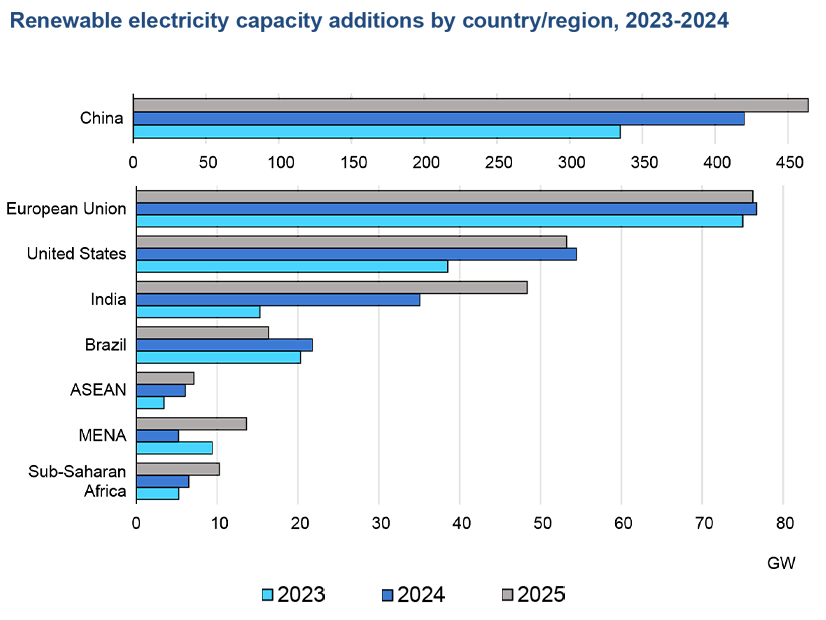
New analyses report record growth for the global renewable energy sector in 2025 and project continued expansion through the end of the decade.
Energy think tank Ember reported that solar and wind capacity additions outstripped demand growth in the first half of 2025 and that renewables produced more electricity than coal for the first time.
The International Energy Agency predicted that installed renewable capacity would more than double by 2030 despite supply chain, financing and grid integration headwinds. But IEA lowered its five-year growth forecast for two of the largest markets — the U.S. and China — because of their shifts in policy.
Ember issued its “Global Electricity Mid-Year Insights 2025” report Oct. 7. The U.K.-based think tank, which seeks to accelerate the clean energy transition, said its report is based on monthly electricity data from 88 countries accounting for 93% of global demand.
Global electricity demand grew only 2.6% (369 TWh) in the first half of the year, but solar generation increased 31% (306 TWh) and wind 7.7% (97 TWh).
In total, renewable output grew to 5,072 TWh, or 34.3% of global electricity, while coal decreased fractionally to 4,986 TWh, or 33.1% of the worldwide total.
But first-half results varied, Ember reported, with some countries or regions diverging significantly from the global trend.
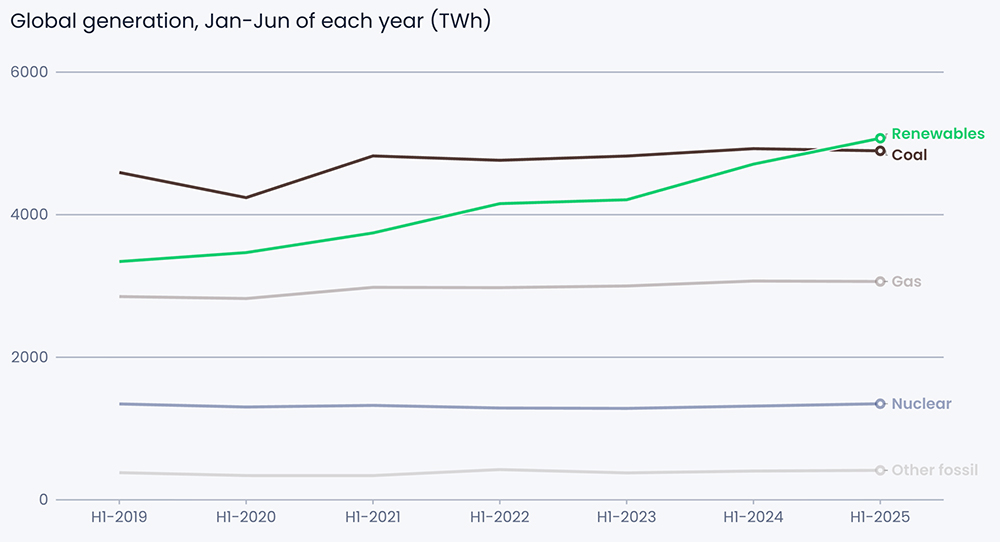
China, the EU, India and the U.S. are home to about 45% of the world’s population but use 63% of its electricity. Fossil fuel generation deceased in China and India but increased in the EU and U.S. China retained its position as the global leader in clean energy growth, accounting for 55 and 82% of new solar and wind capacity, respectively, plus 73% of new nuclear.
The picture was different in the U.S., with solar and wind additions meeting only 65% of the country’s demand increase. This and higher natural gas prices caused a shift toward coal generation, which increased 17% (51 TWh).
“Globally, renewables growth met all the increase in electricity demand,” Ember said. “That certainly wasn’t the case in the U.S.”
IEA is expecting more of this trend in the years to come. “The report’s outlook for global renewable capacity growth is revised downward slightly compared with last year, mainly due to policy changes in the United States and in China,” it said in its Oct. 7 announcement of “Renewables 2025.”
“The early phaseout of federal tax incentives along with other regulatory changes in the United States lowered our growth expectations for renewables in the U.S. market by almost 50% compared with last year’s forecast. China’s shift from fixed tariffs to auctions is impacting project economics, resulting in a reduction in our forecast for renewables’ growth in the Chinese market.”
Beyond the policy changes in the U.S. and Chinese markets, IEA sees other headwinds for much of the world:
-
- Supply chains remain concentrated in China.
- Offshore wind delays and cancellations continue.
- Major manufacturers of solar and wind components have reported large losses.
- The rise of variable renewables has been accompanied in some places by a rise in curtailments and negative prices; demand-side flexibility and dispatchable power plants will be increasingly necessary.
But IEA revised its growth projections upward in some regions because of supportive new policies, faster permitting and proliferation of rooftop solar, particularly in India, Europe and most developing or emerging economies.
With this balance, IEA is projecting 4,600 GW of new renewable capacity to be installed by 2030, 80% of it solar. This would be 2.6 times the capacity in 2022, but it would fall short of the pledge to triple capacity at 2023’s COP28 in the United Arab Emirates. IEA also maps out an accelerated scenario of more supportive polices, under which 2030 capacity would reach 2.8 times 2022 levels.
In its “Renewables 2024” report a year ago, IEA predicted 5,500 GW of new renewable energy by 2030, bringing the worldwide capacity to 2.7 times its 2022 level.
2024 set a record for renewables deployment — 685 GW — and IEA is predicting 2025 will set another record: more than 750 MW under its main scenario, or 840 GW under its accelerated scenario.