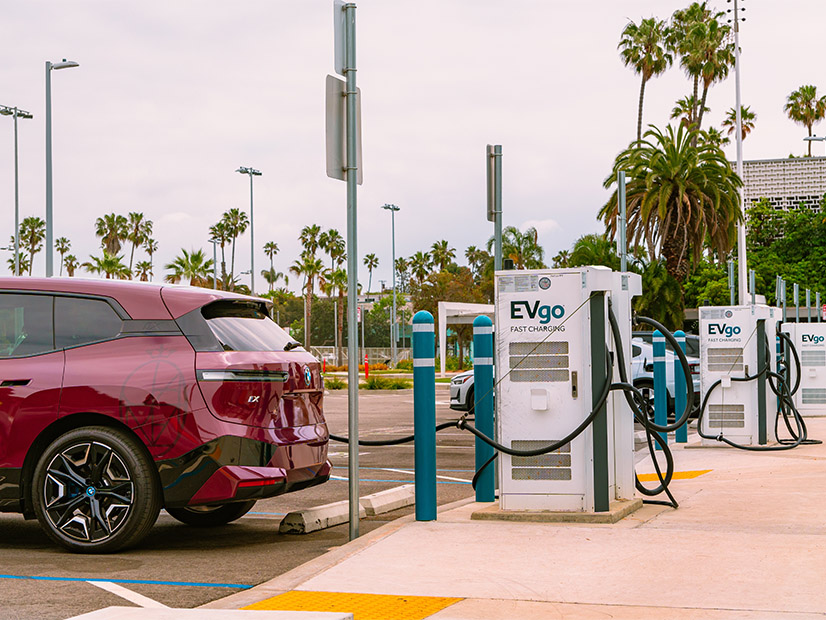
The California Energy Commission projected significant funding cuts to a key electric vehicle charging program, despite the state setting a record for the number of EVs sold in a quarter.
CEC staff on Oct. 9 published a draft report of the investment plan for the CEC’s clean transportation program, in which forecast funding for EV charging infrastructure for light-duty vehicles dropped from $98.5 million in 2025/26 to $34.2 million in 2026/27. In 2027/28, the projected funding amount decreased slightly to $33.2 million.
But EV sales are going in the opposite direction: In Q3 of 2025, California sold about 125,000 EVs — the most recorded in a quarter in the state and about 29% of total vehicle sales in the quarter, Gov. Gavin Newsom (D) said in an Oct. 13 news release. The previous record occurred in Q3 2023 when about 27% of vehicles sales were EVs.
In February 2025, California had more than 178,500 public and shared-private Level 2 and DC fast-charging ports for light-duty vehicles.
The CEC told NetZero Insider that the decrease in light-duty EV charging funding is due to projected increased investment from the private sector, along with reduced future state budget allocations. If either of these scenarios changes, next year’s investment plan update could allocate funds differently, the CEC said.
As for medium- and heavy-duty charging infrastructure, CEC staff predicted an increase in funding from $15 million in 2025/26 to $44 million in 2026/27. About 5,800 medium- and heavy duty-vehicles were registered in the state at the end of 2024. Most of these vehicles were buses.
In total, California plans to have 1.5 million zero-emissions vehicles by 2025 and 5 million by 2030. As of June 2025, more than 61 percent of clean transportation program and supplemental funds have gone to projects in disadvantaged or low-income communities or both, the CEC said.
EV Data Collection Approved
Separately, at an Oct. 8 business meeting, the CEC approved new EV charging data-collection regulations, which require public EV charging port owners in California to submit data about charger usage semiannually. Required data includes a charger’s location, availability and pricing. The data may be shared with third parties.
California will become the first state to adopt EV charging reliability and reporting regulations, CEC Commissioner Nancy Skinner said at the Oct. 8 voting meeting.
“We are laying the foundation for EV charging station reliability across the nation,” Skinner said. “[EV charging] is so important for our consumers and so important to our meeting the goals of EV adoption, because if there is a sense of unreliability, then it’s going to be harder for people who haven’t yet gone to an EV to go there.”
Publicly available Level 2 chargers have a 96% reliability of working as designed, while DC fast chargers have a 91% reliability, Skinner said.
The data collection will give the CEC, for the first time, the ability to have a comprehensive inventory of the installed chargers in this state, Skinner said. The data includes all chargers not in a residence.
“Those of us who are EV drivers, we know that we commonly use different apps or websites to find a charger,” Skinner added. “Now, if the information is not widely shared, then that charger’s not going to show up, and we won’t know that it exists.”
The regulations, Skinner said, are “going to empower us to have that inventory and to get that more publicly accessible information. So, it’s just going to improve the overall EV driver experience in California.”