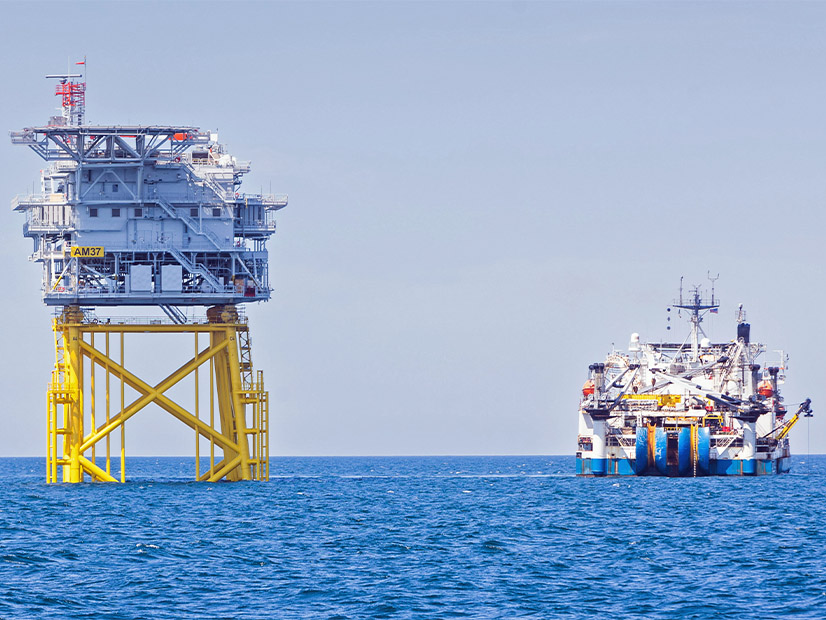
A judge has lifted the federal stop-work order on Vineyard Wind 1, allowing work to resume on the long-running, nearly completed Massachusetts offshore wind project.
The Jan. 27 ruling by the U.S. District Court for Massachusetts (1:26-cv-10156) is the latest legal setback for the Trump administration’s campaign against offshore wind, which culminated in a Dec. 22 blanket stop-work order that cited national security concerns. (See All U.S. Offshore Wind Construction Halted and Offshore Wind Developers Fight to get Back in the Water.)
Four of the five facilities under construction in U.S. waters have won permission in January from four federal judges to resume work.
The fifth, Sunrise Wind, is set for a Feb. 2 hearing on its request for a preliminary injunction (1:26-cv-00028) before the same judge who granted Revolution Wind’s request for a preliminary injunction Jan. 12. (See Judge Again Lifts Revolution Wind Stop-work Order.)
Empire Wind and Coastal Virginia Offshore Wind also have secured injunctions. (See Judge Allows Construction to Resume on Empire Wind and Dominion Wins Injunction, Can Restart Offshore Wind Construction.)
Vineyard was the last of the five projects to request an injunction, waiting until Jan. 15 to file in court. Later Jan. 27, after the injunction was issued, Vineyard said it “will continue to work with the administration to understand the matters raised in the [stop-work] order.”
“Vineyard Wind will focus on working in coordination with its contractors, the federal government, and other relevant stakeholders and authorities to safely restart activities as it continues to deliver a critical source of new power to the New England region,” it added.
To submit a commentary on this topic, email forum@rtoinsider.com.
The 62-turbine, 800-MW Vineyard Wind 1 is a joint venture of Avangrid and Copenhagen Infrastructure Partners that put its first steel in the water in June 2023. It was far behind its original schedule even before the stop-work order, but it is nearly complete and has begun sending power to the grid.
The impact of the stop-work order has extended beyond the developers themselves.
GE Vernova, the manufacturer of the turbines and blades being installed off the south coast of Massachusetts, said Jan. 28 that the federal stop-work order contributed to the $225 million loss the company’s wind business recorded in the fourth quarter of 2025.
CFO Ken Parks said during an earnings call that one turbine is left to be installed and 10 need blades installed.
If GE Vernova does not install these components before March 31, he said, it will lose access to the installation vessel needed for the work. If it cannot install the equipment, it cannot bill the developer for the work, potentially resulting in a $250 million loss in 2026, he said.
For this and other reasons, the wind business will record a $600 million loss for 2025, 50% more than the $400 million predicted in early December, giving it a ‑6.6% EBITDA margin for the year.
GE Vernova’s two other component businesses fared much better: Power recorded 52% more orders and 10% more revenue in 2025 than in 2024 and boosted its EBITDA margin to 14.7%. Electrification recorded 21% more orders and 26% more revenue year over year and bumped its EBITDA margin up to 14.9%.
U.S. Sens. Ed Markey and Elizabeth Warren (D-Mass.) welcomed the Jan. 27 injunction.
“This stay is an important step in the process to fight back against the Trump administration’s lawless attacks against our union jobs, grid security and energy affordability,” they said. “Vineyard Wind 1 is currently delivering affordable and reliable power into our grid and has the permits, financing and approval to deliver even more. Shutting off Vineyard Wind 1 would kill thousands of local union jobs, prevent power from reaching 400,000 homes, and cause us to lose out on $3 billion of energy savings.”