Two new studies released by advocates on opposite sides of the clean energy debate reach opposite conclusions about the economic benefits of renewables.
A coalition of free market think tanks on Jan. 13 trumpeted a new report by Always On Energy Research (AOER) concluding that if state renewable energy mandates in New England were abandoned in favor of new nuclear and natural gas generation, ratepayers would save hundreds of billions of dollars over the next 25 years.
The Coalition for Community Solar Access (CCSA) on Jan. 14 hailed a new report it commissioned from Synapse Energy Economics that found expanding New York’s distributed solar portfolio to 20 GW and increasing the state’s energy storage capacity could lead to $1 billion in annual energy cost savings for ratepayers by 2035.
The AOER report was quickly criticized in a rebuttal by a group of decarbonization advocates who called its data selective, its analyses flawed and its proposed scenarios highly unrealistic.
The CCSA report, on the other hand, is itself a rebuttal or rebuke of New York state’s recent step back from some of its clean energy goals and its governor’s interest in an all-of-the-above energy solution to ensure affordability.
Although the conclusions and suggested solutions vary widely, the underlying issue — expensive electricity — is not debatable.
In its most recent monthly price report, the U.S. Energy Information Administration calculated the average U.S. electricity price across all customer sectors nationwide at 13.63 cents/kWh in October 2025. New York was 57% higher at 21.34 cents and New England was 75% higher at 23.8 cents.
For all of 2024, those seven states ranged from 42 to 88% higher than the national average. Only California and Hawaii were higher.
New England
The AOER report was released by the Maine Policy Institute, Fiscal Alliance Foundation, Josiah Bartlett Center for Public Policy, Rhode Island Center for Freedom & Prosperity, Yankee Institute and Americans for Prosperity Foundation.
It is a continuation of previous AOER state-level analyses, including a 2024 study that modeled the economic and reliability impacts of energy policies in the six New England states; all but New Hampshire have established aggressive decarbonization requirements.
While AOER does not explicitly identify itself as pro-fossil fuel, it repeatedly describes itself with common pro-fossil keywords such as affordable, abundant and reliable, and its work frequently faults green policies.
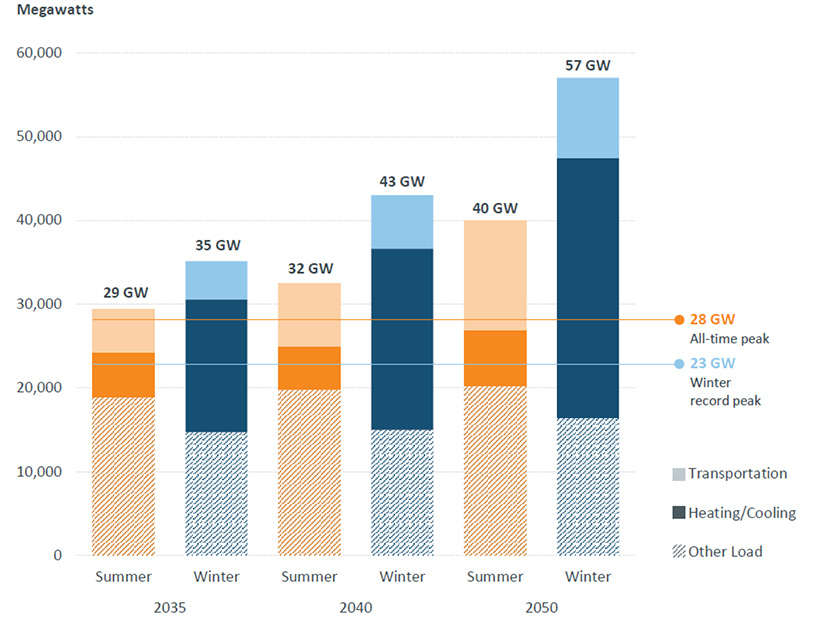
The 2026 report — “Alternatives to New England’s Energy Affordability Crisis” — looked at four ways to meet a total peak demand of 52.5 GW on the ISO-NE grid in 2050:
-
- The renewables scenario would combine 19.2 GW of onshore wind, 43 GW of four-hour storage, 66 GW of offshore wind and 68.4 GW of solar at a cost of $815 billion.
- The nuclear scenario gradually replaces all carbon dioxide-emitting generation with 20.4 GW of large nuclear plants and 14.7 GW of small modular reactors, plus 13.7 GW of natural gas generation in a bridge and/or peaker role at a total cost of $415 billion.
- The natural gas scenario entails all types of existing generation assets being used until they reach the end of their useful lives, then being replaced with new combined cycle gas-fired plants plus new gas combustion turbine peakers. This would cost $107 billion.
- The “happy medium” scenario would add 10.8 GW of new nuclear and 24.3 GW of new gas capacity to existing generation at a cost of $196 billion.
The authors note that each scenario faces significant obstacles: the sheer scale of a wind-solar-storage buildout, anti-offshore wind policies, insufficient gas pipeline capacity and the very concept of building so many nuclear reactors. They also said they did not attempt to factor in the cost of things such as building electrification or quantify the fuel cost savings such steps would offer.
The think tanks that released the AOER report focused on the dollar figures and urged New England policymakers to turn away from renewables.
“New Englanders are being asked to bankroll an energy experiment that is dramatically more expensive and far less reliable than proven alternatives. This study puts hard numbers behind what families and businesses already feel every month. State-mandated wind and solar are driving up costs while increasing the risk of blackouts. Replacing these mandates with nuclear and natural gas would save hundreds of billions of dollars, strengthen grid reliability and deliver real emissions reductions without sacrificing affordability or economic competitiveness,” Fiscal Alliance Foundation Executive Director Paul Diego Craney said in a news release.
Not so fast, the Acadia Center said Jan. 16.
The 501(c)(3) working to reduce carbon emissions in the Northeast laid out a point-by-point rebuttal of the report three days after AOER released it, saying its analysis “grossly inflates the cost of clean energy, selectively ignores fuel savings and proposes highly unrealistic alternative scenarios.”
It also ignores the societal cost of carbon emissions, understates the cost of nuclear, overstates the installed capacity needed and does not consider the prospect of emerging clean-energy technologies, Acadia said.
Acadia similarly attacked AOER’s 2024 report, “The Staggering Costs of New England’s Green Energy Policies.”
New York’s Shift
The Empire State through rhetoric and policy has long been one of the most aggressively green states in the nation.
But energy development comes at a high cost and slow pace in New York, and renewables are lagging far behind the goals the state mandated in its landmark 2019 climate law.
With utility costs high and rising further, with existing generation assets aging and with the Trump administration actively opposing renewables, New York Gov. Kathy Hochul (D) recently has taken a more pragmatic stance, continuing to embrace the state’s green goals but hesitant about the cost of reaching them.
Among other things:
-
- The New York Power Authority is taking a measured approach to its new role as renewable energy developer, initially targeting fewer and smaller projects than advocates would like and expecting a high attrition rate for them.
- The newly updated State Energy Plan predicts a longer reliance on fossil fuels, possibly including what until recently was unthinkable — new-build fossil generation.
- The state allowed a controversial gas pipeline expansion plan to go forward after previously rejecting it.
- Hochul has held off on implementing a planned cap-and-invest system.
- The state appears poised to continue its subsidies for existing nuclear power plants, which cost ratepayers about $500 million/year.
- Hochul in mid-2025 ordered development of 1 GW of new nuclear capacity, then kicked that up to 5 GW in her 2026 State of the State Address.
All of which has left clean energy and public power advocates increasingly restive, but not resigned.
Distributed solar generation is one of the bright spots in New York’s clean energy landscape — deployment has surpassed goals and by some measures has led the nation.
A large group of mostly Democratic Assembly members and senators are sponsoring the Accelerate Solar for Affordable Power (ASAP) Act (A8758/S6570), which would boost the state’s goal from 10 GW of distributed solar by 2030 to 20 GW by 2035.
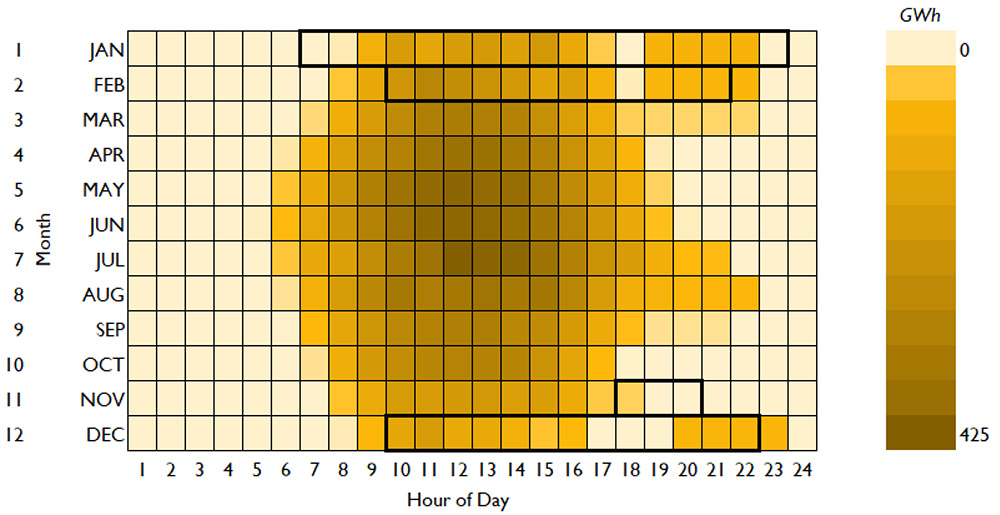
Installed capacity presently stands at 7.3 GW with 2.8 GW more in the development pipeline, advocates say.
The study Synapse Energy Economics conducted for CCSA concluded that with 20 GW of distributed solar and 3.7 GW of distributed storage in place by 2035, an estimated $1 billion/year in ratepayer energy costs would be avoided. The savings would accrue to all ratepayers, though not equally across regions.
This much capacity would avoid the use of 56 Bcf of gas for energy generation, or about 11% of New York’s total in 2024. That reduction would yield a savings of $947 million in societal cost of greenhouse gas emissions.
The authors say other benefits such as public health improvement and the ability to defer grid upgrades would be notable but were not quantified for the report.
Synapse lists multiple environmental advocacy organizations among its clients. The scope of its work includes a significant focus on green energy and decarbonization but extends to other aspects of the power grid.
“This study shows that smart policy choices can unlock real savings for all customers, not just those who install solar on their rooftops,” CCSA Northeast Director Kate Daniel said in a news release. “The ASAP Act is an opportunity to build on New York’s leadership and scale solutions that are already working.”
ASAP’s sponsors embraced that conclusion.
“In these uncertain times and with headwinds from the federal government, it’s more important than ever for New York state to lean into and expand on our successes,” said Assemblymember Didi Barrett (D), sponsor of the ASAP Act in the Assembly and chair of its Energy Committee.
“Solar energy is the cheapest form of energy to produce and a linchpin for affordability,” said State Sen. Pete Harckham (D), sponsor of ASAP in the Senate and chair of its Committee on Environmental Conservation. “This new study re-emphasizes the long-term, abiding value of renewable energy and storage systems in this regard. At this point, we should be exponentially increasing our clean energy efforts and gigawatt goals with distributed solar projects to create thousands of green jobs and save ratepayers millions of dollars.”