Clean energy policies and their impact on rising utility rates are under scrutiny in New Jersey’s most competitive gubernatorial race in years as voters decide on a replacement for Democratic Gov. Phil Murphy, a champion of green energy.
Six Democrats and five Republicans have filed to seek the governor’s office, which Murphy used to aggressively promote offshore wind (OSW) projects, electric vehicle (EV) adoption and building electrification strategies. Murphy called on the state to have 100% carbon-free electricity by 2035.
With the primary scheduled for June 10 and the general election Nov. 4, candidates have been bombarding voters with campaign ads for weeks.
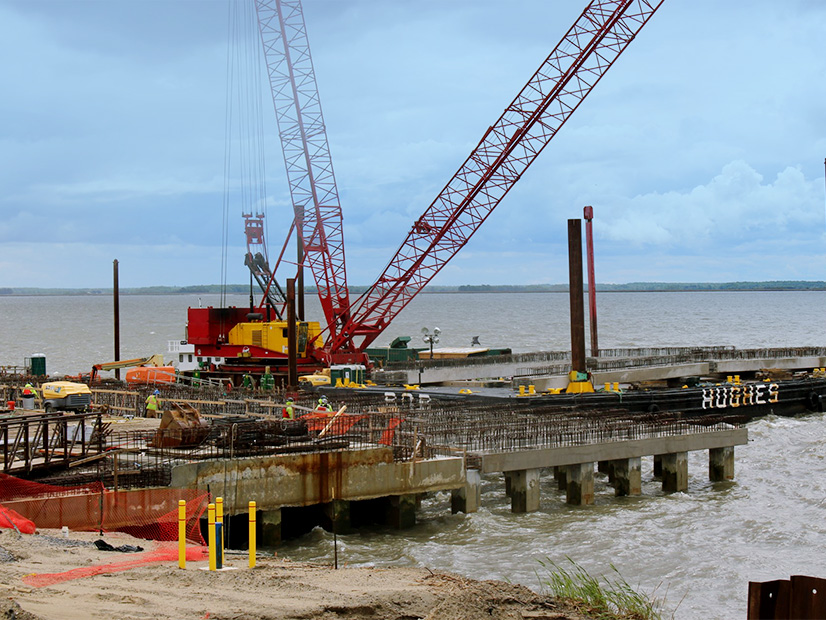
Yet the terrain faced by the candidates is vastly different — and less friendly to clean energy — from the one Murphy enjoyed in his two terms in office. The state’s major gamble on OSW largely has stalled amid logistical and cost challenges, flagging public support and opposition to wind power from President Trump.
And the state could experience energy shortfalls because too few new generating sources are coming online as fast as old fossil-fueled plants shut down. That has helped cause a dramatic hike in electricity prices that has led to consumer outrage. (See NJ Lawmakers Sound Energy Supply Alarm.)
Ratepayers will see the average bill rise by about 20% on June 1, a hike that has triggered a vigorous inquiry from legislators on what happened and how the state can boost its supply. Observers say electricity generation likely will emerge as a campaign issue with an intensity rare in electoral and public policy debates.
“I don’t think it’s hyperbole to say that this is probably the most important gubernatorial primary in recent memory for both sides of the aisle, for the directions of both parties, and certainly for policies for environment and energy,” said a leading environmental advocate.
Future Power Shortage
The rate hike comes as the public already clearly is concerned about energy costs, according to a poll by the William J. Hughes Center for Public Policy at Stockton University. It found that 67% of registered voters said utility costs were getting worse, compared with 27% who said they remained the same.
New Jersey officials say the rate hike was created by the PJM capacity auction in July 2024, which resulted in a price increase that was 10 times larger than in previous years. PJM says the auction outcome was shaped in part by a surge in demand from EV use and a predicted influx of energy-intense data centers. New Jersey officials blame PJM’s inaccurate forecasting, saying it predicted more future demand than is realistic, which pushed up auction bid values.
Micah Rasmussen, director of the Rebovich Institute for New Jersey Politics, said energy likely will be a more central issue in the general election than in the primaries.
“The Republican candidates all point to Gov. Murphy’s clean energy policies as being responsible for the high cost of energy in the state, as well as present and future supply constraints,” he said. “We should expect to see some (GOP) scapegoating of New Jersey’s clean energy investments as being responsible for this year’s sticker shock in the cost of residential electric, even though that’s directly attributable to the annual PJM auction.”
Moreover, “Democratic candidates will not be jumping to the outgoing governor’s defense,” he added. “So there’s not a tremendous amount of intra-party contrast.”
The Trump Effect
New Jersey traditionally leans Democratic — both U.S. Senators are Democrats, and no Republican has won a U.S. Senate seat since the mid-1970s. The Democrats control both state legislative houses. But Republicans have succeeded in gubernatorial races — with Chris Christie and Christine Todd-Whitman each winning twice in the past 30 years.
To add to the uncertainty, Murphy’s second electoral victory, in 2021, was much closer than his 2017 election, which some analysts attributed to public concern over his clean energy push. Others felt it was a reaction to the impact of the pandemic.
Throw in Trump’s dominance of the Republican party, and his recent ability to attract swing voters, and the gubernatorial outcome is far from predictable. Vice President Kamala Harris in the 2024 election won by only 5 points.
That has unnerved some environmental groups, which hope a Democratic victory would enable the state to continue many of Murphy’s policies even in the face of Trump’s crackdown. They argue that clean energy is the solution to the state’s pending energy shortfall.
“The political environment, the protection of our natural resources, is more important than ever,” said Ed Potosnak, executive director of the New Jersey League of Conservation Voters. “I think right now, affordability is front of mind. I just can’t say it enough: Clean energy is the cheapest energy, and it’s also going to save money in the long run.”
Democratic Nuance
The six Democrats seeking the governor’s office include Steve Sweeney, a longtime legislator and the former state senate president, and Steve Fulop, a former Marine and an Iraq war veteran who is mayor of Jersey City, the state’s second-largest city.
Two members of the U.S. House of Representatives are running: Mikie Sherrill, a former Navy helicopter pilot and federal prosecutor, and Josh Gottheimer, who worked at the U.S. Commission on Civil Rights under Presidents Obama and Clinton. Also running are Ras Baraka, the mayor of Newark, New Jersey’s largest city, and Sean Spiller, a former high school science teacher and mayor of Montclair, who also is president of the New Jersey Education Association, the state’s powerful teachers’ union.
In general, the candidates support a commitment to clean energy, with some nuanced divergences from Murphy’s path. Gottheimer, for example, who is more of a centrist Democrat, touts an “all-of-the-above” energy strategy on his campaign website, setting a distance from Murphy’s single-minded focus on electrification.
Sherrill’s commitment to “invest in clean energy like solar” suggests a far more vague clean energy focus than the current governor’s vision.
Fulop backs Murphy’s OSW commitments, one of the governor’s most controversial moves. Polls have shown a drop in support for offshore wind, from 82% in favor in 2008 to 54% in 2023. Republicans and Jersey Shore residents in the past 18 months have waged an aggressive campaign to head off the projects, in part by expressing concern — somewhat improbably — for the impact on the area whale population.
Baraka embraces Murphy’s stance of fossil-free electricity generation by 2035.
Sweeney largely avoids energy issues on his campaign website, but suggested to Fox News that he would halt the state’s adherence to Murphy’s earlier commitment to be 100% clean energy by 2050.
Potosnak, of the League of Conservation Voters, said his organization endorsed Sherrill, in part because she is “not the same as Murphy” and has a “fresh perspective.”
She outlined a more “robust and innovative” solar program than Murphy’s, “putting solar on as many as is practical government buildings and parking lots, which is great, because that saves us from cutting down forests,” he said.
“I don’t think the environment is a left or right issue. It’s an issue of critical importance to our future, for our families, for our businesses,” Potosnak said. But he added that while Republican candidates for a variety of offices have in the past courted the League’s support, none did in this gubernatorial race.
“We reached out to them,” he said. “Unfortunately, none applied for the endorsement.”
GOP OSW Ban
That disinterest in the League’s outreach likely stems in part from the GOP’s tight embrace of Trump, who has frozen the nation’s offshore wind projects and is believed to be considering cuts to subsidies for clean energy, such as the federal tax credits for solar and EVs.
A poll released April 25 by the Eagleton Institute of Politics, a unit of Rutgers University, found that the Democratic race is close, with Sherrill leading the pack with 17%, followed by Fulop at 12% and Spiller, Baraka and Gottheimer all at 9 or 10%.
The poll found the Republican race much less open, with 42% of New Jersey registered Republicans and Republican-leaning independents surveyed saying they prefer Jack Ciattarelli. A former assemblyman, Ciattarelli ran against Murphy in 2021 and came within three points of beating him. The second-place candidate in the poll, former radio host Bill Spadea, drew 12%.
Ciattarelli, Spadea, Barbera and Kranjac are all strong Trump supporters.
Bramnick has criticized Trump, and he argues that he’s the Republican most in tune with New Jersey’s centrist voters and so is most electable in the general election.
Spadea, in a recent post on X, rebuffed Democratic criticism that PJM carries the blame for state’s future energy shortfall. He blamed the Democrats’ “radical climate change agenda” for plant closures. He said he would scrap Murphy’s Energy Master Plan, cut subsidies for wind and solar, and increase nuclear and natural gas electricity generation.
Bramnick has called for the state to pursue natural gas and nuclear solutions until clean energy technologies become “more affordable and reliable.”
Ciattarelli says that if elected, he would draft a state Energy Master Plan based on an all-of-the-above energy policy. He wants to ban offshore wind farms and withdraw New Jersey from the Regional Greenhouse Gas Initiative (RGGI). He also would “repeal unrealistic and unaffordable state mandates and timelines regarding electric vehicle sales, household appliances, home renovation and home construction — which would make New Jersey even more expensive,” his website says.
He doesn’t name the mandates, but that likely would include Murphy’s 2021 commitment to New Jersey to California’s Advanced Clean Truck (ACT) regulations, which require truck manufacturers to meet increasing electric vehicle sales targets, and his 2023 adoption of the Advanced Clean Cars II, which will require all new light-duty vehicles sold in the state to be zero emission by 2035.
Murphy’s administration also has vigorously promoted building electrification — the use of electric heating and hot water systems — but has not mandated their use and says he would rather use incentives to get the job done.