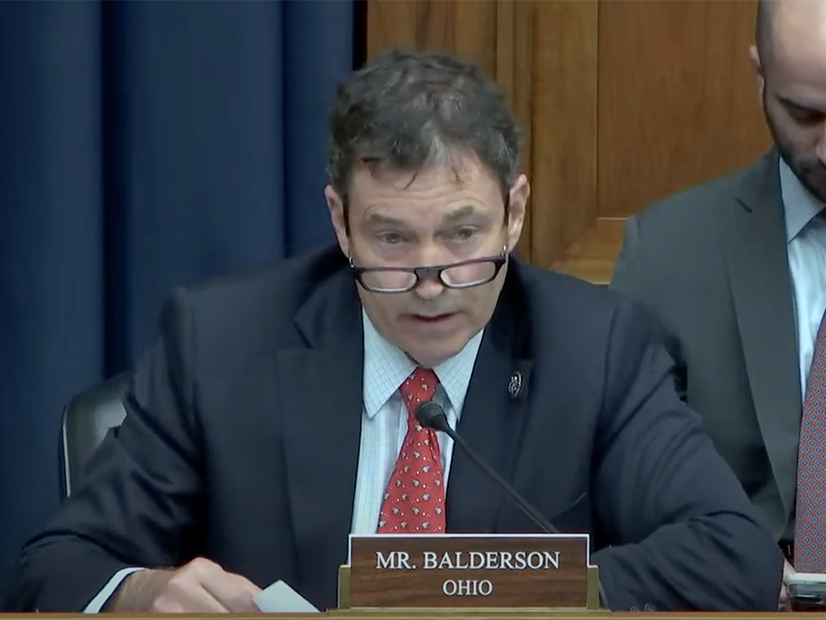
A bill that would allow dispatchable energy projects to jump ahead in the interconnection queue under certain circumstances sparked debate during a House Energy and Commerce Subcommittee on Energy hearing April 30.
Subcommittee members grilled two panels of experts during the hearing to gather information related to 14 energy-related bills. One of those was H.R. 1047, the Guaranteeing Reliability through the Interconnection of Dispatchable (GRID) Power Act, introduced by Rep. Troy Balderson (R-Ohio) in February. (See Bills Introduced in Congress to Speed up Queues for Dispatchable Power Plants.)
The bill would direct FERC to launch a rulemaking that would allow transmission providers to file requests to move their dispatchable power projects up in the interconnection queue. Applicants would be required to show why the prioritization was needed and how it would improve grid reliance or resilience. Transmission providers also would need to conduct a stakeholder engagement and public comment process before submitting the applications.
FERC then would be required to issue a decision within 60 days.
Todd Snitchler, CEO of the Electric Power Supply Association, described the provisions of the GRID Power Act as “an emergency relief valve.” EPSA has endorsed the legislation.
“What it seeks to do … is a very balanced approach to try and address a critical issue in a way that does not immediately advance any one project to the front of the line and in fact takes a measured approach to try and ensure reliability over time,” Snitchler said in response to questioning from Balderson.
Snitchler compared the bill to PJM’s Reliability Resource Initiative (RRI) that FERC approved in February. PJM described the initiative as a way to get shovel-ready projects connected faster by adding them to the final transition cycle of its reformed interconnection process, rather than waiting for the new cycle to be implemented next year. (See FERC Approves PJM’s One-time Fast-track Interconnection Process.)
“This has a very similar flavor in trying to address the occasions as they arise in a way that will allow the emergency to be relieved, and then go back to business as usual,” Snitchler said.
The GRID Power Act defines dispatchable power as “an electric energy generation resource capable of providing known and forecastable electric supply in time intervals necessary to ensure grid reliability.”
Some lawmakers, including Rep. Jake Auchincloss (D-Mass.), said that instead of focusing solely on dispatchability, “the first [project] to get connected should be the first that’s ready.”
Rep. Robert Menendez (D-N.J.) said natural gas power plants may face lengthy delays in receiving new turbines.
“We want to get projects on the grid. The interconnection process is absolutely a part of that,” Menendez said. “But getting projects on the grid also includes financing, local permitting and supply chain issues that all must be addressed as well.”
Witness Kim Smaczniak, a partner at energy law firm Roselle LLP, said the GRID Power Act would make it easier to create an interconnection queue that “picks winners and losers among resources.” Smaczniak was a special counsel at FERC, where she helped develop the commission’s Order 2023 interconnection reforms.
In written comments, Smaczniak said that because of the limited transmission capacity, the bill would increase uncertainty and costs for power projects seeking to connect to the grid.
“Timely, certain, cost-effective interconnection can make or break whether a project is commercially viable,” she said.
No action was taken on the GRID Power Act or other legislation during the hearing. Lawmakers have 10 business days to submit additional questions on the bills.