A conservative-leaning energy advocacy group is out with a new report on the value of methane-based hydrogen production paired with carbon capture and storage.
So-called “blue” hydrogen is poised to help expand U.S. energy dominance as the global market for lower-emissions hydrogen takes shape, the authors write, and federal incentives are essential for the nation to remain competitive in the early stages.
The Citizens for Responsible Energy Solutions (CRES) Forum report released May 5 included modeling analysis that projected tens of thousands of new jobs and tens of billions of dollars in economic impact from a robust blue hydrogen sector.
The report comes amid ongoing debate over clean-energy tax credits created under former President Joe Biden, which subsequently were targeted by President Donald Trump but are finding support from some Republican lawmakers who see economic benefits in their districts from those credits.
Among these are the 45V clean hydrogen production tax credit. It and other incentives are “essential” for helping the United States stay competitive in the emerging market, the authors write, as the advanced technology involved carries high upfront costs.
While U.S. industrial decarbonization initiatives no longer enjoy the same level of support as they did under President Biden, the report notes that other major economies continue to ramp up such efforts.
“The U.S. benefits from abundant natural gas resources and technological leadership in CCS, making it uniquely positioned to become a global leader in blue hydrogen production,” the authors write.
Their analysis of data from the International Energy Agency shows that all blue hydrogen projects publicly proposed in the United States would have a combined annual production capacity of 9.8 million metric tons by 2035.
Using multiple scenarios, the report calculates:
-
- Construction of those plants nationwide could support 29,000 to 79,000 construction jobs through 2035.
- Texas and Louisiana would see the largest boost in construction employment.
- Construction could have an annual economic impact of $6.7 billion to $18.7 billion.
- Annual operations would support 18,000 direct jobs and 44,000 indirect or induced jobs.
- The bulk of those permanent jobs again would be in Texas and Louisiana.
- Operations would support $22.4 billion in economic output.
Production of 9.8 MMT of blue hydrogen also would ripple through the natural gas industry, creating steady demand and supporting nearly 6,800 direct jobs, the report estimates.
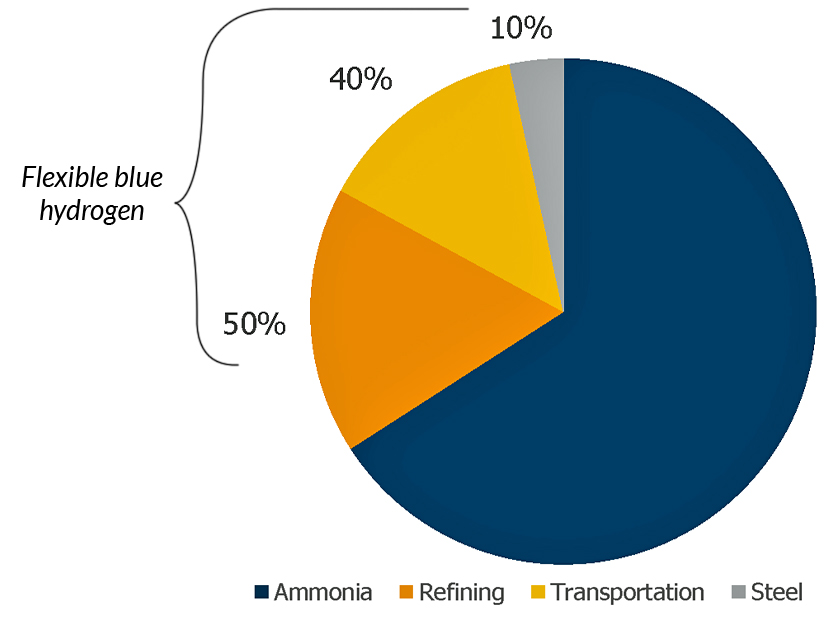
The authors note that roughly two thirds of announced blue hydrogen production would be devoted to ammonia, most of it for fertilizer. The remainder might be used mainly for petroleum refining and transportation, with a small amount going to steel production.
“The 45V tax credit is not just an investment in energy; it is an investment in America’s economic strength, industrial leadership and long-term global competitiveness,” the authors write.
Dramatically increasing the production and dramatically decreasing the production cost of clean hydrogen was one of Biden’s high-profile Earthshot initiatives, but the vision was hampered by the slow rollout of details crucial to investment decisions. The 45V tax credit rules were not finalized until two weeks before Trump’s inauguration.
Beyond the economics, there is disagreement over how “clean” various types of hydrogen generation really are, and there was spirited argument between industry lobbyists and environmental advocates over the details of 45V as they were being finalized.
Those details play a critical part in how expensive production is and how impactful it is on the environment.
Hydrogen itself does not create carbon dioxide when burned or run through a fuel cell, but significant amounts of the greenhouse gas can be generated through hydrogen production.
Also, given that hydrogen produces less energy per unit of volume than methane, more hydrogen may be needed for a given application.
Finally, the carbon capture and storage that is integral to blue hydrogen also consumes energy.
There is room for reduction, however — the vast majority of U.S. hydrogen production is “gray,” which essentially is the same as blue hydrogen but without carbon capture.
Environmental advocates press instead for “green” hydrogen — emissions-free hydrogen produced with emissions-free electricity newly built for that purpose. Green at present is much more expensive than gray.
CRES is a nonprofit seeking to educate Republican lawmakers and the public about conservative solutions to address U.S. energy, economic and environmental security while increasing the nation’s competitive edge. It identifies its goal as lowering global emissions to maintain a clean environment and mitigate the impacts of climate change.