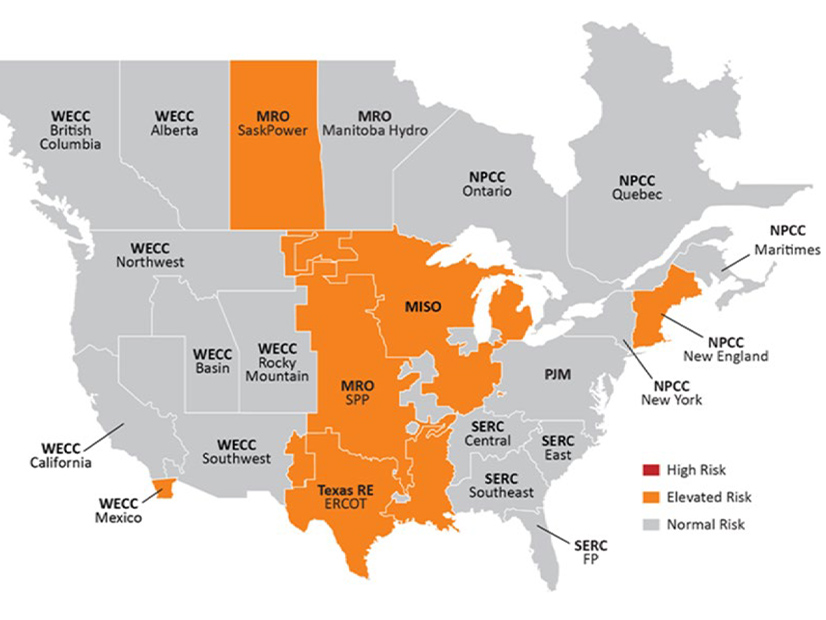
Multiple areas of North America’s electric grid are expected to “face challenges in meeting higher demand this summer” amid the ongoing transition to variable energy resources, NERC said in its 2025 Summer Reliability Assessment.
Most of the areas of concern highlighted in the assessment, released May 14 and covering the months of June-September, are in the middle of the continent, with MRO-SaskPower, MISO, MRO-SPP and ERCOT facing elevated risk — meaning potential for insufficient operating reserves in above-normal conditions. NPCC and WECC-Mexico in Baja California also face elevated risk, according to the report.
No areas face high risk, meaning potential for insufficient operating reserves in normal peak conditions, and all other areas were assessed as normal risk, indicating that sufficient reserves are expected in all conditions.
A major driver of risk in NERC’s assessment areas is the rapidly growing demand on the grid. Since the summer of 2024, the ERO said, the aggregate peak demand across the regions has grown more than 10 GW, more than twice as much as it grew over the previous year.
As demand rises, traditional generation resources have retired; NERC noted more than 7.4 GW of generators by nameplate capacity have retired since the prior summer or become inactive for the season. Of the retired generation, 2.5 GW was gas-powered, while 2.1 GW was coal-fired.
These retirements have been offset by the addition of 30 GW of solar and 13 GW of battery resources by nameplate capacity, which “are expected to provide over 35 GW in summer on-peak capacity,” NERC said, along with wind facilities that should provide 5 GW at peak. However, NERC warned that the changing resource mix “in general has less flexibility and more variability, which could cause problems meeting demand.”
NERC also expressed concern about the response of inverter-based resources to grid disturbances. In a webinar announcing the SRA’s release, Mark Olson, NERC’s manager of reliability assessments, said “operators … need to be prepared for the potential that large-scale amounts of resources can disconnect during grid disturbance events.”
He noted the ERO’s recent report on shortcomings of IBRs on the grid, which led NERC’s Board of Trustees to approve a Level 3 alert setting out essential actions regarding IBR performance and modeling at their May meeting. (See NERC Warns Many Inverters’ Information Not Up to Date.)
Weather is another factor in the risk calculation, with the National Oceanic and Atmospheric Administration predicting above-average summer temperatures across much of the continent and below-average precipitation in the Northwest and Midwest. Similar predictions from Environment and Climate Change Canada were included in the report as well.
“Temperatures really are closely correlated with demand, and although average temperatures aren’t necessarily telling you that peak demand is going to rise, you can have a reasonable expectation that the higher average temperatures that are expected this summer could bring the potential for extreme temperatures and peak demand levels to exceed previous records,” Olson said.
Olson pointed out that drought conditions also persist in parts of the U.S. and Canada, which could cause problems with hydroelectric generation while raising wildfire risk, which “can lead to impacts for generation and transmission.”
NERC’s recommendations for reliability coordinators, balancing authorities and transmission operators in the elevated risk areas include reviewing seasonal operating plans for communicating and resolving supply shortfalls issues, making plans for higher-than-expected forced generator outage rates, and operating conservatively as much as possible to make sure adequate resources are available. The ERO also recommended that owners of solar resources implement recommendations from NERC’s IBR performance alert of March 2023.