

CAISO has delayed its final decision on how to allocate congestion revenues in its Extended Day-Ahead Market (EDAM) after receiving comments from stakeholders asking for more analysis.
CAISO planned to vote on its draft final proposal in late May but decided to hold off until June. Adjusting the proposal’s planned approval date has “allowed us to further explore additional enhancements suggested by stakeholders,” said Anna McKenna, CAISO vice president of market design and analysis, at a May 20 WEM Governing Body meeting.
The congestion revenue initiative is a top priority for CAISO in 2025. The organization received comments from PacifiCorp that questioned the way congestion revenues will be allocated in the proposed EDAM design. The primary concern is whether certain congestion revenues should be allocated to the balancing area in which the congestion costs accrued, or to the neighboring EDAM balancing authority area where the transmission constraint is located, specifically in cases in which parallel — or loop — flows occur.
On May 19, CAISO published a revised draft final proposal, which fine-tunes the allocation of parallel flow congestion revenues “based on the exercise of eligible firm point-to-point and Network Integration Transmission Service and Open Access Transmission Tariff transmission rights.”
The revised draft provides details about congestion revenues that are not received under the current design for the EDAM entity. Any remaining parallel flow congestion revenue accrued because of a transmission constraint in a neighboring EDAM balancing area would be allocated to the area where the binding transmission constraint is located, CAISO wrote.
The revised draft is consistent with FERC requirements that say congestion revenues accruing internal to an EDAM balancing area because of an internal transmission constraint are allocated fully to that balancing area — i.e., where the transmission constraint is located, CAISO wrote.
“Stakeholders continued to note the concern that the proposed design in the near term may incent self-scheduling by transmission customers in order to receive a congestion hedge, a ‘use it or lose it’ concept to the exercise of transmission rights,” CAISO said in the draft. “In this context, stakeholders indicated broad support for an economic bidding enhancement to enable parallel flow congestion revenue allocation for balanced cleared market schedules based on economic bids, not only self-schedules.”
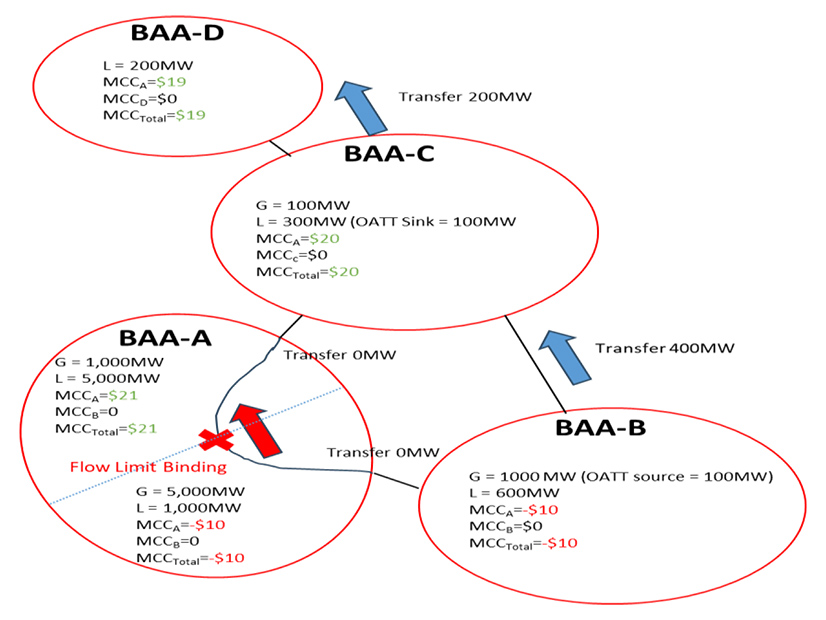
The revised proposal includes an example of a load event that shows how much money would be distributed to four balancing areas: BAA-A, BAA-B, BAA-C and BAA-D. In the example, the market footprint net settlement is an over-collection in congestion revenue of $135,800. Under the current EDAM design, all of the congestion revenue is allocated to the BAA where the constraint is modeled, CAISO wrote. However, under the revised draft, the congestion revenue associated to balance OATT self-schedules is allocated to the EDAM entity where OATT rights are exercised.
CAISO will hold a stakeholder meeting on the revised final draft proposal May 27, with comments due by June 2. CAISO plans to publish a final proposal June 6.


