Arizona utilities are seeking U.S. Department of Energy funding to help plan for additional nuclear power facilities in the state.
Arizona utilities are seeking U.S. Department of Energy funding to help plan for more nuclear power facilities in the state.
Representatives from Arizona Public Service (APS), Tucson Electric Power (TEP) and Salt River Project (SRP) discussed their plans May 21 during an Arizona Corporation Commission workshop on advancing nuclear power generation.
APS is leading the effort, working in partnership with TEP and SRP. The goal is to select a site for a future nuclear facility and submit an early site permit application to the Nuclear Regulatory Commission, according to Brian Cole, vice president for resource management at APS.
In evaluating sites, the utilities will consider the availability of land, water, transmission infrastructure and workers. Coal-fired power plant sites are one possibility, as are the site of the Palo Verde nuclear generating station and other locations.
To help with the planning, the utilities have applied for funding through the Generation III+ Small Modular Reactor program in the DOE’s Office of Clean Energy Demonstrations.
The utilities are applying for funding in the “fast follower” category, which will provide up to $100 million to address hurdles the U.S. nuclear industry has faced in areas such as design, licensing, supply chain and site preparation. Awardees must match the DOE funding.
DOE opened the funding opportunity in October and reissued the solicitation in March. The Arizona utilities submitted a revised application in April. They expect a decision by the end of the year.
Small modular reactors could provide reliable power for energy-intensive applications such as industrial uses, artificial intelligence and data centers, DOE said in a March announcement. SMRs offer flexible deployment due to their compact size and modular design, the agency added.
“Light-water small modular reactors could also leverage the existing service and supply chain supporting the country’s current fleet of light-water reactors, helping speed up the near-term deployment of new nuclear reactors,” DOE said.
Technology Options
Despite the DOE grant’s focus on Generation III+ SMRs, the Arizona utilities are remaining open for now to different types of nuclear technology, Cole said.
“We also want to make sure we keep the door open for both SMRs and large-scale nuclear,” Cole told commissioners.
An early site permit (ESP) from the NRC may consider a range of technologies, according to Tom Cooper, SRP’s senior director of future system assets and strategy. The ESP, which is a voluntary permit, is a way to reduce the risk surrounding a nuclear project, he said.
An early site permit “does not authorize construction or operations, but it is a significant de-risking factor, because it gives you a very strong indication that the … NRC finds that site suitable to host nuclear.”
Palo Verde’s Status
APS operates the 4.2-GW Palo Verde nuclear power plant, the largest power producer on the Western grid. It shares ownership of Palo Verde with six utilities: SRP, El Paso Electric, Southern California Edison, Public Service Company of New Mexico, Southern California Public Power Authority and the Los Angeles Department of Water and Power.
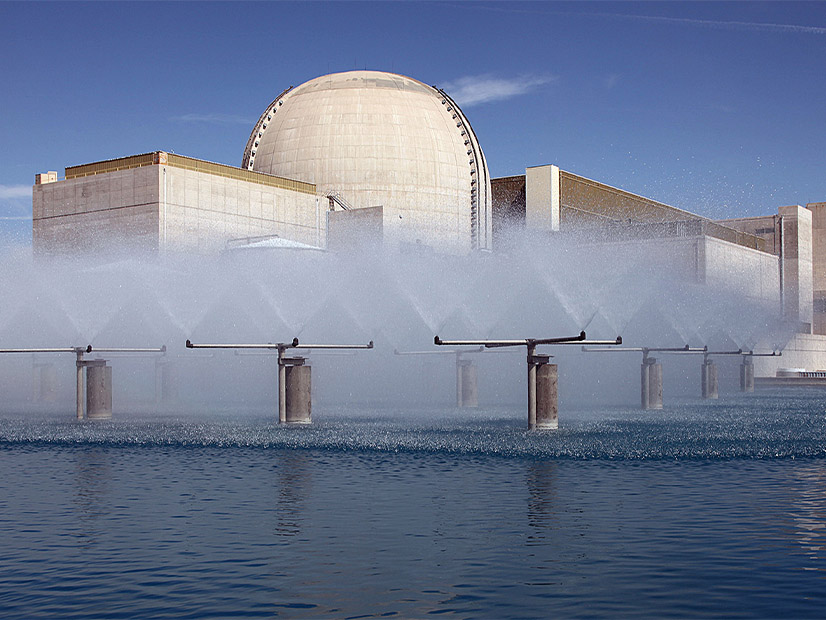
Palo Verde is the only nuclear plant that’s not next to a body of water. The facility uses reclaimed wastewater.
“We continue to evaluate water strategy at the station,” said John Hernandez, vice president of site services at Palo Verde. One idea is to use lower-quality wastewater.
The first of Palo Verde’s three reactors is set to mark 40 years of operation in June. In 2011, the NRC granted Palo Verde a 20-year license extension that runs to 2047. An application for an additional 20-year license extension is being considered, with a target date for approval of 2029, Hernandez said.
Although APS has the largest ownership stake in Palo Verde, at 29%, followed by SRP at 20%, ownership shares in a new nuclear facility would be subject to negotiation, Cole said.
Commissioner Lea Marquez Peterson asked whether California utilities might want to be involved in a new Arizona nuclear facility, a move that might help reduce risk for the Arizona utilities.
California entities “don’t have that political openness to placing a new nuclear plant in their state, but seem to be open to keeping the energy,” she said.
Cole said the current focus for a potential nuclear project is Arizona’s needs.
“We’re looking at this right now as an Arizona project, but that doesn’t mean … that there won’t be additional partners in the future,” he said.