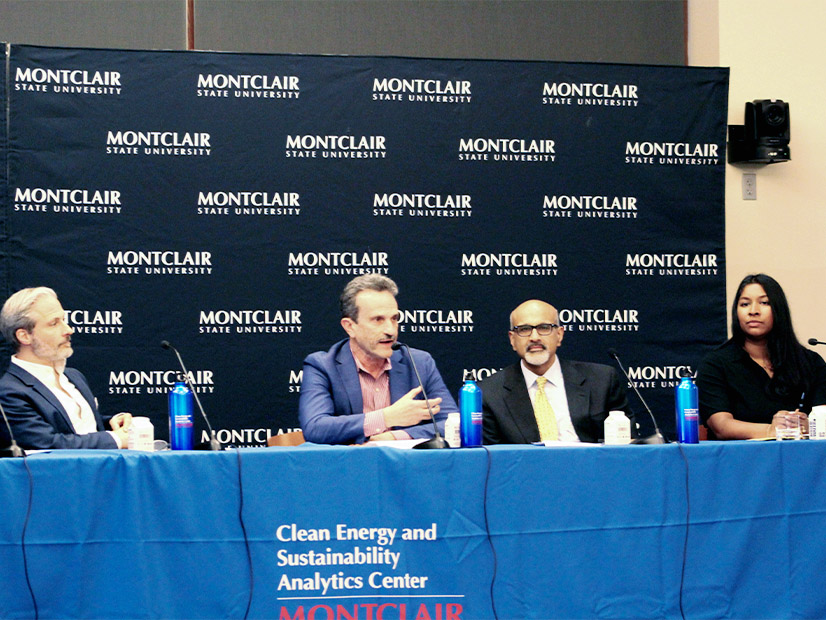
MONTCLAIR, N.J. — The double whammy of federal funding disruption and predictions of a dramatic surge in electricity demand will require state government to implement resource adequacy and financial support policies for new energy sources, speakers at a recent energy conference said.
The loss of federal support as the Trump administration redirects federal efforts toward fossil fuels, coupled with declining interest from private funders, has thrown clean energy financing into turmoil, said Abhay Pande, managing director of Princeton Capital Advisors, at the Clean and Sustainable Energy Summit 2025 on May 14.
Assessing the financial environment now facing clean energy developers, he said, “two words jump out — chaos and unprecedented, maybe unprecedented chaos.”
Historically, projects have been funded by private capital and corporate venture capital, he said. Government funding has supported “early-stage project development around the country, construction and actually building out and scaling,” he said.
“Almost all of these have changed in the last year, and almost none of them for the better,” Pande said. “So for everything that’s going to happen going forward, the solution is going to be the state.”
Investors Looking Elsewhere
The funding problem was one of several challenges addressed in what conference organizers called “A Resilient Future” in the face of expected demand from EVs, data centers and other energy uses. (See N.J.’s Power Future Clouded by Data Center Uncertainty.)
The conference came a few days before the House of Representatives on May 22 approved the Trump administration’s budget bill, which would repeal or phase out many clean energy tax credits. The budget now will be considered by the Senate. (See House Passes Reconciliation Package that Would End Energy Tax Credits.)
The Inflation Reduction Act’s investment tax credits and production tax credits, which are a target for reduction in the budget talks, have played a significant role in keeping down energy production costs, Pande said. The credits have helped reduce solar costs “potentially on a per megawatt hour basis by 50%, reducing wind by 30%, even reducing nuclear by about 20%,” he said. Nuclear power, however, got a big boost from Trump on May 23. (See Trump Orders Nuclear Regulatory Acceleration, Streamlining.)
The elimination or reductions under discussion for other sources could have a “huge impact in the resource adequacy, as far as money goes in, in terms of investments,” Pande said.
Staff cuts at the Department of Energy also likely will hamper project development, he said. That has included downsizing at the federal Loan Programs Office, which provided funding for clean energy projects under President Joe Biden.
Meanwhile, private sector funders have their own challenges, he said.
“The private equity community continues to have a ton of money that they raised from pension funds and endowments and sovereign wealth funds over the last five years,” Pande said. “But they’re having a hard time finding a way to make attractive returns — the 15-ish percent that they need per year.”
In the search for attractive investments, “there’s some re-shifting of private equity and investing, which over the last 10 years has overwhelmingly shifted to renewable, and is now in transition back to fossil fuels,” he said. Some investors have left energy altogether to invest in artificial intelligence and biotechnology, he said.
“We’re certainly facing headwinds,” Pande said. “But it creates an important role for states and state governments to fill some of the gaps that at least allow early-stage developers and new technology [to start projects], at which point the private sector will jump in.”
Headwinds, but Sustained Interest
There are some bright spots outside the United States. “The global commitment towards investing in energy transition really hasn’t changed,” Pande said. “The sovereign wealth funds in the Middle East and Asia and Europe are as committed, possibly even more, to investing in renewable energy than they ever were.”
There is a “lot of appetite” in Middle Eastern sovereign and European sovereign wealth funds to invest in the U.S. energy transition, Pande said. And there still is interest from some U.S.-based investors as well, he said.
“The interest in ensuring long-term sustainable investing continues,” he said. “People talk about it less, because there was some backlash from a number of state pensions and so forth in the past. But in talking to — certainly the U.S., major endowments and pension funds — that commitment hasn’t changed at all. They just don’t mention it as much because they don’t want to pick a fight with anybody right now.”
Studying Resource Adequacy
Coinciding with the conference, New Jersey Gov. Phil Murphy (D) took steps to address the pending 20% increase in electricity for the average ratepayer set to begin June 1.
The hike stemmed from the New Jersey Basic Generation Service auction in February, which state officials say was in turn shaped by the PJM capacity auction in July 2024. The auction concluded with prices — $270/MW-day — about nine times higher than the previous auction.
PJM officials say the rising prices are due to the unforeseeable spike in demand and state policies that are shutting down old, mostly fossil-fuel sources of energy at a faster rate than replacement sources — mostly clean energy — are coming online.
Murphy directed the New Jersey Board of Public Utilities (BPU) to “open a new proceeding on resource adequacy” that would evaluate proposals to bring more generation online quickly. He directed the agency to “continue to determine how New Jersey can best achieve its reliability, equity and clean energy objectives while keeping costs to consumers as low as possible.”
The proceeding also will look at “whether New Jersey is best served [by] the regional capacity market administered by PJM” and directs the BPU to “identify policy opportunities to mitigate increased ratepayer costs due to demand growth driven by data center proliferation.”
Preethy Thangaraj, deputy director of Murphy’s Office of Climate Action and the Green Economy, said at the conference that the governor’s directive is his response to the state facing steep load growth.
“We have volatile energy markets. Things are very complex, and how we deal with resource adequacy is also evolving,” she said. “The state has been very focused on ensuring that we really leverage every tool in the toolbox to make sure we are responding to the market conditions.”
That will include the state having an “important role to play in funding the incremental cost between what we consider to be the status quo, traditional technologies to new technologies,” she said.
Changing Demand Patterns
Creating more generation will require a range of solutions, said Larry Barth, director of corporate strategy at New Jersey Resources, which operates solar and gas generation facilities.
“There are tradeoffs in every one of these generation resources. Solar is great for decarbonization, but it’s not necessarily great for resource adequacy,” he said. “Gas is something you can fire up at a moment’s notice, but it’s not necessarily going to help us with emissions.”
A further complication is that demand peaks are changing, said Jason Lemme, managing director at Hartree Partners, an energy and commodity trading company. PJM now sees its highest peaks in the winter, with a recent, near-record peak in the early morning of Jan. 20, he said. That is different from past peaks, which occurred in the summer in early evenings, driven by demand for air conditioning use, he said.
Summer peaks, occurring when the sun is out, can be met with solar generation. But a recent 7 a.m. winter peak occurred in the dark, when solar was inactive, he said.
The state also should consider greater use of excess capacity in its gas-fueled generators, he said. Due in large part to the impact of emissions restrictions under the Regional Greenhouse Gas Initiative, these plants are much more efficient than those in Pennsylvania, Ohio and elsewhere, using less gas to produce the same amount of electricity.
“Why don’t we increase the utilization of assets that we already have in the state that are incredibly efficient to begin with?” Lemme asked. “And that, I think, goes a long way to solving part of the problem that we have, at least in the state in the near term.”