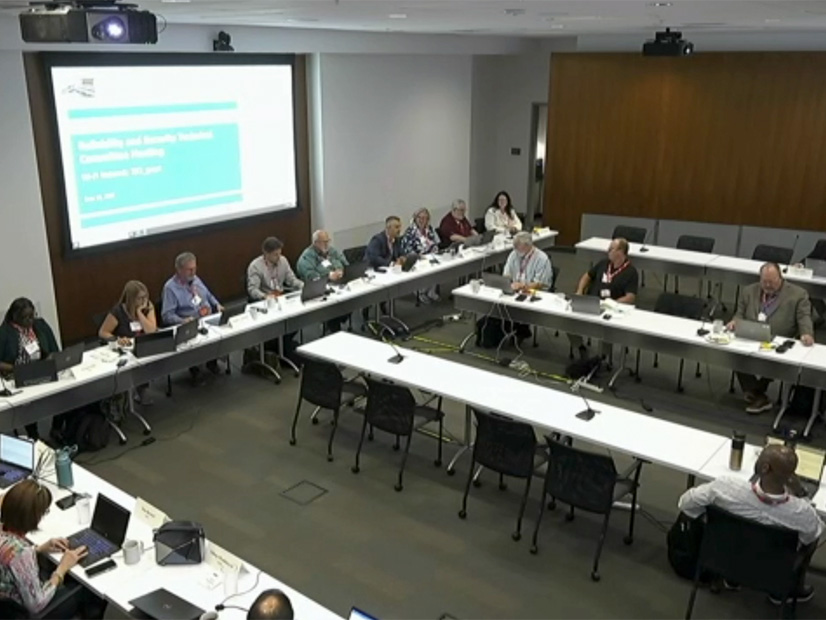
At the quarterly meeting of NERC’s Reliability and Security Technical Committee on June 10, NERC Chief Engineer Mark Lauby reminded members that the industry is facing “a busy time” dealing with the growing number of risks to grid reliability.
“Every meeting I come to, I always say this is the most important meeting we’ve had in a long time,” Lauby joked in his introductory remarks at CAISO’s headquarters in Folsom, Calif. “Of course, the RSTC is … the centerpiece of risk identification and risk mitigation, and clearly the work we have before us today is extremely important.”
The challenges “coming at [the ERO] like a head of steam” include the rapid growth of large loads like data centers and their impact on the grid, along with the reliability risks posed by inverter-based resources, which Lauby reminded attendees was the subject of several ongoing standards projects to meet FERC Order 901.
NERC Trustee Kristine Schmidt acknowledged the meeting — which kicked off three days of joint meetings among the RSTC, Reliability Issues Steering Committee and Standards Committee — represented a “heavy lift” for members and their companies. Echoing Lauby’s comments, she told attendees it was “critically important that we have your participation, leading the charge and creating such an important role for everything we do.”
The risks identified by Lauby and Schmidt ranked high on the meeting’s agenda, with Jack Gibfried of NERC’s Large Loads Task Force (LLTF) submitting for RSTC comment a white paper assessing the ability of existing engineering practices, requirements and reliability standards to address the reliability impacts of emerging large loads. Committee members will have 30 days to submit comments, starting June 13.
Gibfried said the white paper will feed into the LLTF’s next work plan item, a reliability guideline proposing best practices to address the gaps identified in the paper. He added that the task force hoped to submit the final edit of the white paper, addressing members’ comments, at the RSTC’s September meeting, hence the shortened comment period from the usual 45 days.
The LLTF white paper was the first of three accepted for comment by committee members. The next came from the Electric Vehicle Task Force (EVTF), with the goal to “identify, validate and prioritize the potential [grid] reliability risks related to motor vehicle electrification.”
EVTF members also requested a shortened comment period of 30 days for this white paper, in hopes of finishing their revisions by the September RSTC meeting. However, at the urging of Southern Company’s Todd Lucas, committee members approved a standard 45-day comment period for the paper.
NERC’s System Planning Impacts from DERs Working Group (SPIDERWG) asked for comment on a white paper analyzing the impact of DER aggregators on SPIDERWG’s model framework. The committee again approved extending the proposed 30-day comment period to 45 days.
Two more white papers, both from NERC’s EMT Modeling Working Group (EMTWG), were submitted for the committee’s approval, having completed their own comment periods and been revised according to the feedback received.
The first will help industry “enhance the understanding and utilization of EMT modeling in addressing the emerging challenges and opportunities associated with high penetration of [inverter-based resources] and changing resource mix,” according to the EMTWG. The second is meant to “highlight the typical life cycle for an IBR project and its model, use cases and challenges in the operations planning study space, typical practices and lessons learned.”
Members agreed to endorse three standard authorization requests (SARs) at the meeting as well, the first submitted by SPIDERWG. This SAR was prompted by observations of the impact on grid frequency of DER tripping from underfrequency load shedding programs.
Specifically, the SAR is aimed at establishing “consistent modeling practices as other stability depictions for the UFLS database” by clarifying terms and equations used in NERC’s standards. SPIDERWG said the clarity enhancements in the SAR are needed because “UFLS is a last measure before widespread frequency collapse.”
The other two SARs were developed to help NERC meet its obligations under Order 901, the fourth and final milestone of which — involving planning and operational studies requirements for all IBRs — is approaching next year. (See NERC Submits IBR Work Plan to FERC.) One of the SARs represents operating studies and the other planning studies.