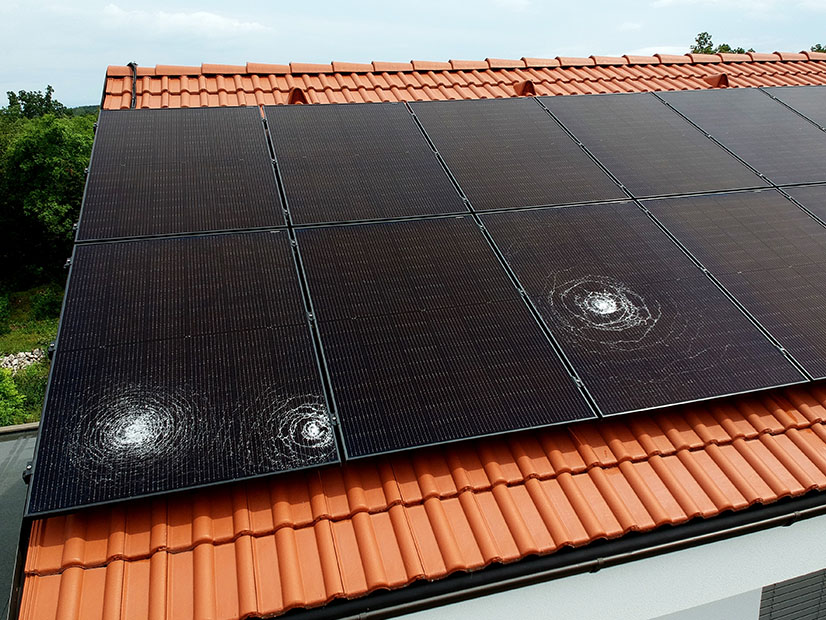
Hail remains the most expensive threat to photovoltaic solar panels but far from the most common, the 2025 edition of an insurer’s risk report indicates.
Hailstones accounted for only 6% of incidents resulting in losses to solar panels, but those losses amounted to 73% of the total, kWh Analytics noted June 10 as it announced its seventh annual “Solar Risk Assessment.”
Fires, hurricanes, inverter failures and damage from severe convective storms other than hail rounded out the top five sources of financial loss. Damages from those four types of incidents all were reported more frequently than hail, however.
The report brings together academic, technology, financial and insurance insights on the solar energy and battery energy storage system (BESS) sectors.
The threat picture is important to understand, kWh said, because solar and storage are an increasingly large part of the U.S. energy portfolio while facing increasing threat from climate change.
“As renewable energy becomes the backbone of the electrical grid, ensuring system resilience is no longer optional — it’s imperative,” kWh Analytics CEO Jason Kaminsky said. “Keeping these assets operational requires unprecedented collaboration among asset owners, operators, financiers, insurers, brokers and manufacturers.”
The Energy Information Administration in February reported a record 30 GW of utility-scale solar was added to the U.S. grid in 2024, accounting for 61% of capacity additions. It reported June 10 that it expects solar to rise from 5% of U.S. power generation in 2024 to 8% in 2026.
The Solar Energy Industries Association reported June 9 that the total nameplate capacity of all classes of installed solar generation — utility, community, commercial, residential — stands at 248 GW nationwide.
Takeaways from analyses by kWh and industry partners for the 2025 “Solar Risk Assessment” include:
-
- Thicker glass and better stow protocols can reduce the probability of hail damage.
- Cyber threats are increasing, and so must protection strategies — solar and BESS facilities offer multiple attack points, and the integration of their diverse systems only increases exposure.
- A significant factor in fire damage is overgrown vegetation. Better management of vegetation and wiring can mitigate risk of fire, which is second to inverter failure in frequency and second to hail in cost.
- New research shows wildfire smoke can reduce an affected solar facility’s annual revenue by as much as 6%, double the amount cited in kWh’s 2022 Solar Risk Assessment.
- The weather-adjusted performance index lags industry expectations by 8.6% nationwide, with the largest underperformance seen in winter and a gradual decline seen in the nine years analyzed; performance data is insufficient to pinpoint a root cause, but better understanding of the phenomenon would reduce financial risk and boost investor confidence.
- Performance-degrading hot spots on individual modules continue to be a concern, highlighting the importance of the compatibility of components within systems and suggesting the need for industrywide collaboration and early identification of systemic issues.
- Artificial intelligence can be a powerful tool for risk assessment but needs to be fine-tuned. In one analysis, out-of-the-box AI models miscalculated up to 20% of solar operational issues, struggling especially with weather-related and damage losses.
- Factory quality-control inspections are finding issues with 28% of BESS fire suppression systems and 15% of thermal management components. Non-conforming materials, poor workmanship and insufficient quality control were commonly cited causes.
- While a handful of BESS failures continue to occur each year, the massive buildout of these systems has dropped the number of failures per installed GWh of capacity 98% from 2018 to 2024.
- Much more common are state of charge estimation errors for lithium phosphate batteries — the error rate can exceed 15%.
- There is a disconnect between BESS technical performance and financial oversight: Operation and maintenance staff who were surveyed reported finding far more technical issues than asset managers reported. A strategy to collect, analyze and share the billions of datapoints generated is essential to maximizing the systems’ value.
- This last point is not academic. The report cites one customer’s history of uneven cell discharging, which led to a performance loss of 18 MWh per day that grew to roughly $1 million in annual losses.
Climate insurance provider kWh Analytics draws its insights from a database of more than 300,000 zero-carbon projects and $100 billion in loss data.
For its 2025 report, kWh drew on its own analyses and those from Central Michigan University Assistant Meteorology Professor John Allen, Kiwa PI Berlin, 60Hertz Energy, VDE Americas, GroundWork Renewables, Radian Generation, Zeitview, Clean Power Research, Clean Energy Associates, EPRI, ACCURE Battery Intelligence and TWAICE.