New York’s governor has directed the state power authority to develop an advanced nuclear facility with at least 1 GW of nameplate capacity.
The move is intended to bolster the state’s lagging clean energy efforts while simultaneously injecting a large quantity of emissions-free baseload power into the grid to facilitate decarbonization and economic development.
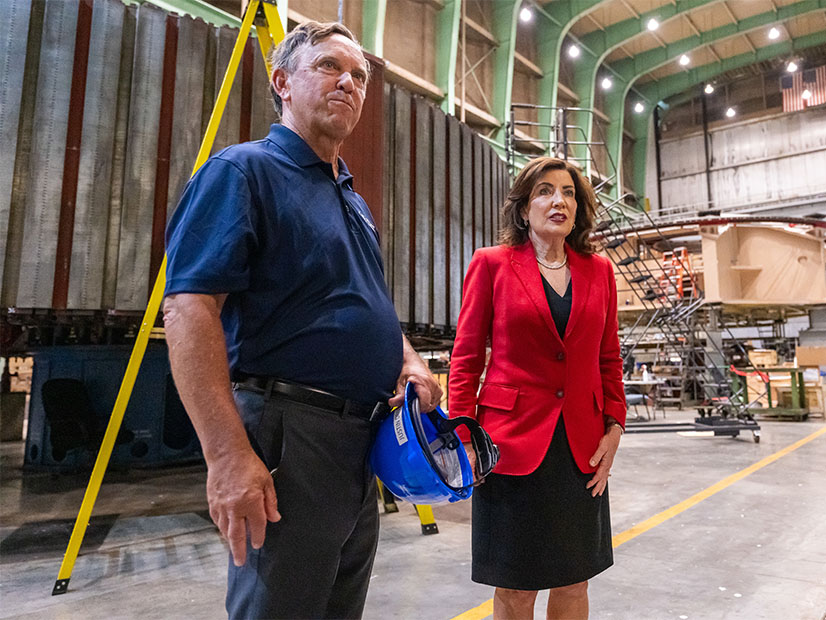
In her announcement June 23, Gov. Kathy Hochul (D) did not elaborate on details about the facility to be built. The New York Power Authority clarified later that no determination has been made on the reactor technology to be used.
The move places Hochul in an increasingly large group of industry, government and policy leaders hoping to advance a nuclear renaissance in the United States.
It also places her squarely in the crosshairs of nuclear power’s many remaining opponents, a fact the governor alluded to when she said: “I’m the first Democratic governor in a generation to say to nuclear, ‘I’m embracing this. My state will embrace this.’”
On cue, opponents raised questions about the plan or attacked it outright, as they have criticized the administration’s increasing willingness over the past few years to consider new nuclear generation. (See N.Y. Takes a Closer Look at Advanced Nuclear.)
In January 2025, New York joined Constellation Energy in an application to the U.S. Department of Energy for a grant to support co-locating one or more advanced reactors with the two existing reactors at Nine Mile Point on the south shore of Lake Ontario.
Hochul said this new initiative builds on that collaboration and sets the stage for collaboration with other states and with Ontario — North America’s first small modular reactor is being built in Canada, on the lake’s north shore. (See Ontario Greenlights OPG to Build Small Modular Reactor.)
The new nuclear project would be built in partnership with the private sector in a community that welcomes it, Hochul said. The state wants to help finance the plant and buy the power it generates, she said, and she is directing the Department of Public Service to work with NYPA to protect ratepayers.
Important Role
New York’s four operating commercial reactors, all owned by Constellation, receive ratepayer-funded subsidies in recognition of their value in providing 21% of the state’s electricity with zero carbon emissions.
Nuclear opponents pounce on such subsidies (here and in other states) and point to the fantastically high cost of recent reactor construction projects as proof that nuclear is uneconomical — in addition to being potentially dangerous.
Levelized cost of energy comparisons do show that new-build nuclear is several times more expensive than new-build solar and wind farms of the type proposed across upstate New York. (See Lazard: Solar and Wind Retain Lowest LCOEs.)
But the levelized value of electricity is harder to quantify.
NYISO shows a very low capacity factor for New York solar — 16% for front of the meter and 12.7% for behind the meter for 2023. Onshore wind was much higher in 2023, but still only 22%.
Extensive backstops would be needed for any whole reliance on photovoltaics and wind turbines to power the Empire State, likely at considerable cost.
In contrast, the Nine Mile Point reactors, which are 37 and 55 years old, ran at a capacity factor of 92.8% in 2023, and the 50-year-old Fitzpatrick reactor operated at 99.9%.
Further, New York’s efforts to encourage wind, solar and storage construction are lagging for a host of reasons. The state expects to miss the first milestone in its 2019 climate law — 70% renewable energy by 2030 — perhaps by a wide margin.
New York stood at just 23.2% renewables in 2023, due in part to the shutdown of the Indian Point nuclear reactors in 2020 and 2021. (See NY Quantifies Slow Progress Toward Renewables.)
Hochul mentioned this as she spoke June 23 about the new initiative and flagged the shortcomings of wind and solar.
“It shouldn’t be this hard. But no matter how hard we fight for renewables, solar works when the sun is shining, wind turbines spin when the air is moving,” she said. “We need electricity that’s reliable all day long, regardless of the weather outdoors.”
That would be fossil fuel or nuclear, and New York is not going to add fossil generation, she said.
Criticism Lobbed
Hochul’s comments on the state’s clean-energy transition have been more pragmatic than dogmatic, particularly when ratepayers are at risk of bearing higher costs.
She put on hold the plans for the state’s cap-and-invest system, for example, and she echoed some of President Trump’s speaking points in her June 23 comments, saying the federal nuclear regulatory process was too slow and too cumbersome. (See NY Defers Action on Controversial Cap-and-invest.)
(Trump moved to speed nuclear power research, development and deployment and ease regulatory oversight with a series of executive orders May 23. (See Trump Orders Nuclear Regulatory Acceleration, Streamlining.))
State Sen. Liz Krueger (D), chair of the Senate Finance Committee, shared questions about Hochul’s announcement that likely were shared by many nuclear skeptics and opponents: Is it the most cost-effective option? Can it be completed quickly? What will happen to radioactive waste? Are there alternatives? Will local governments be allowed to consent or refuse?
“I have yet to see any real-world examples of new nuclear development for which all of these questions can be answered in the affirmative,” Krueger posted on X.
Others took issue with the role to be played by NYPA, which was given expanded authority to develop renewables but debuted with a 3-GW plan that carried a high expected rate of attrition, far short of the robust 15-GW vision advocates had sought. (See NYPA Finalizes Road Map for Renewables Development.)
“NYPA has the power and mandate to build 15GW of renewables and should not let Trump promises lead New Yorkers away from it,” Public Power NY said. “After appointing a Republican to lead NYPA while remaining silent on its mandate to build wind and solar, Hochul’s decision to step in based on promises from Donald Trump shows just how unserious she is about New Yorker’s energy bills and climate future. NYPA should be laser-focused on rapidly scaling up their buildout of affordable solar and wind, which is the only way to meet the state’s science-based climate goals and lower energy bills.”
Others were more enthusiastic about Hochul’s announcement, including business and organized labor leaders. Hochul estimated the new advanced nuclear facility would create 1,600 construction jobs and 1,200 permanent jobs.
The plant would be upstate, much of which is economically stagnant and has been losing population for generations.
Hochul spoke not far from her childhood home, and noted she was the only one of six siblings who did not leave the state to start her career. A wind farm now stands where her father and grandfather once worked in a steel mill.
Part of the goal with the nuclear project is to provide the power for new economic development, she added.
State Sen. George Borello (R) applauded the plan and suggested the former NRG coal-fired plant on the shore of Lake Erie be prioritized as a site. Its shutdown left a gaping hole in the economy and budget of the city of Dunkirk, he said.
“This would bring back critical revenue, generate well-paying jobs and deliver the long-overdue economic recovery that Dunkirk desperately needs,” he posted on Facebook.
Constellation also welcomed Hochul’s June 23 announcement with enthusiasm but without specifics on next steps.
A previous version of this story misstated the number of commercial reactors now in operation in New York.