NERC is seeking comments from industry stakeholders on potential changes to the ERO’s standards development process found in an upcoming white paper, members of the task force that wrote the document said in a webinar July 21.
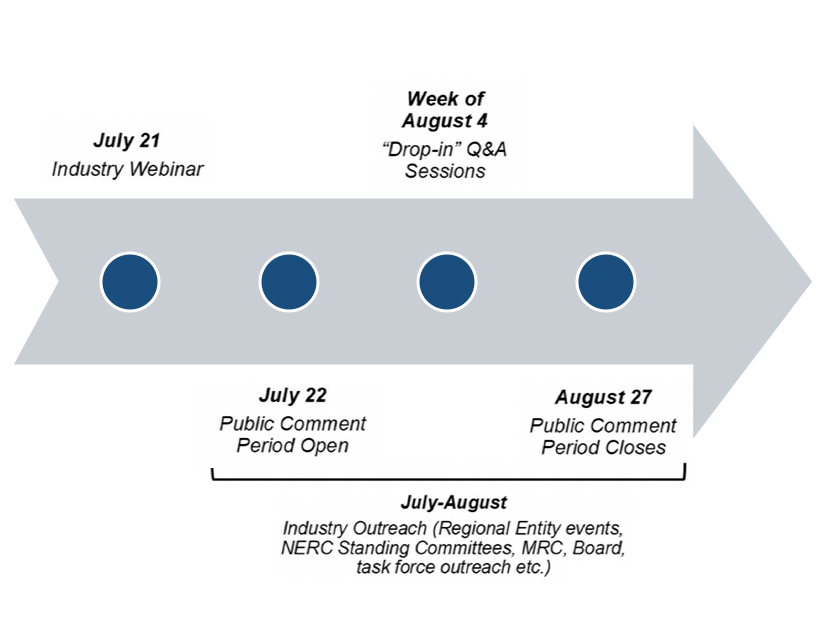
The draft white paper is a key product of NERC’s Modernization of Standards Processes and Procedures Task Force (MSPPTF), launched by the ERO’s Board of Trustees at its February meeting. (See “Task Force to Examine Standards Process,” NERC Leaders Highlight Canada-US Collaboration.) It will be released July 22, with a public comment period to open the same day and close Aug. 27.
NERC’s board decided to stand up the task force after growing concern that the ERO’s standards process was too deliberative to keep pace with the rapidly changing reliability risk landscape. The board’s use of its authority in 2024 under Section 321 of NERC’s Rules of Procedure to accelerate the pace of two standards projects that seemed unlikely to meet a FERC deadline brought more attention to these issues.
“The industry is at an inflection point due to the rapid evolution in reliability risks, such as plant retirement, more variable generation and … extraordinary load growth,” MSPPTF Chair Greg Ford, CEO of Georgia System Operations, told webinar attendees. “While previous incremental enhancements have marginally improved our efficiency, the task force believes that a more transformational change to the NERC standard development process will certainly improve NERC’s ability to address these risks in a timely manner.”
Ford said that NERC’s data showed the development of a standard takes on average about three years, with about 20% of that time spent developing an initial standard authorization request (SAR) into a final version that a standard development team can work on. The next stage of development, going from the SAR to submitting a first draft standard for industry ballot, takes about 50% of development time on average, and the remainder is spent refining the draft standard based on industry feedback until it meets final approval.
Recognizing these stages, the white paper’s authors divided their proposed changes by the phase of development to which they apply. The initiation phase begins when a request to develop a standard is submitted and ends when the request is approved to begin drafting; standard development begins when the request is approved and ends when a first draft is proposed; and balloting begins when a proposed standard is ready for industry to vote and ends when the standard is either approved or returned to drafting.
Two of the white paper’s proposals will pertain to the initiation stage, Southern’s Todd Lucas said, calling them “options that we can use as a starting point … and get to a draft recommendation later this fall based on the input we get.”
Both options are intended to address the fact that “there are multiple ways [today] for a [SAR] to get initiated” by establishing a single process to identify and vet candidates for development. The first would involve a biannual review process, involving an open submission period and industry conference focused on prioritizing submissions. The other would be to centralize all submissions through NERC’s Reliability and Security Technical Committee.
Another three proposals, introduced by Ford, apply to the development phase, with the goal of getting “off the blank page … much sooner.” One way to do this, Ford said, is to use artificial intelligence more extensively, at least for low- or medium-priority projects, in tandem with a standing body of subject matter experts maintained by NERC.
“Not every standard that goes through this process may need a drafting team,” Ford said. “We can run [low- and medium-priority] projects through this process using subject matter experts, as well as this AI tool. We’ll run that through comment periods from the industry, we will convene technical conferences throughout this stage so that we can keep industry in tune … and we’ll be able to put together a package that we can communicate and get comments from the industry.”
An alternative to this proposal is to outsource standards drafting to a third-party contractor. In this scenario NERC still would oversee the contracting and drafting processes, and it still would go out for industry comment as normal. The third proposal would see the current process remain in place, but with tweaks for greater efficiency, possibly using AI tools.
For the third phase of development, balloting, MISO’s Todd Hillman listed three potential ideas. The first would involve replacing NERC’s current system of ballot pools formed from industry volunteers for each candidate standard, representing “somewhere in the neighborhood of 470 potential votes,” with a standing ballot body composed of about 24 members. These members still would represent the ERO’s industry sectors, but with a smaller, dedicated membership the authors hope that participation in each balloting process could be higher.
Another option would be to adopt an approach similar to FERC’s rulemaking process, which would replace the stakeholder balloting with a “notice and comment approach.” Under this model, NERC would post a draft standard for comments with questions to guide feedback. NERC then would analyze any comments received, update the draft based on the feedback, and then move forward to the board rather than calling for votes from industry. Finally, the third proposal under the balloting section would keep the existing system, with incremental changes.
NERC and the regional entities plan to hold industry outreach events during the comment period, with Q&A sessions the week of Aug. 4. Based on feedback, the MSPPTF will create formal recommendations with the goal of submitting them to the board at its February 2026 meeting.