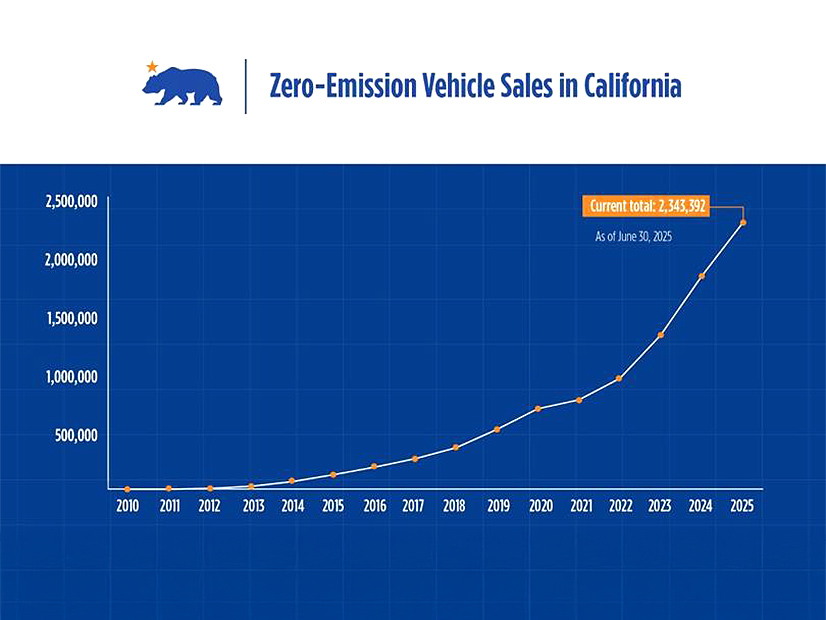
In the face of federal attacks on California’s landmark zero-emission vehicle regulations, the state is “doubling down” on efforts to spur ZEV adoption.
The California Air Resources Board (CARB) in July completed a series of four public sessions seeking feedback on ways to encourage ZEV adoption — part of an initiative called ZEV Forward. Input from the sessions will help shape recommendations CARB will send to Gov. Gavin Newsom in August.
“Across the country, people are looking to California to fill that void that now exists at a federal level,” California Transportation Secretary Toks Omishakin said during a session in Sacramento.
And CARB on July 24 approved amendments to its Advanced Clean Trucks (ACT) regulation to give truck manufacturers more flexibility in complying with the rules. ACT requires truck makers to deliver for sale in the state an increasing percentage of ZEVs over time.
ACT is a complement to CARB’s Advanced Clean Cars II regulation, under which car manufacturers must provide an increasing percentage of ZEVs through 2035, when all new cars sold in the state must be zero-emission or plug-in hybrid.
The federal government is now trying to overturn those regulations.
But CARB has prepared for challenges to ACT. In July 2023, the agency entered into the Clean Truck Partnership with truck makers, promising to provide more compliance flexibility to manufacturers in exchange for a pledge to comply with the regulations regardless of the outcome of litigation or changes to CARB’s authority to enforce them. (See CARB, Manufacturers Partner to Support Clean Truck Rules.)
“One of the reasons that we were really interested in this Clean Truck Partnership is to provide both certainty to the state and to manufacturers going forward, where there might be a potential for a change in the federal posture around clean energy and clean technology,” CARB Executive Officer Steven Cliff said during the July board meeting.
The ACT amendments the board approved July 24 include a pooling provision, in which a manufacturer may transfer surplus ZEV credits generated in one state to another state that has adopted ACT.
Amendments adopted in October 2024 gave manufacturers three years, rather than one, to make up a ZEV credit deficit from a particular year. The amendments also allow manufacturers to use credits from near-zero-emission trucks to make up part of a deficit. (See Calif. Revises Clean Truck Rules to Ease Compliance.)
The Waiver Battle
In May, Congress adopted three resolutions to roll back EPA waivers that allowed California to enforce three of its clean vehicle regulations: ACT, ACC II and an omnibus rule that sets emission standards for internal combustion heavy-duty trucks sold in the state.
On June 12, the day President Trump signed the resolutions, California filed a lawsuit in U.S. District Court calling the overturn of the EPA waivers unlawful.
To rescind the waivers, Congress used the Congressional Review Act, which was designed for overturning federal rather than state rules, according to the complaint. In addition, the EPA waivers are not rules and thus aren’t subject to the CRA, the lawsuit said.
In addition to California, plaintiffs include 10 other states: Colorado, Delaware, Massachusetts, New Jersey, New Mexico, New York, Oregon, Rhode Island, Vermont and Washington.
Also on June 12, Gov. Gavin Newsom fired off an executive order “doubling down” on the state’s commitment to clean cars and trucks.
“We won’t let this illegal action by Trump and Republicans in the pockets of polluters stand in the way of commonsense policy to clean our air, protect the health of our kids and compete on the global stage,” Newsom said in a statement.
The order directs state agencies, including CARB and the California Energy Commission (CEC), to make recommendations to the governor within 60 days on ways to spur ZEV adoption in the state.
It also directs CARB to develop an Advanced Clean Cars III regulation “consistent with state and federal law” that would build on existing regulations or provide an alternative if California doesn’t prevail in the court on its regulations.
Ideas to surface at the July public meetings included offering more incentives and loan programs for ZEV buyers, expanding hydrogen-vehicle infrastructure or offering pooled insurance programs for car share fleet operators.
Others emphasized the need for approaches that don’t require a federal waiver.
ZEV Sales Growth
In the second quarter of 2025, 21.6% of new vehicles sold in California were ZEVs, amounting to 100,670 vehicles, the California Energy Commission (CEC) reported. That number is lower than sales in the second quarter of 2024.
The dip in sales was driven by lower Tesla sales, while non-Tesla ZEV sales remained strong, the CEC said.
At the national level, EV sales in the first half of 2025 were up 1.5% year-over-year, with 607,089 vehicles sold, according to a report from Cox Automotive’s Kelley Blue Book. Second-quarter figures were down 6.3% year-over-year.
“With government-backed incentives set to end in September and economic pressures mounting, the second half of the year will be a critical test of EV demand,” Stephanie Valdez Streaty, senior analyst at Cox Automotive, said in a statement. “Q3 will likely be a record, followed by a collapse in Q4, as the electric vehicle market adjusts to its new reality.”
For medium- and heavy-duty trucks in California, manufacturers sold 131,552 vehicles from model year 2024. Of those, 30,026 were ZEVs, or 22.8%. Cliff provided the figures during CARB’s July board meeting.
And manufacturers have accumulated about 26,000 more ZEV credits than are needed to comply with ACT, he said.
Coalition Formed
California is not alone in its ZEV efforts.
In May, Newsom and governors of 10 other states launched the Affordable Clean Cars Coalition, an initiative organized by the U.S. Climate Alliance. The goal is to make cleaner vehicles more affordable and accessible by reducing costs, increasing options and expanding infrastructure.
Participants are California, Colorado, Delaware, Maryland, Massachusetts, New Jersey, New Mexico, New York, Oregon, Rhode Island and Washington.