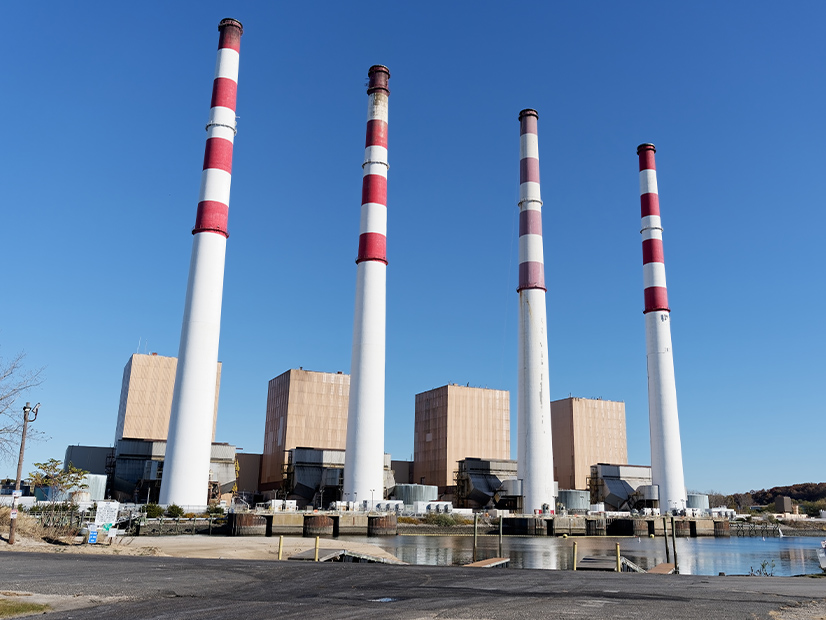
One of New York’s largest fossil-burning power plants will host a pioneering test run by a non-combustion hydrogen generator.
National Grid Ventures and Mainspring on Aug. 21 announced the project as the world’s first commercial installation of a linear generator operating on 100% hydrogen. September 2026 is the target date to start generating electrons.
The hope is that a year of rigorous testing on the grounds of National Grid’s Northport Power Plant will provide important lessons for potential larger-scale applications in commercial power generation. Along the way, its low-temperature, non-combustion process will produce minimal emissions and up to 250 kW of power for internal operations at the plant.
The project also could become a building block for the dispatchable emissions-free resources that are central to New York state’s clean-energy strategy in the 2030s and 2040s. No DEFRs have been identified that exist in scalable form.
“We were really drawn to the technology that Mainspring has to offer,” Will Hazelip, U.S. president of National Grid Ventures, told NetZero Insider. “This was really about seeing how that works and how it could potentially be a DEFR.”
The New York State Energy Research and Development Authority (NYSERDA) is contributing $2 million to the project.
The Long Island Power Authority also supports the effort. The Advanced Energy Research and Technology Center at nearby Stony Brook University will design the framework and methodology for the testing and then evaluate the results.
National Grid Ventures, the energy business arm of the UK-based utility, is confident it can obtain enough green hydrogen for the test program.
“So what we really want to be able to do is show that it’s fully capable of utilizing hydrogen as a fuel, and what that looks like in very specific generation technology terms,” Hazelip said, “so that specifically New York state has a better idea of how this particular type of technology could be a part of the energy mix in the future.”
The total project budget was not disclosed.
Mainspring’s linear generator is a 250-kW modular unit the size of a shipping container; it is compact enough that as much as 18 MW of capacity plus external inverters could be sited on a single acre. It operates at slightly more or less than 46% efficiency, depending on whether it is fueled with biogas, hydrogen, natural gas or propane.
The selling points are its simplicity (there are only two moving parts, and they do not need to be lubricated); its black-start and rapid-dispatch capacity; its versatility (it can switch from one fuel type to another, or use a blend, or use impure fuel); and its reduced emissions.
Nitrogen oxide emissions are near zero, because the fuel is being compressed rather than burned, and with carbon-based fuels the carbon emissions are lower than they would be in combustion systems.
Spokesperson Kevin Hennessy told NetZero Insider that Mainspring has deployed dozens of megawatts of capacity in the past five years for applications such as agriculture, landfills and wastewater treatment, the majority fueled by natural gas or biogas, and has hundreds more megawatts in various stages of its pipeline.
The Northport Power Plant was built by LILCO in phases starting in the 1960s as an oil-burning facility and later was converted to dual gas-oil capability. Its four main turbine-generator units are rated at a combined 1,516 MW and once provided more than a quarter of Long Island’s electricity.
National Grid has owned the facility since 2007, and while the plant is operated at a lower capacity factor than it once was, it remains an important grid asset. It recently reached its highest-ever output — 1,564 MW — during the July heat wave.
New York has had some other hydrogen firsts in the past few years, when the New York Power Authority ran the first gas-hydrogen blend in the state at a Long Island power plant and Constellation generated the first pink hydrogen in the nation at one of its upstate nuclear plants. (See NYPA Reports Successful Hydrogen Test at Natural Gas Power Plant and Constellation Gives Details on First-in-nation Pink Hydrogen Production.)
The state presents ambitious objectives and then creates an ecosystem to support these types of new applications, Hazelip said.
Mainspring, meanwhile, hopes to take what is learned in Northport and apply it nationwide, Hennessy said: “From our perspective, New York’s on the vanguard, leading the way with some thoughtful policy initiatives — certainly on the East Coast, but I think nationally — so it’s a great, great market to prove it out.”
NYSERDA President Doreen Harris said the project “represents a pivotal frontier in building a resilient electricity grid to power Long Island homes and businesses. This first-of-its-kind project will demonstrate how clean hydrogen can serve as a dispatchable resource to help maintain grid reliability while supporting an affordable energy transition.”
The $2 million grant for the Northport project comes through the Advanced Fuels and Thermal Energy Research Program administered by NYSERDA. The other grants announced Aug. 21 were:
-
- GTI Energy, over $220,000 to evaluate New York’s geological hydrogen storage potential;
- Plug Power, $2 million to partner with Verne to co-develop new hydrogen distribution trailers with cryo-compressed storage technologies;
- Stony Brook University, over $4.9 million for a low-pressure, ambient-temperature hydrogen storage system at Northwell Health Hospital; and
- SWITCH Maritime, $2 million to develop and demonstrate New York’s first hydrogen fuel cell-electric ferry.
A spokesperson said NYSERDA hopes to gain insight from the Northport project about the technology being used: “NYSERDA will analyze the project data throughout the demonstration, assessing the technical and economic viability of linear generators. The research will inform NYSERDA’s future work on clean hydrogen, and findings will be shared with the public and utilities to help determine potential pathways for broader adoption in New York state.”