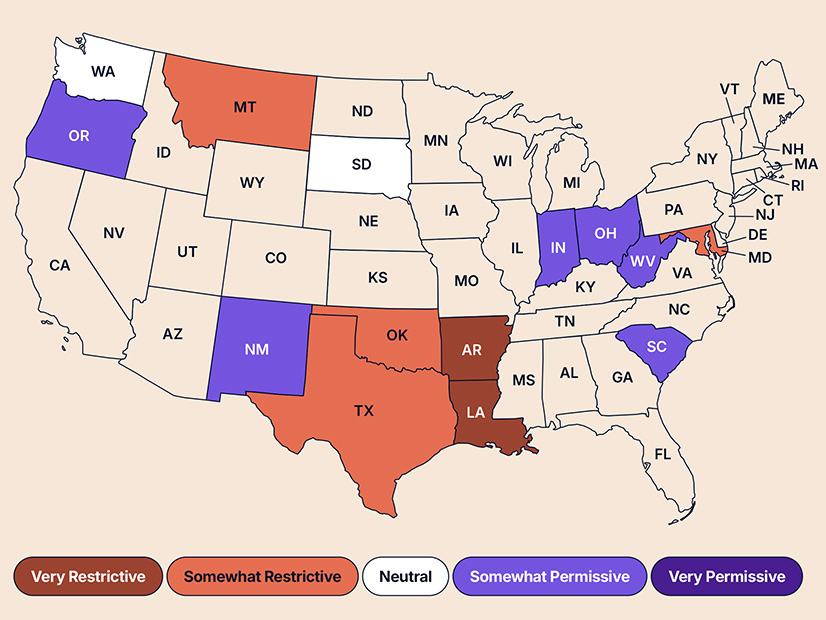
Proposals that would negatively affect renewable energy far outnumbered supportive legislation introduced in state legislatures in the first half of 2025, Clean Tomorrow reports.
But of the 305 bills in 47 states tracked by the clean energy advocacy organization’s Siting Solutions Project, only 39 have been signed into law or are still pending — 10 of them permissive and seven restrictive.
Clean Tomorrow brought the details together in its new report “The State of Siting: 2025 Legislative Roundup.”
Not surprisingly, the report flags a stark partisan divide among those making the proposals: Restrictive legislation proposed by Republicans outnumbered their permissive proposals by a 9-1 ratio. Democrats authored substantially fewer proposals, but their supportive measures outnumbered their restrictive measures by a 2-1 ratio.
Both parties proposed a similar number of bills judged likely to have a neutral or ambiguous effect, such as through small procedural or technical adjustments.
Notably, the small number of bipartisan proposals were more evenly split between restrictive, neutral and permissive. But 40% of them became law — twice the percentage of Democratic proposals and four times the percentage of Republican proposals enacted.
The greatest number of restrictive bills involved increasing the number and types of local approvals required for renewable energy proposals — a frequent rallying cry for home rule advocates and clean energy opponents, and a potential quagmire for developers.
Other common restrictive policy proposals entailed:
-
- increasing local zoning authority;
- expanding setback requirements;
- imposing financial security mandates;
- extended notification and hearing processes;
- limits on siting on agricultural land; and
- limits on development on public lands.
Solar, storage and wind development has been a divisive subject for years and became more polarizing as President Joe Biden guided a massive renewables funding package into law and President Donald Trump cranked up the anti-renewable rhetoric as part of his second-term pro-fossil energy dominance initiative.
In its Aug. 22 announcement of the legislative analysis, Clean Tomorrow cited a June report by the Pew Research Center that contrasted results of 2016 and 2025 surveys.
Wind and solar had been the types of energy development most heavily supported by Democrats and Republicans alike surveyed in 2016 and remained the most favored by Democrats in 2025, Pew said. But wind and solar are now Republicans’ least-favored option, behind nuclear, offshore drilling, hydrofracking and coal mining.
Clean Tomorrow noted the importance of state-level policies in determining the future of the nation’s clean energy economy and said the 2026 legislative season will help clarify whether the flurry of restrictive proposals in 2025 is more than a temporary backlash.
The report predicts significant siting legislation will advance in Colorado, Indiana, Louisiana, Oklahoma, Pennsylvania and Virginia in 2026, and summarizes the issues.
It also breaks down specifics on 2025 developments in key states.
Other takeaways from the report include:
-
- Restrictive legislation is most common in states that have had the largest wind and solar generation additions.
- Opponents tried to repeal or weaken permissive siting reforms that several states had enacted in the past four years.
- Texas, Illinois and New York led the nation in number of legislative proposals; restrictive measures outnumbered supportive measures by a wide margin in all three states, but New York saw a much larger percentage of neutral proposals than Texas or Illinois.
- Siting and permitting reforms that are technology-agnostic fare better in states with at least one Republican legislative chamber but tend to be opposed by environmental advocates because they smooth the path for new natural gas infrastructure.
- In 2025, Texas saw the nation’s greatest number of restrictive legislative proposals, some of which had the potential to eviscerate the renewable energy industry there. But only three of 32 measures became law, and they carried only modest changes.