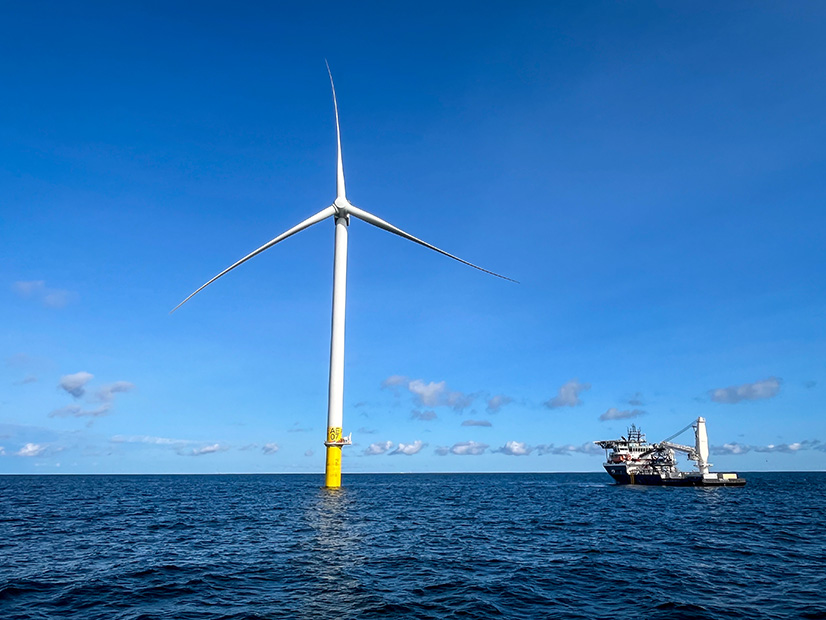
The Trump administration is moving to close the door on U.S. offshore wind development by remanding approvals for all projects not already under construction.
Federal attorneys filed a motion in the U.S. District Court for D.C. on Sept. 3 saying the U.S. Bureau of Ocean Energy Management plans to vacate the permit it issued to New England Wind during the Biden administration.
In late August, federal attorneys made similar comments about the SouthCoast Wind project off the New England coast, as well as about US Wind’s plans off the Maryland coast. And in March, EPA put a hold on an air permit for Atlantic Shores, at least temporarily blocking the New Jersey project from any start of construction.
Those four projects were the late movers among the 11 approved during the Biden administration. One of the 11 is completed; one was canceled by the developer; and five are in some stage of construction.
Numerous plans at earlier stages of development are on indefinite hold amid the clampdown President Donald Trump has ordered on the offshore wind sector, because of the restrictions themselves or from investors being driven away by the heightened risk and uncertainty that has resulted.
The recent motions were filed in three cases where wind power opponents had sued various federal agencies challenging regulatory approvals that allowed the three projects to move forward. In separate motions, Department of Justice attorneys asked the courts to delay the cases because the federal government is going to do essentially what the plaintiffs were seeking.
Federal attorneys said the government is planning to remand and vacate BOEM’s approval of the construction and operations plan for the Maryland offshore wind projects no later than Sept. 12 (24-cv-03111); move for voluntary remand of the SouthCoast approval by Sept. 18 (1:25-cv-00906); and remand and vacate New England Wind’s approval (1:25-cv-01678) no later than Oct. 10. The EPA action against Atlantic Shores on March 14 was a voluntary remand. (See EPA Puts Hold on Atlantic Shores OSW Permit.)
With Trump’s flat rejection of wind power, it is questionable when or if the approvals would be reinstated once remanded.
In the most recent New England offshore wind solicitation, SouthCoast and New England Wind were selected to feed 1,868 MW to Massachusetts and 200 MW to Rhode Island. (See New England OSW Contracts Delayed Again.)
Coupled with the BOEM’s stop-work order on Revolution Wind — an 80% complete project that would send 704 MW to Connecticut and Rhode Island — the pending actions represent a clear threat to New England’s clean energy ambitions.
“New England needs this energy,” Gov. Maura Healey (D) said Sept. 3. “Having already undergone years of expert review, these projects are primed to lower costs and improve reliability. There is absolutely no need for the Trump administration to reopen permitting processes and deny jobs, investment and energy to the states.”
ISO-NE had warned Aug. 25 that delaying Revolution Wind would increase reliability risks for the New England grid. (See ISO-NE Warns Halting Revolution Wind Boosts Reliability Risk.) On Sept. 3, it pointed to remarks by CEO Gordon van Welie about the importance the offshore wind sector holds for the region.
“The region is counting on the entry of resources in the form of large quantities of offshore wind to maintain resource adequacy,” van Welie commented to FERC in May (AD25-7). Solar panels and short-duration battery storage, he added, would not be an adequate replacement for the giant marine turbines.
Nick Krakoff, a senior attorney with the Conservation Law Foundation, told NetZero Insider that remanding and vacating the construction and operations plans for SouthCoast and New England Wind is a move that can be challenged in court by the developers and or the states involved, but the concept of victory is not clear-cut.
“There’s certainly legal avenues,” he said. “I think the bigger question is, what happens to industry? The Trump administration is just actually sabotaging an entire industry.”
Trump’s strategy has proved quite viable so far: Multiple offshore wind development efforts have been placed on hold since his election, Atlantic Shores among them. (See Developer Shelves Atlantic Shores, Seeks to Cancel ORECs.)
Those that remain face a regulatory limbo as the administration floods the zone with new hurdles and limitations. Projects that are under active construction can incur huge cost overruns because of delays.
All of this creates an untenable business environment.
“The longer this drags out, the more difficult it becomes for the developers financially,” Krakoff said. “I think it’s just another example of this administration’s disdain for the rule of law.”
The systematic attempt to kill an entire industry is unprecedented, he added. “You kind of expect this in other countries, but not this country.”
Trade group Oceantic Network criticized the administration’s stated intention to remand and vacate permits that were issued after years of review. “The unlawful and escalating actions by the Trump administration against fully permitted offshore wind projects up and down the East Coast represent one of the largest, economically devastating assaults on U.S. workers, businesses and energy in generations,” it said.
“Halting construction and revoking permits on approved projects after years of thorough agency review will raise electricity prices for millions across the country, jeopardize billions of dollars in private investment, threaten our national shipbuilding, steel and manufacturing supply chains, and undermine our nation’s energy security.”