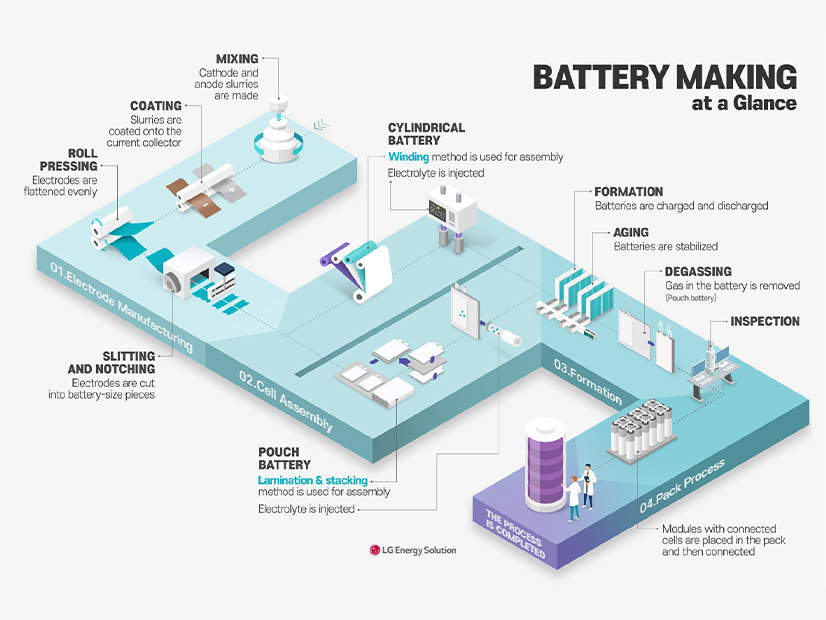
The California Energy Commission approved a $28 million grant to Electrochemistry Foundry to build and operate a battery fabrication and testing facility in Hayward, Calif.
The 20,000-square-foot facility will be “shared-use” and able to produce 10,000 lithium-ion battery cells per year.
California does not have open-access battery manufacturing facilities, the CEC said in the grant award. Without these types of facilities, startups face “long delays and steep cost barriers that cause many promising battery innovations — especially in underserved sectors like heavy-duty transportation, industrial electrification and stationary storage — to stall before reaching the market,” the agency said.
Most shared battery testing facilities are thousands of miles away in the Midwest, South or East Coast, Electrochemistry Foundry representatives said. Building such facilities within a one-hour drive of people who use them is ideal and ensures maximum ease of access and collaboration, they said.
“Early-stage startups cannot justify leasing their own dedicated facilities, and most startups currently can only access fractional lab space from biotech facilities, which are not well-suited for supporting battery and electrochemical companies,” Electrochemistry Foundry representatives said.
However, Barry Broome, CEO of the Greater Sacramento Economic Council (GSEC), asked the CEC to defer approval of the item and require an outside audit of the award process that granted the project to Electrochemistry Foundry.
GSEC founded Cal EPIC, a nonprofit that finished second in the CEC’s grant award process, behind Electrochemistry Foundry. GSEC is a public-private partnership that connects business and community leaders to build a regional economic development strategy that focuses on growth, sustainability, equity and competitiveness, the organization says on its website.
“Given our engagement with the CEC and others during this grant process, we have serious concerns as to the fairness of the solicitation development and award decision and transparency of the communications and processes surrounding them,” Broome said in a Sept. 9 statement.
“This [battery facility] is a critical asset to our community. … And, you know, in this era of transparency in government, we’re counting on our government to set the tone for that, since it’s been lost throughout the country,” Broome said at the CEC’s Sept. 10 business meeting. “This location has unique advantages that we thought were missed in the [grant award] scoring.”
VGI Grants, REC Software Changes
At the meeting, the CEC also approved about $15.4 million in grants to nine entities related to Vehicle-Grid Integration (VGI) work. Grants included about $2.4 million to Rivian to build an alternating current bidirectional charging system and $2.7 million to Lucid Group to build an alternating current bidirectional onboard charging system.
Also at the meeting, representatives of the Western Electricity Coordinating Council (WECC) told CEC commissioners they are working to find new software for the Western Renewable Energy Generation Information System (WREGIS), which tracks renewable energy certificates predominantly in the Western Interconnection.
WREGIS operates using software provided by CleanCounts, but the organizations’ contract expires Dec. 31, 2027, and CleanCounts has chosen not to extend it, WECC staff said. The contract’s expiration has prompted reevaluation of how WREGIS’s future looks and how its services to users and programs can be enhanced, they said.
To replace CleanCounts, WECC staff recommend building custom software for WREGIS. They also recommend separating WREGIS from WECC, which would allow the owners of WREGIS to focus solely on the program’s goals.