
Texas regulators have approved Entergy Texas’ request to build two natural gas-fired generating units in MISO’s portion of the state, but they limited the construction costs eligible for recovery to a combined $2.4 billion.
Thomas Gleeson, the Public Utility Commission’s chair, filed a memo Sept. 10 outlining his proposal to protect ratepayers from “bearing the burden of … potentially higher costs” during construction. In doing so, Gleeson rejected an administrative law judge’s recommendation to deny Entergy’s application (56693).
“I think the proper thing to do on the cost cap is to impose a hard cost cap of $2.4 billion,” he said during the PUC’s Sept. 11 open meeting.
The ALJ found in June that, while all parties agreed Entergy had shown a “significant near-term need” for additional capacity, it had not demonstrated the two gas units were a cost-effective alternative to meet that need. The judge recommended Entergy’s application be denied as it did not meet its burden of proof.
However, the judge said also that Entergy had demonstrated an “imminent” need for additional capacity as early as 2028, leaving little time to secure different resources. It said the PUC could approve Entergy’s Dispatchable Portfolio, as it has been labeled, but that it should impose certain conditions of cost recovery.
The PUC applied conditions in the order requiring weatherization and permit approval for future implementation of hydrogen operations and carbon capture and storage.
Entergy Texas filed an application for approval to build the two plants in June 2024, saying they were part of the company’s “urgent need” to add 40% more generation capacity in four years in the face of “extraordinary” economic and population growth in Southeast Texas.
“We’ve heard directly from our customers and communities about the need for more power to support our rapidly growing region, and these facilities will deliver just that,” Entergy Texas CEO Eliecer Viamontes said in a statement.
The plants will be capable of providing 1,207 MW of energy and will generate a combined $2.74 billion in regional economic activity during construction, Entergy said. The company said the units are expected to be in service by 2028.
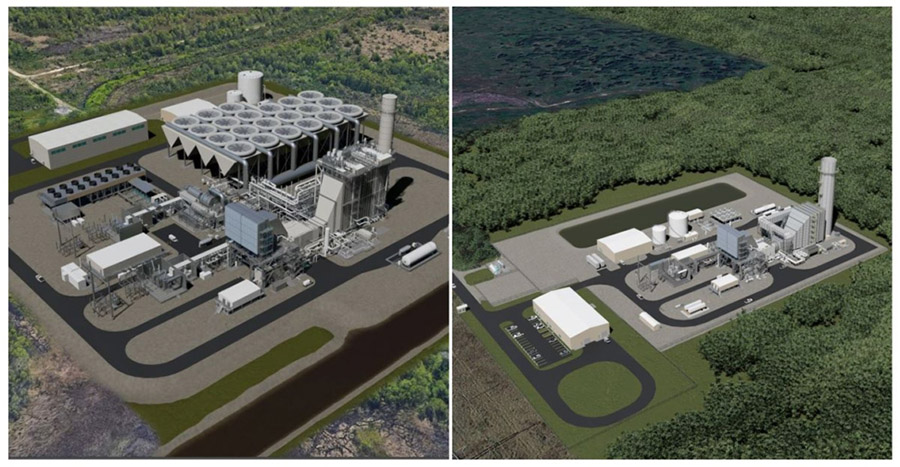
Legend Power Station, near Port Arthur in southeast Texas, is a 754-MW combined cycle turbine facility. It will be carbon capture-enabled and feature a hydrogen-capable combustion turbine.
Lone Star Power Station is a 453-MW hydrogen-capable combustion turbine facility near Cleveland, northeast of Houston.
Under the terms of the PUC’s approval, Legend will be limited to $1.6 billion and Lone Star to $799 million in recoverable costs.
An Entergy Texas spokesperson said both projects have been accepted into MISO’s new Expedited Resource Addition Study process (ERAS). “We expect their generator interconnection agreements to be available next year,” she said.
However, the projects do not appear on the list of 10 finalists to enter the first ERAS cycle. MISO plans to accept another round of applications for a second cycle in early November and begin studies in December. (See MISO Selects 10 Gen Proposals at 5.3 GW in 1st Expedited Queue Class.)
Legend and Lone Star are part of Entergy Texas’ Southeast Texas Energy Plan, also known as STEP Ahead. The six-step plan aims to add 1,600 MW of capacity to the grid by 2028 along with transmission and grid-hardening projects.
Commissioner Kathleen Jackson agreed with Gleeson in the 2-0 decision. Commissioner Courtney Hjaltman recused herself from the discussion and vote.
Mobile Gens Synchronized
ERCOT legal staff told the commission that CPS Energy and LifeCycle Power have interconnected eight of the 15 mobile generators that have been moved from Houston to San Antonio to address a transmission constraint.
Nathan Bigbee said the remaining units are expected to be synchronized and available for ERCOT’s dispatch by mid-October, two months later than originally planned. All 15 30-MW units will be dispatched only during emergency conditions through March 2027.
The units originally were leased from LifeCycle Power by CenterPoint Energy in Houston. ERCOT says the generators are necessary to mitigate emergency load-shed that may be necessary to avoid overloads of a generic transmission constraint. It became apparent in February that the grid operator would not be able to extend reliability-must-run agreements to two aging CPS gas-fired units. (See ERCOT Board OKs Mobile Generators in San Antonio.)
ESRs as ‘Stand-alone’ Resources
Commission staff recommended that energy storage resources (ESRs) be included in the PUC’s first proposed rulemaking on net metering arrangements involving a large load co-located with an existing generation resource (58479).
Legislation passed during the 2025 biennial session requires ERCOT to study the system impacts of net metering arrangements involving “stand-alone” resources as of Sept. 1, 2025, and new large-load customers. On Sept. 2, staff posted a market notice that included an attachment listing the types of stand-alone resources.
Bigbee said he found “near-universal” support for including ESRs during a Sept. 2 workshop on net metering.
“We believe that’s a defensible approach as well,” he said. “So, if it’s the commission’s will, we’d be happy to include them on the list.”
The commission will discuss the proposed rulemaking at its Sept. 18 open meeting.
The PUC also:
-
- Remanded back to docket management a revised order on CenterPoint’s system resiliency plan. In a memo, Hjaltman said the utility’s proposed transition from a five-year to a three-year vegetation management trimming cycle lacked key information supporting cost recovery. She requested supplemental evidence to justify the plan’s approval and a proposed cost-recovery mechanism. An ALJ filed the revised order in July (57579).
- Delayed action on Entergy Texas’ proposed 500-kV single-circuit transmission line in Northeast Texas. The 150-mile line has drawn opposition from local landowners, who requested a rehearing of the State Office of Administrative Hearings’ decision to recommend a certificate of convenience and necessity for the line. The project’s various routes range from 131 to 160 miles and its costs are projected to be between $1.33 billion and $1.52 billion (57648).