A new reliability guideline could help make the capacity accreditation process more transparent and balance “consistency with regional adaptability,” NERC staff wrote in a new report based on discussions in a workshop earlier in 2025.
NERC published the Evaluating Resource Contributions for Reliability and Capacity Supply report Sept. 29. It summarized a workshop held by the ERO in June focusing on current practices for capacity accreditation, including effective load-carrying capability (ELCC), barriers to standardization and opportunities for alignment across planning assessment areas, and it provided recommendations from NERC staff to develop a consistent framework for assessing resource adequacy contributions.
ELCC, which represents the total output with which a generator can be counted on to serve load when added to an existing system, is widely used in capacity accreditation, but approaches vary across planning regions because of different modeling assumptions, system characteristics, regulatory environments and stakeholder processes, the report’s authors wrote. Real-time outputs may also “vary significantly from installed capacity,” with writers citing a day in 2023 when wind resources with an assessed ELCC of 25 GW generated only 300 MW in practice.
Workshop participants identified some reasons behind these different approaches. One driver is diversity of resource types. Accreditation in systems in which a single resource dominates focuses primarily on this resource, while calculations for more diverse systems “must consider the interactions between multiple resource types.”
Even a single resource type can lead to added complexity, participants said, observing that “a wind farm’s performance can vary drastically across geographic areas within the same system.” Additional factors in ELCC creation include regional differences such as state- or province-level regulatory requirements and risk tolerance, along with the software used for calculations.
Participants affirmed the value of ELCC in resource planning but said a more standardized approach to RA studies could “provide both consistency and transparency across regions.” They suggested that NERC contribute to developing criteria to improve consistency of RA studies while not altering existing market constructs or prescribing a single accreditation method to apply across systems.
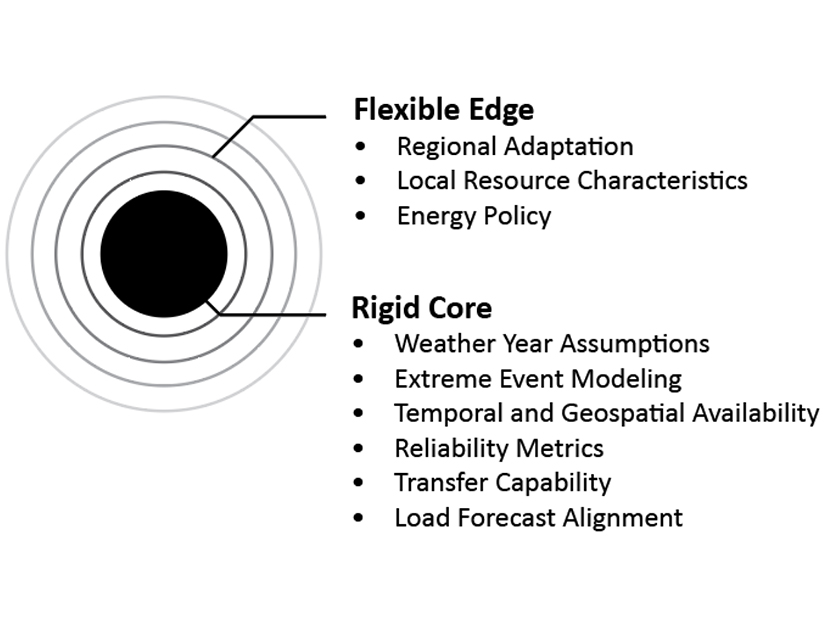
Based on the discussions, NERC staff recommended that the ERO “provide leadership” on the issue by developing a reliability guideline on ELCC and other accreditation methods that brings structure to their development. Key elements of this guideline, according to staff, should include a “rigid core/flexible edge” model that combines well-defined underlying assumptions with flexibility in regional adaptation.
The report’s authors suggested several common baselines for the core principles, such as weather year assumptions that normalize sample size and weighting for each year; detailed modeling for planned an unplanned resource and transmission outages, weather-dependent outages, energy and fuel constraints and operational limits; and interregional and internal transmission.
Elements of the “flexible edge” include encouraging marginal and multi-scenario ELCC assessments that can reflect changing system portfolios and incorporate anticipated resource additions and retirements, addressing hybrid and demand response resource types through expanded ELCC methods or new metrics and identifying validation techniques for ELCC-based models and benchmarking across regions.
Along with developing the guideline, the authors suggested that the ERO promote transparency and documentation of resource modeling approaches, assumptions in RA constructs and techniques for study processes and validation. They said NERC’s Reliability Assessment Subcommittee and Probabilistic Assessment Working Group could help planners share experiences and establish consistent methodologies.
NERC can also conduct energy assessments for each interconnection that can serve as the basis for a harmonized approach to resource accreditation. Planners can use these studies to benchmark regional practices and identify deficiencies with current tactics.