The U.S. Department of Energy has terminated 321 grants totaling $7.56 billion for 223 projects, apparently targeting Democratic-leaning states.
The Oct. 2 DOE announcement did not specify the grants being eliminated, but later in the day, Democrats on the House Appropriations Committee posted the list. They said the projects are in 108 congressional districts represented by Democrats and 28 represented by Republicans.
Russell Vought, director of the Office of Management and Budget, posted on X on Oct. 1 that the cuts were being made to “Green New Scam funding” for projects that are part of the “Left’s climate agenda.” The 16 states he identified were won by former Vice President Kamala Harris in her losing run against President Donald Trump in 2024.
The 32 U.S. senators representing those 16 states are all Democrats and all voted against a bill that would have averted the federal government shutdown.
But the grant cancellations will have some fallout in red states as well.
MISO-SPP Portfolio
Among the terminated financial awards, the fifth largest is the $464 million grant for the MISO–SPP Joint Targeted Interconnection Queue (JTIQ) portfolio under DOE’s Grid Resilience and Innovation Partnerships (GRIP) program.
The grant was intended to offset about 25% of the projected $1.6 billion capital costs for the JTIQ portfolio’s five 345-kV projects. The funds were awarded in 2023 to the Minnesota Department of Commerce, the lead applicant in a project that also involves the Great Plains Institute and the two RTOs. (See DOE Announces $3.46B for Grid Resilience, Improvement Projects.)
A Commerce Department spokesperson said the department has not received “any formal notification” from DOE on the GRIP funding’s termination. However, it was included in the list distributed by House Democrats.
In a statement provided to RTO Insider, the Commerce Department said it was “deeply concerned” about DOE’s suggestion of an “illegal effort to rescind federally obligated energy funds targeted exclusively at blue states.”
“If true, this would represent an unprecedented and politically motivated breach of federal law and funding norms — with potentially serious consequences for families, businesses and communities across Minnesota,” it said. “Without these investments, Minnesota could face higher energy prices, slower infrastructure development, and increased burdens on low- and middle-income households — all while demand for clean, affordable energy continues to grow.”
While Minnesota has been coordinating the application process and is responsible for the granted funds, the JTIQ’s proposed projects are sited in the Dakotas, Iowa, Kansas, Missouri and Nebraska, all of which lean heavily Republican.
The grid operators have said the “backbone” projects will unlock 28 GW of capacity and reduce curtailments in the highly congested region along their seam. FERC has approved and reaffirmed the RTOs’ proposal to fully allocate the costs of the JTIQ portfolio to interconnecting generation assessed per megawatt. (See FERC Upholds MISO and SPP’s JTIQ Cost Allocation over Criticism.)
“Federal energy funding plays a vital role in expanding clean energy generation, providing reliable energy transmission [and] creating jobs,” Commerce said. “This kind of action directly undermines [DOE’s] stated priorities: ensuring energy abundance and maintaining affordability for Americans.”
Commerce said it is working with state and federal partners to “assess” the situation and protect Minnesota’s interests.
An SPP spokesperson said it is working with Commerce and MISO to “review the order and consider options.”
MISO said it is monitoring the “developing situation” and that it will coordinate with its project partners “to understand any potential impacts.”
The project’s partners have 30 days to appeal the termination; DOE said some award recipients already have begun that process.
DOE said in May it was reviewing the “billions of dollars that were rushed out the door” in the Biden administration’s final days. It requested additional information to evaluate 179 awards covering more than $15 billion in financial assistance. (See MISO-SPP JTIQ Fed Funds Caught Up in DOE Review of Grants.)
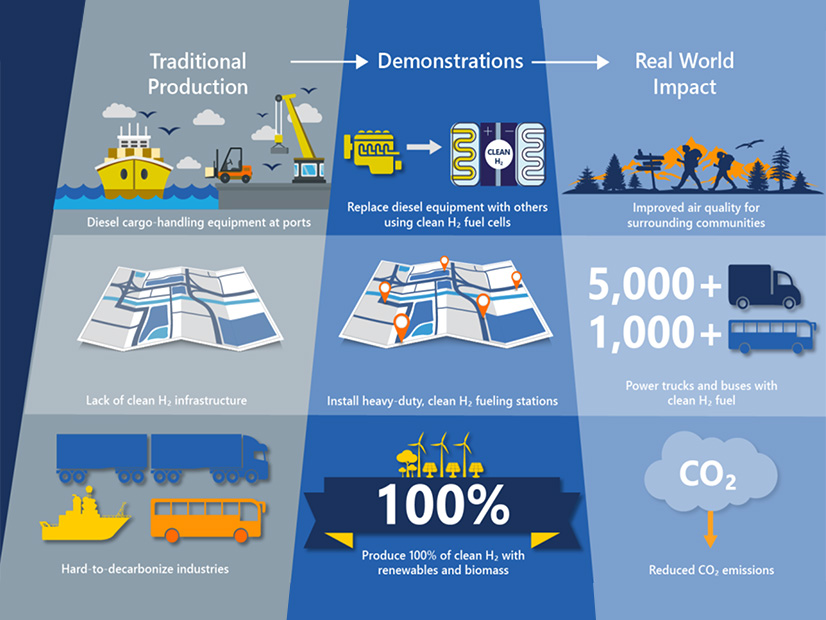
The largest cuts were to the Biden administration’s Hydrogen Hub initiative. California stands to lose $1.2 billion promised to its $10 billion-plus ARCHES hydrogen initiative, while the Pacific Northwest Hydrogen Hub stands to lose $1 billion.
The CEO and board chair of ARCHES called the decision short-sighted but said the initiative would go on without federal funding.
California Gov. Gavin Newsom (D) went on the attack: “In Trump’s America, energy policy is set by the highest bidder, economics and common sense be damned.”
Protest and Praise
“Following a thorough, individualized financial review, DOE determined that these projects did not adequately advance the nation’s energy needs, were not economically viable and would not provide a positive return on investment of taxpayer dollars,” the department said in a news release.
OMB’s Vought identified the states hosting targeted projects as California, Colorado, Connecticut, Delaware, Hawaii, Illinois, Maryland, Massachusetts, Minnesota, New Hampshire, New Jersey, New Mexico, New York, Oregon, Vermont and Washington.
DOE said the grants being terminated had been awarded by its offices of Clean Energy Demonstrations, Energy Efficiency and Renewable Energy, Grid Deployment, Manufacturing and Energy Supply Chains, Advanced Research Projects Agency-Energy and Fossil Energy.
It said 26% of the terminated grants and 41% of the money were awarded between Election Day 2024 and Inauguration Day 2025.
Reaction to the announcement was swift.
U.S. Sen. Adam Schiff (D-Calif.), a frequent critic of Trump, posted: “Our democracy is badly broken when a president can illegally suspend projects for blue states in order to punish his political enemies.”
U.S. Rep. Troy Nehls (R-Texas) posted: “Terrific news. Terminate the Green New SCAM.”
U.S. Sen. Patty Murray (D-Wash.), vice chair of the Appropriations Committee, said: “President Trump has spent the year hurting families, killing jobs and raising people’s costs, and now he and Russ Vought are gleefully using the shutdown they have caused as a pretext to inflict even more pain. … This administration has had plans in the works for months to cancel critical energy projects, and now, they are illegally taking action to kill jobs and raise people’s energy bills.”
In a Truth Social post, Trump suggested there is more to come: “I have a meeting today with Russ Vought, he of Project 2025 fame, to determine which of the many [Democratic] agencies, most of which are a political SCAM, he recommends to be cut, and whether or not those cuts will be temporary or permanent.”
U.S. Rep. Rosa DeLauro (D-Conn.), ranking member on the House Appropriations Committee, said: “This was obviously designed as a political attack by the White House targeting Democrats. But the sad reality is that Americans — the middle class, working class and vulnerable — who voted for both Democrats and Republicans will be hurt by this. This is divisive, it is petty, and unfortunately it is exactly what we have come to expect from President Trump and Russ Vought.”