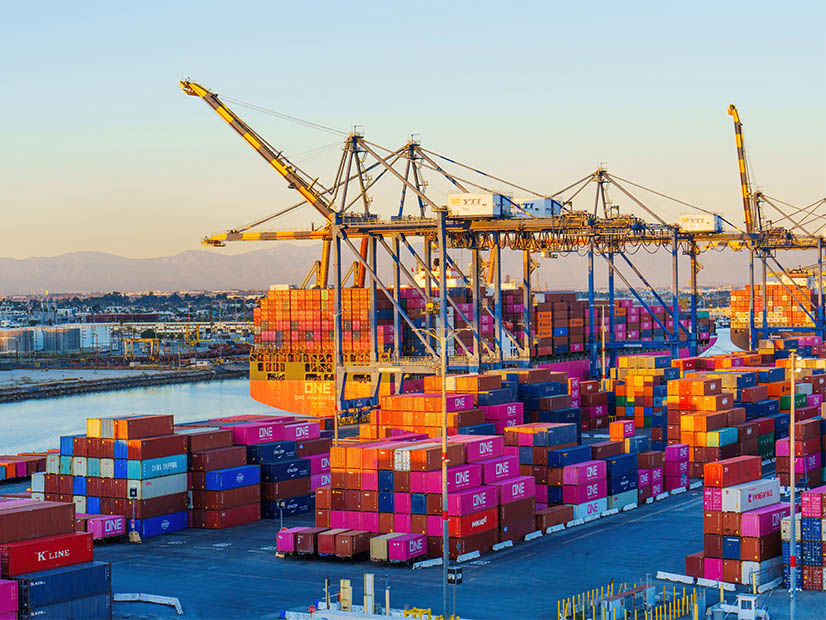
The California Energy Commission approved $42 million for five offshore wind projects at ports in the state, despite recent federal policy changes that have left the future of the renewable resource in limbo.
The California Energy Commission has approved $42 million for five offshore wind projects at ports in the state, despite recent federal policy changes that have left the future of the renewable resource in limbo.
Existing port infrastructure in California is “insufficient” to support the offshore wind industry because of long development timelines and high investment costs, one of the commission’s grant awards said.
The largest funding amount went to the City of Long Beach, which received $20 million to build a 400-acre offshore wind terminal at the Port of Long Beach. The funding will go toward the completion of engineering calculations, environmental assessments and community engagement activities. Engineers on the project also will determine whether the port can be designed to be a zero-emissions terminal. Construction is planned to start in 2027 and be completed by 2035.
In 2022, the CEC set a goal to install up to 5 GW of offshore wind capacity by 2030 and 25 GW by 2045. That amount of capacity requires 15-MW turbines, which have components that are “so large that the only feasible way to transport them is by waterborne transit; road and rail transit are not feasible,” the grant says.
Also in 2022, California passed Assembly Bill 209, which created the Offshore Wind Waterfront Facilities Improvement Program and directed the CEC to develop plans to improve California’s ports, harbors and waterfront facilities for floating offshore wind purposes.
“The wind [energy] resource offshore is significantly better and stronger, and actually more enduring than the wind on land,” Chair David Hochschild said at the CEC’s Oct. 8 business meeting. “One of the key steps is the port investment and the port infrastructure.”
At the national level, offshore wind projects are expected to see a sharp decline in construction over the next five years and beyond, a BloombergNEF analyst reported to the CEC. (See Renewable Construction Slump Starts in 2028, Forecast Shows.) This decline is due to recent federal policy changes that eliminated some tax credits for renewable energy construction projects.
CAISO, however, in May selected Viridon, a transmission engineering firm, to build about 400 miles of new transmission lines for two planned offshore wind facilities in Humboldt County. The transmission projects could cost an estimated $4.1 billion. (See CAISO Chooses Viridon to Develop Humboldt OSW Transmission Projects.)
At the CEC meeting, the commission also awarded $18.2 million to the Humboldt Bay Harbor, Recreation and Conservation District to convert an existing industrial site into a heavy-lift terminal for the manufacturing of large offshore wind components. Humboldt Bay can provide a “critical role for offshore wind development in Central California, Northern California and Oregon,” the award says.
Three smaller grants approved at the meeting were as follows:
-
- The Port San Luis Harbor District: $3 million to continue the design of port upgrades to receive offshore wind equipment and to fund community engagement activities about offshore wind energy off the Central Coast.
- The City of Oakland: $750,000 to design upgrades to the Port of Oakland that would prepare the port for offshore wind equipment delivery and fabrication purposes.
- The City of Richmond: $750,000 to complete 30% of a design to upgrade port infrastructure on up to 216 acres at the Point Potrero Marine Terminal. These sites offer “extensive berth availability, access to deep-water navigation channels and a strategic location within the San Francisco Bay, close to the five current California offshore wind lease areas,” the grant award