ERCOT has introduced a new initiative to advance research and evaluate emerging concepts and solutions in the face of an evolving grid and new technologies.
Through the Grid Research, Innovation and Transformation (GRIT) approach, ERCOT says it will collaborate with public and private sector experts to identify and address emerging grid issues, research them and then prototype the solution — in other words, create an experimental model or a basic version of a product to test its functionality, then refine the design before mass production.
Prashant Kansal, director of grid transformation, told the grid operator’s stakeholders recently that the GRIT initiative is a proactive look at a future problem. The grid and its supporting operational technologies are evolving rapidly, requiring deliberate focus and specialized expertise to ensure future readiness.
“The grid is changing a lot, and it’s both on the grid side … and the operations side,” Kansal told members of the Technical Advisory Committee in August. He cited the increased growth of inverter-based resources, large loads, grid-enhancing technologies and distributed energy resources on the grid side and artificial intelligence, data and computation capabilities on the operations side.
“Combine those two things together and there is definitely a need for ERCOT to be proactive in understanding what problems we are facing,” Kansal said. “That the core mission for the grid transformation initiatives that we’re carrying on.”
“We are seeing greater interest from industry and academia to collaborate on new tools and innovative technologies to advance the reliability needs of tomorrow’s energy systems,” ERCOT CEO Pablo Vegas said in a statement. “These efforts will provide an opportunity to share ideas and bring new innovations forward as we work together to lead the evolution and expansion of the electric power grid.”
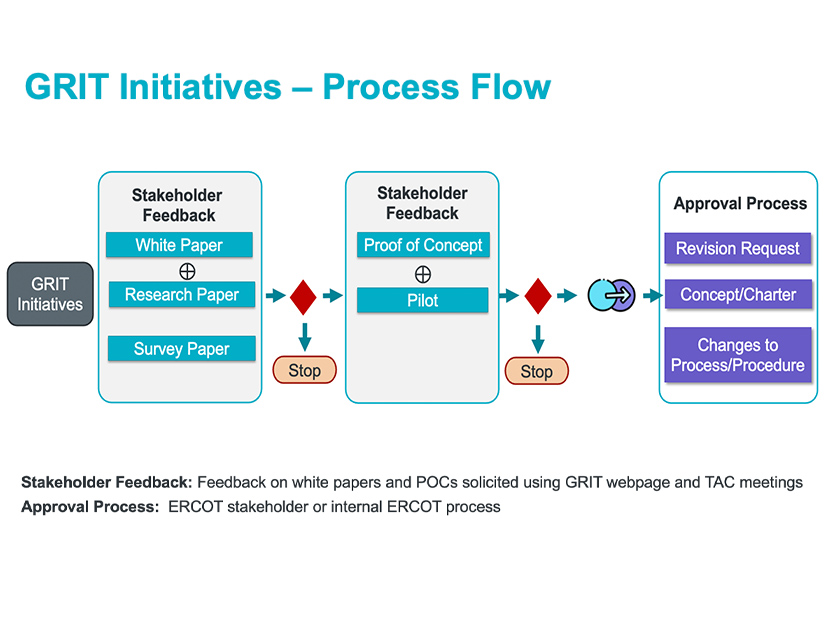
Staff will take proposed initiatives from ERCOT stakeholders and regulators, the national labs, vendors, universities and other grid operators and funnel them through various internal processes. Bi-weekly meetings with business directors and bi-monthly meetings with subject-matter experts will consolidate the different problems and solutions before the proof-of-concept test of the initiative’s feasibility.
“Once we have those initiatives and we look at the problem statement, we are categorizing them into two things,” Kansal said. “One, do we understand the problem or not? And if we have a problem, do we understand the solution or not? If we understand both the problem and the solution, that fits within the business team. If you don’t have either of them, then that belongs in the transformational realm, where our team can work with different partners within ERCOT and different partners outside ERCOT to help understand the problem or the solution.”
The initiatives then will be brought back into the operational realm and go through the stakeholder process, Kansal said.
The GRIT program opened with 14 initiatives identified through internal and external discussions. ERCOT has deployed a website to help stakeholders track the initiatives and to read and comment on white papers as they are drafted. The first five papers include topics on AI and machine learning, DERs’ operational data and the case for multi-interval security constrained optimal power flow.
The website also includes a portal to apply for the ISO’s Research and Innovation Partnership Engagement (RIPE) program, enabling partners with “transformative ideas” to engage with ERCOT on new technologies, and information about the grid operator’s annual Innovation Summit. The third such summit is scheduled to be held March 31, 2026, in Round Rock, Texas.
As part of the GRIT efforts, ERCOT said in early October it selected GE Vernova to participate in a proof-of-concept implementation of the ERCOT Distribution Awareness Platform (EDAP). The technology is designed to “talk to” DERs or energy storage batteries at the distribution level or behind the customer’s meter to provide real-time situational awareness to the ISO’s operations and planning teams.
The grid operator says EDAP will deliver the tools needed to improve visibility into DERs, strengthen reliability and ensure the grid evolves to meet growing demand and increased DER penetration.
Kansal told TAC members that ERCOT is partnering with Texas A&M University to deepen its knowledge of the architecture of data centers, crypto mines and power supplies and better model them.
“This is going to be a changing world in next few years because this architecture is evolving,” he said.