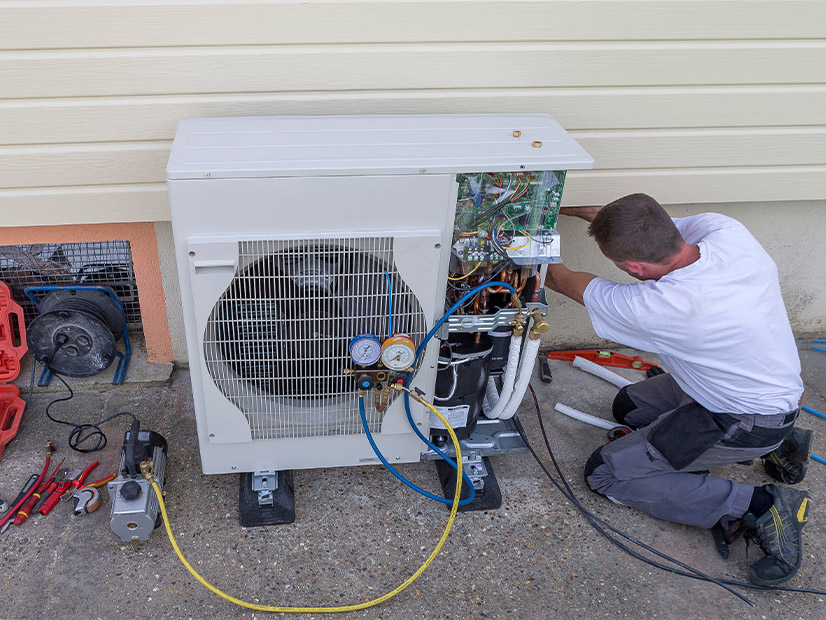
Maryland residents can benefit from the rollout of heat pumps the most by targeting state funds for low-income customers, according to a report released by the Sierra Club’s Maryland Chapter and the Center for Progressive Reform.
Maryland residents can benefit from the rollout of heat pumps the most by targeting state funds for low-income customers, according to a report released Oct. 14 by the Sierra Club’s Maryland Chapter and the Center for Progressive Reform (CPR).
“Building Electrification in Maryland: Implementation of Zero-Emission Heating Equipment Standards for Low-Income Households” found that the right strategies could lead to $145 million in health benefits, $350 million in energy savings and $311 million in climate benefits.
The Climate Solutions Now Act of 2022 set up the zero-emission heating equipment standards (ZEHES) to start replacing fossil-fuel burning heating equipment at the end its life with heat pumps and heat pump water heaters starting in 2029.
The regulations implementing the ZEHES have not been written, and the report seeks to put numbers on the costs and benefits of switching to heat pumps as consumers’ existing equipment needs replacement, report co-author and CPR Senior Policy Analyst Bryan Dunning said in an interview. Another factor was ensuring that low-income customers were not left behind in the transition to technology that has higher upfront costs but is cheaper over its lifetime.
“Utility bills are already high in Maryland right now, full stop,” Dunning said.
The ZEHES program will require that 14,000 space heating units and up to 22,000 water heaters are replaced with heat pumps each year for low-income consumers, who will need significant help to cover those costs, according to the report. Based on the lifespan of current equipment, water heater replacements should be accomplished by 2039 and building heating equipment by 2059.
“In the context of replacements for [low-income] households, modeling projects a yearly total cost of close to $300 million, with an additional cost, depending on implementation policy, of an additional $80 million for building weatherization,” the report says.
Even without the ZEHES program, the water and air heating equipment would need to be replaced at the end of its lifetime at an estimated annual cost of $185 million for low-income households.
While the benefits outweigh the costs, the state will need to help low-income customers, or their landlords, pay for the upfront costs, and recent policy changes at the federal level complicate that.
“Federal funds are not included in our pathway forward,” Dunning said. “One can hope that the feds may elect to support electrification in the future again, the way they had previously done, or perhaps more so, but we did not hang our recommendations on that. So, the numbers that are in our report in terms of the costs and where cost allocation has to come from [are] totally focused on the state side of things. It’s really looking at also specifically leaning on non-general fund money, so you don’t need an additional allocation from the legislature.”
Those funds include the Strategic Energy Investment Fund that comes from the Regional Greenhouse Gas Initiative, the EmPOWER program, the Clean Heat Standard being developed by the Maryland Department of the Environment and low- to zero-interest financing from green banks. In general, the paper recommends that bigger shares of the funding from some of those programs go to low-income consumers.
Given that the program does not start until 2029, the report suggests starting on replacing heating sources that have the biggest payback, which are oil, propane and electric resistance heating, the last of which is not part of ZEHES. But rolling out heat pumps comes with a quicker repayment period now than those that use natural gas, at just four years, while replacing electric water heaters with heat pump technology can be paid back in three years.
“Over 61% of water heaters in [low-income] Maryland homes currently employ electric resistance and would quickly benefit from replacement,” the report says. “Tanked heat pump hot water heaters can heat during off-peak hours, holding the hot water until peak morning hours during the winter and peak evening hours during the summer. Because they can schedule operation, these heaters can lower peak electric demand, thus contributing to lower electric rates and reducing grid congestion.”
All heat pumps have some electric resistance backups in them, which would kick in during the rare winter arctic cold snaps that impact Maryland, though generally the state’s climate is well suited for the technology, Dunning said.
“Maryland exists in a bit of a Goldilocks zone climate wise,” he added. “It’s our position that you can do this without backups.”
Backup heating sources are sometimes in states further north, but Dunning said arguments from utilities to keep natural gas heating as a backup do not make sense given the normally mild winters in Maryland.