IESO removed a credit rating requirement for prospective bidders to enroll in its Transmitter Selection Framework Registry, a prequalification mechanism for the competitive procurement that is expected to begin in 2026.
IESO has removed a credit rating requirement for prospective bidders to enroll in its Transmitter Selection Framework Registry (TSF-R), a prequalification mechanism for the ISO’s competitive procurement that is expected to begin in 2026.
Removing the requirement will ensure that all applicants are “assessed using consistent financial criteria,” IESO officials said in an engagement session Oct. 15.
“This allows us to evaluate organizations consistently through these early phases, but it’s expected that credit rating requirements will be expected and introduced as a requirement at the time of” the request for proposals, said Denise Zhong, IESO senior manager for resource adequacy and sector evolution.
IESO officials said the change was made in response to feedback after its stakeholder engagement in June. (See IESO Moving Forward with Competitive Tx Plans.) The TSF-R opened July 31.
“Concerns were raised around the current credit rating criteria within the TSF Registry that [they] may be too restrictive at this stage of the process, and it seemed that it was required for some but not all,” Zhong said.
Throughout their presentations, Zhong and her colleagues emphasized the importance of Indigenous participation and support for projects. They said since the June engagement, the ISO has continued talks with Building Ontario Fund (BOF) and Canada Infrastructure Bank (CIB) to develop ways to encourage Indigenous participation and provide loans to developers of TSF projects.
The BOF is administering the Indigenous Opportunities Financing Program (IOFP) — formerly the Aboriginal Loan Guarantee Program — which provides credit support to help Indigenous corporations attract lenders.
“The IOFP is not a loan or a grant program,” said Andrew Lee, IESO senior adviser for resource acquisition. “The IOFP is a form of credit support intended to enhance Indigenous corporations’ credit worthiness and attract lenders willing to provide a loan.”
Three loan guarantees totaling $327 million have been provided by the fund through September, Lee said, including most recently one for the Chatham-Lakeshore transmission line, a 49-km, double-circuit 230-kV line in southwestern Ontario.
IESO says initiating competition — a directive from the Minister of Energy and Mines’ Integrated Energy Plan (IEP) — will lower costs and produce innovation. The ISO is working with the ministry to identify the first transmission project to be opened to competition, with a focus on the South and Central Bulk Study, with recommendations scheduled for late 2025, and the North of Sudbury and Eastern Ontario bulk studies, both expected in early 2026.
But most of the 1,500 km of new transmission lines planned or under development will be awarded to incumbent transmitters.
‘Partial Contracting’ Model
The ISO announced in June that it had decided on a “COD+10” partial contracting model, in which the winning bidder will receive a contract covering all costs of financing, designing, building, operating and maintaining the line for the first 10 years of commercial operation.
Bidders will be asked to submit 10 annual revenue requirements (ARRs) for the initial 10 years of operation. In year 11, the contract will transition to traditional rate regulation under the Ontario Energy Board (OEB), which will review the prudency of ARRs going forward.
The model will include binding commitments for cost management, scheduling and Indigenous participation, officials said.
IESO also has been consulting with the OEB to develop the regulatory framework for the program, including exempting TSF-contracted transmission projects from “leave-to-construct” requirements.
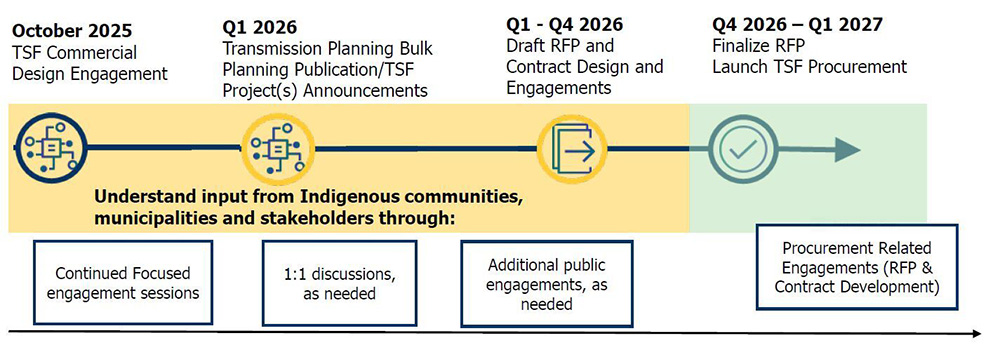
“One of the key recommendations coming out of the TSF is to remove the leave-to-construct requirement during project development phase for TSF projects,” Zhong said. “This change is intended to reduce timelines in the development phase, recognizing that, again, a procurement process overall will require additional time and careful execution.”
The ISO also has been meeting with transmitters, financiers, and engineering, procurement and construction firms to inform the design of the program.
Routing, Cost Containment
IESO said it will specify terminal connection points for projects but will not prescribe routes.
“In some cases, a corridor may have been identified and/or protected by the Ministry of Energy and Mines,” the ISO said. “Such a corridor will not preclude other route alignments as determined through field studies and/or community engagement.”
IESO said it is considering cost-containment provisions and ways to manage cost adjustments to balance “cost certainty and flexibility for legitimate changes.”
It asked stakeholders for feedback on whether it should set cost caps or allow developers to propose them.
To protect ratepayers, IESO said it will monitor developers’ performance and may reduce their payments if they fail to meet contractual benchmarks regarding availability (based on outages) and transfer capability.
“Unlike the rate regulated cost of service model where reasonable operational and maintenance costs are reimbursed to the transmitter, the IESO foresees a potential risk of underinvestment in maintenance and operation from transmitters as an approach to improving transmitter profit margins,” it said.
Feedback
Sonny McGinnis complained about difficulty communicating with the ISO. McGinnis, who was representing the Anishnaabeg of Naongashiing in northwestern Ontario, said he “tried calling after our sessions months ago. I could never line up with anyone. Nobody knew what the heck I was talking about. … It can’t be just lip service we’re getting.”
Stakeholders should provide written feedback on the TSF plan to engagement@ieso.ca by Nov. 5. IESO plans to share solicitation documents and contract term sheets in an engagement session in January.