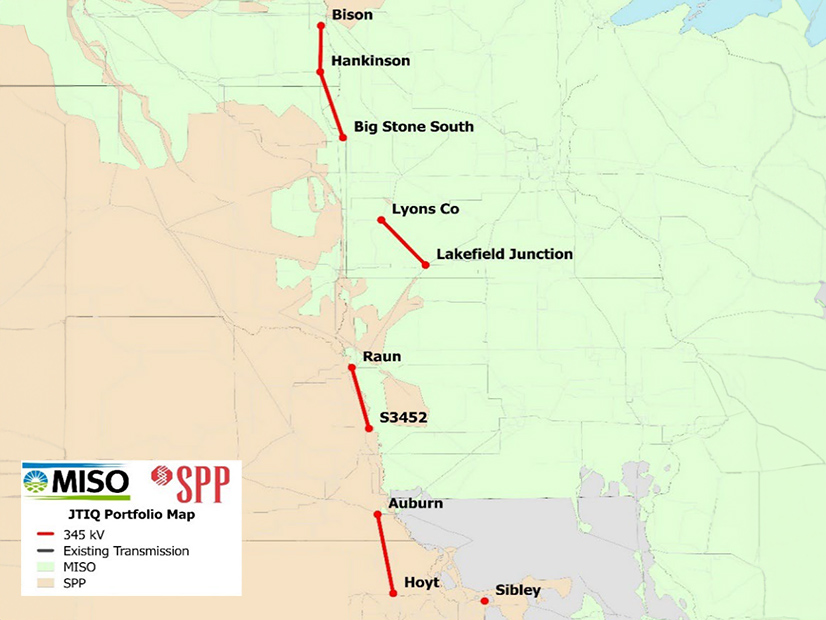
LITTLE ROCK, Ark. — SPP says it plans to continue working the Joint Targeted Interconnection Queue’s portfolio of five 345-kV projects on its seam with MISO, despite the U.S. Department of Energy’s threat to pull $464 million in previously granted funds.
General Counsel Paul Suskie told stakeholders Oct. 14 that staff’s initial internal assessment has determined “nothing stops these projects from going forward.”
“They can proceed,” he said during a Markets and Operations Policy Committee meeting. “We are having communications with MISO to see if they’re in agreement with that. Staff’s current indication is these projects will still go forward if DOE funds are pulled for the grants.”
Suskie told MOPC that he called Minnesota Public Utilities Commissioner John Tuma, who confirmed that as of Oct. 13, DOE has not yet provided confirmation of the funding’s termination.
The funds were awarded in 2023 to the Minnesota Department of Commerce, the lead applicant in the JTIQ initiative that also involves the Great Plains Institute and the two RTOs. However, the department in early October included the $464 million grant under its Grid Resilience and Innovation Partnerships (GRIP) program on a list of projects that it intended to terminate. (See DOE Terminates $7.56B in Energy Grants for Projects in Blue States.)
POLITICO has reported that DOE has “clashed” with the White House over the administration’s desire to spare most grants so they can be used as bargaining chips with Congress and the states, explaining the lack of confirmation from the department.
“At this point, we don’t know [the grant’s status],” Suskie said. “We know the rumors, the press reports. That’s all we know at this point in time. Really, it’s a wait-and-see game.”
MISO has said it is monitoring the situation and that like SPP and Minnesota, it has yet to receive word of the grant’s termination. (See MISO Says JTIQ Tx Portfolio Stands — for Now.)
The GRIP funds would offset about 25% of the predicted $1.6 billion in capital costs for the JTIQ portfolio’s five projects.
FERC approved the RTOs’ request to allocate the portfolio’s costs 100% to interconnecting generation assessed on a per-megawatt basis. In doing so, it cited the GRIP funding as one of the “unique set of facts and circumstances of the proposed JTIQ framework.” (See FERC Upholds MISO and SPP’s JTIQ Cost Allocation over Criticism.)
“This potentially has not just impacts on the practicality of these lines,” the Advanced Power Alliance’s Steve Gaw said during the MOPC discussion. “I’m not seeing anything that others don’t see, but there are also potential legal implications from this equity impact.”
The portfolio’s projects are centered on the RTOs’ northern seam and have been framed as enabling 28 GW of primarily renewable generation. Each grid operator would have two projects in its footprint and share the fifth.
The SPP projects will be evaluated for system impacts first through its one-time expedited resource adequacy study process and then through the 2024 Integrated Transmission Planning cluster. Staff have targeted March 2026 to execute ERAS generator interconnection agreements.