Key organizations across California voiced strong opposition to Pacific Gas and Electric’s proposed rate increases that are under review at the California Public Utilities Commission.
Protesting organizations include the California Farm Bureau Federation, the California Community Choice Association and the Environmental Defense Fund, among many others.
The proposed rate increases are part of PG&E’s 2027 general rate case application, which was reviewed at an Oct. 22 public forum with CPUC officials. PG&E submitted its current general rate case application on May 15, and the commission plans to approve adjusted rates in May 2027.
Critically, PG&E’s application does not include costs associated with recent wildfire mitigation work, community rebuilding projects, billing system upgrades, undergrounding, electricity procurement, fuel and purchase power, or costs to own and operate the Diablo Canyon Power Plant, the CPUC said.
Increases in prior PG&E rate case applications have been driven by wildfire mitigation work, safety work and inflation, PG&E said in its application.
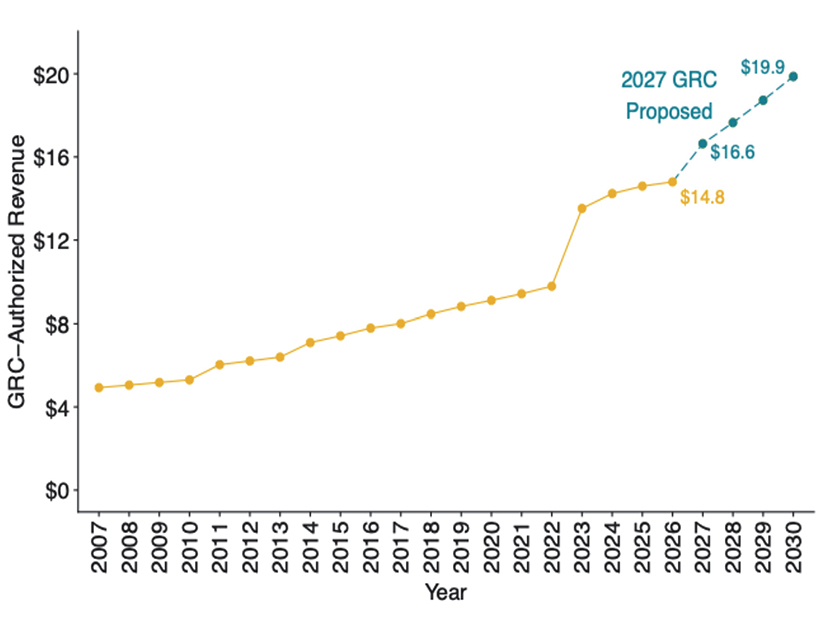
Proposed increases in the 2027 general rate case application are about 8% in 2027 and about 6.1% in 2028, 2029 and 2030.
In 2027, the rate change would increase the average residential customer’s gas and electric bill by about 3.6% compared to a bill in 2025. Electric bills would increase by about 5.2%, while gas bills would decrease by about 0.6%.
The average residential bill would increase by about $9.94/month in 2028, $10.50/month in 2029 and $11.08/month in 2030.
PG&E requested $72 billion over four years to fund its operations and investments, and the application controls a little more than half of PG&E’s overall revenue, CPUC Commissioner John Reynolds said at the Oct. 22 public forum.
“I am mindful that when PG&E pledges that rates will remain stable for years to come, the rates are currently unaffordable for many residents in the state,” Reynolds said at the forum. “Stable rates will not offer [relief] to those who are struggling to pay their bills.”
Displeased Organizations
In comments to the commission, Kevin Johnston, representative of the California Farm Bureau Federation, said PG&E’s rate application contained “a number of assumptions and misdirection” that minimize what continue to be “significant increases” built upon “years of skyrocketing increases” in revenue requirements.
“The authorized revenue requirement in 2017 was $8 billion. The adopted revenue requirement in 2026 was $15.4 billion. A 92% increase in nine years,” Johnston said. “Customers want transparency, not spin.”
The California Community Choice Association added in comments that PG&E’s rate case application raises “critical questions concerning cost shifting.”
CalCCA is concerned specifically with PG&E’s request for $2.45 billion of capital investments between 2027 and 2030 in the company’s hydroelectric generation fleet. Many of the hydroelectric assets have outlived their expected lifespan, and PG&E is not required to relicense these assets, CalCCA said.
The Environmental Defense Fund said in comments that it’s concerned with PG&E’s capital forecasts for setting initial rates and the lack of information about data center forecasts in PG&E’s territory.