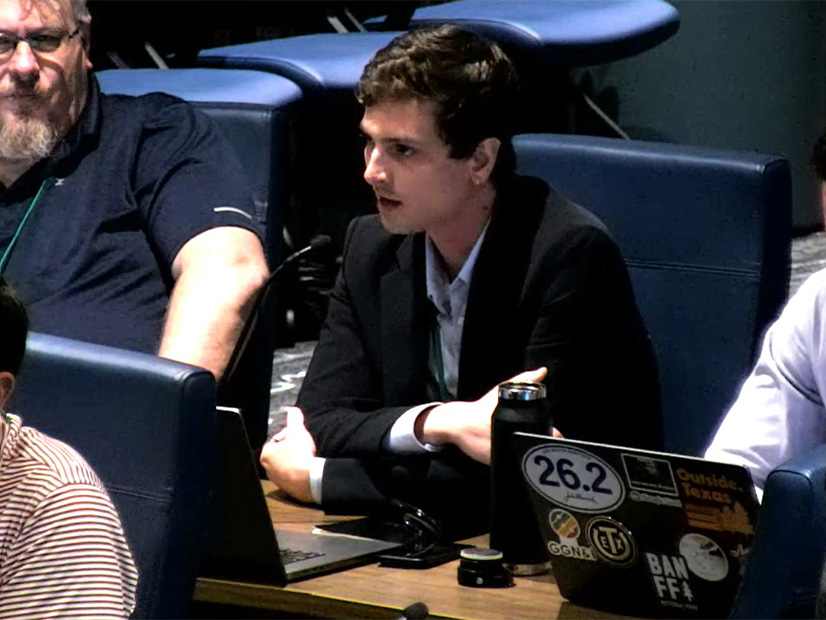
ERCOT stakeholders gathered in Austin on Oct. 22 for a Technical Advisory Committee meeting, only to have a large-load discussion break out.
And with good reason. Staff told TAC members that they are tracking over 200 GW in large-load interconnection requests, primarily from data centers and cryptocurrency mining. Over 130 GW of requests (a 182% increase) have been added to the queue in just the past 10 months. However, only about 6.5 GW have been energized or approved for energization, with an additional 4.7 GW being studied.
That led stakeholders to question whether ERCOT has placed a moratorium on energizing large loads.
Consultant Bob Wittmeyer, chair of the Large Load Working Group, said that is not the case. “More loads have been approved to energize [in West Texas] than we can handle, but those loads are not yet operational, and it will be a while until they are,” he said, repeating what was said at the LLWG’s meeting Sept. 19.
However, Evan Neel, with data center developer Lancium, said the discussion during that meeting was not clear, leading to uncertainty within the market.
“In fact, that following Monday, there were some market research firms that published headlines of the sort that ‘ERCOT pulls the plug on data centers,’” Neel said. “They were citing explicitly things that were said during that meeting,” Neel said. “Obviously that is a concern when we’re talking about bringing investment to the state.”
ERCOT has cited studies that indicate it could lose at most 2,600 MW of load under certain operating conditions, without exceeding the post-contingency frequency limit. Staff said in a June market notice it is “essential” that they have accurate large-load models to assess grid stability risks, saying recent operational events demonstrate “the dynamic models currently representing many of these [loads] do not reflect their actual dynamic performance.”
“We’ve seen conversations around numbers of about 2,600, but the market notice points to a bunch of historical events that have not been anywhere close to that,” Neel said.
Another, more recent market notice bypassed the stakeholder process and addressed large loads potentially energizing on the system without having cleared “certain important hurdles.”
The notice established a new approval process requiring confirmation of all necessary modeling and telemetry is in place before a large load’s energization. The process is effective immediately and applies to any studied large load, regardless of the planning process used to evaluate interconnection’s reliability.
“This is something we don’t do willy-nilly,” Chief Regulatory Counsel Nathan Bigbee said. “Sometimes we may not have time, or we may decide that we don’t have time, to pursue a revision request for the stakeholder process in order to address the reliability risk.
“ERCOT ultimately has a statutory obligation to ensure the reliability of the grid,” he reminded stakeholders. “In some cases where there isn’t sufficient time to pursue a protocol revision or other guide revision, we believe it’s incumbent on us to address that risk. Sometimes that requires establishing policy on an interim basis through a market notice.”
RTC+B Project Eyes Dec. 5
ERCOT’s Matt Mereness said the Real-time Co-optimization + Batteries (RTC+B) project continues to be on the right track as its Dec. 5 implementation date nears.
“It looks like it’ll be a fairly smooth transition without having to take special procedures,” he told TAC during his regular update to members.

The project is in its third and final phase, with the focus on go-live. A required live production test to ensure effective frequency dispatch and control, involving almost 100 qualified scheduling entities and additional marketers, is scheduled for Oct. 30, and a cutover workshop is set for Nov. 13.
Mereness said staff have been evaluating historical data to determine potential ancillary service demand factors, the hourly parameters for each service type that indicate an assumed deployment (energy reservation) based on demand forecasts, intermittent renewable resources and other system conditions. These factors are used in the reliability unit commitment (RUC) studies.
The RTC+B Task Force has scheduled an in-depth meeting Oct. 27 to delve into ERCOT’s analysis and planned values. It is part of a tripleheader meeting that day.
The switchover will take place between 11:59 p.m. Dec. 4 and 12:01 a.m. Dec. 5 as the market begins dispatching energy and ancillary services every five minutes in real time.
Members Show Their College Colors
Members were encouraged to show their college spirit, and some did, wearing jerseys or shirts that exhibited their academic ties.
The meeting soon devolved into good-natured ribbing between Texas Exes and Former Students from Texas A&M. (As good Aggies know, there are no ex-Aggies, only Former Students.)
TAC Chair Caitlin Smith, a University of Texas alum with Jupiter Power, was quick to needle American Electric Power’s Richard Ross, a proud Aggie. “Richard Ross told me the theme of the month is ‘Hook ’em Horns!’” she said.
Ross, who usually sets monthly themes for TAC and SPP stakeholder meetings, snapped to attention. “That’s not true! That’s not true at all!” he said. Caught without a theme, he instead recounted SPP staff’s use of the term “trauma bond.”
“That’s when new staff joins the [stakeholder] meetings and they have the anxiety because they oftentimes get candid feedback and discussion,” Ross said. Turning to ERCOT’s Elizabeth Morales, bedecked in a UT T-shirt for her first TAC meeting, he said, “Elizabeth, this your trauma bond with TAC. I will share with you that that is one ugly shirt you’re wearing.”
“It’s a beautiful burnt orange shirt,” Smith responded, coming to Morales’ defense.
Reliant Energy Retail Services’ Bill Barnes wore a football jersey from the Colorado School of Mines bearing his son’s No. 27. A sophomore, Max Barnes led the School of Mines’ 72-14 win over Adams State on Oct. 18 with 201 rushing yards.
ERCOT’s Jake Pedigo had to step in when a fellow alumnus of the University of North Texas couldn’t remember the school’s slogan. “We are the Mean Green Eagles,” he said, “and it’s ‘C’mon Green, Get Mean.’”
RUC Opt-out Window Expanded
TAC unanimously endorsed, with two abstentions, a protocol call change (NPRR1285) that expands the current RUC opt-out window to incent self-commitment, increasing capacity available to the market at lower expense and reducing RUCs and associated costs.
The endorsement came despite an objection from the Independent Market Monitor.
“On a principal level, it doesn’t really improve self-commitment,” said the IMM’s director, Jeff McDonald. He agreed with staff’s assertion that the change increases flexibility for a generator and its settlement options, but he said that “by increasing the amount of flexibility you have for your settlement options, it would actually decrease the incentives for self-commitment for resources who believe that they might be near the margin of being needed or not needed.”
Dave Maggio, ERCOT’s commercial operations principal, said NPRR1285 eliminates an extra two hours from the lead time before an opt-out decision, which becomes a telemetry function.
“[I] just wanted to make sure it’s clear that it’s not a reversion back to what we had previously,” he said.
TAC’s combination ballot, or consent agenda, included the annual major transmission elements list, five NPRRs, a Nodal Operating Guide revision (NOGRR) and a system change request (SCR) that, if approved by ERCOT’s board, would:
-
- NPRR1263: remove the accuracy testing requirements for coupling capacitor voltage transformers.
- NPRR1280: establish a regional planning group review process for proposals to permanently bypass an existing series capacitor or un-bypass a series capacitor previously designated as permanently bypassed.
- NPRR1293: clarify the “Update Network Operations Model Production Environment’s” milestone dates.
- NPRR1294: incorporate the other binding document “Demand Response Data Definitions and Technical Specifications” into the protocols, standardizing the approval process.
- NPRR1299: clarify and clean up language related to the emergency response service program, including a data file produced at the end of the procurement process using code managed entirely within ERCOT’s Demand Integration group. The file is manually produced and must be posted manually, which is affected by weekends and holidays.
- NOGRR279: modify the monitoring equipment installation deadlines established by NOGRR255 (High Resolution Data Requirements) to Jan. 1, 2029, consistent with NERC standard PRC-028-01 (Disturbance Monitoring and Reporting Requirements for Inverter-Based Resources), and clarify that synchronized resources with standard generation interconnection agreements executed prior to July 25, 2024, have 12 months after their commercial operations date to comply with the new equipment standards.
- SCR831: modify the network model management system, operational data management system, topology processor and the modeling-on-demand system to incorporate short-circuit modeling data for maintaining models built by the system protection working group.