The West-Wide Governance Pathways Initiative’s Launch Committee Co-Chair Pam Sporborg said the stakeholder process of the new regional organization that will oversee CAISO’s energy markets is an evolution of the ISO’s Regional Issues Forum (RIF).
The RIF is a space for the power industry to discuss issues related to the ISO’s Western Energy Imbalance Market (WEIM) and Extended Day-Ahead Market (EDAM). However, following the passage of AB 825 in California, CAISO will hand over responsibility for the markets to the independent Regional Organization for Western Energy (ROWE), which is being designed by the Pathways Initiative’s Launch Committee. The handover is scheduled for early 2028. (See Newsom Signs Calif. Pathways Bill into Law.)
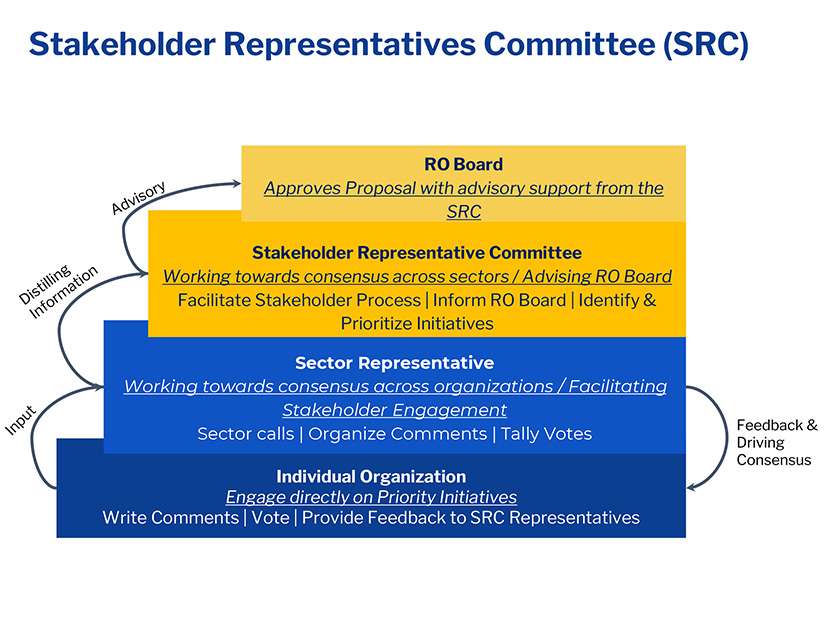
Speaking at the RIF on Oct. 27, Sporborg, director of transmission and markets at Portland General Electric, said the Pathways Initiative’s Stakeholder Representatives Committee (SRC), which will provide advisory support to ROWE’s board, builds on the RIF’s success, praising the forum as enabling “more in-depth dialog on the stakeholder process and the evolution of the market.”
“We … see the Stakeholder Representatives Committee as this incremental evolution beyond the RIF sector liaison role with an expanded number of sectors that I think add some granularity and new voices into the process,” Sporborg said.
“We have more of an opportunity to really have additional engagement in each of the policy development processes,” Sporborg said. She added that there is an “opportunity to bring … members of each sector into that policy development process to ensure that as the market evolves, it’s really evolving at the direction of stakeholders.”
She noted the sectors will be involved in market development by providing SRC members with more say on proposals through an enhanced voting process, comment engagement, analysis and other opportunities.
Sporborg explained the enhanced voting approach, saying stakeholders will submit indicative votes throughout the policymaking process to ensure concerns are being addressed and to provide more analysis on proposals rather than SRC members simply voting “support, oppose or neutral.”
The Launch Committee is considering a remand process to allow entities to refine unpopular proposals. This would apply to final proposals prior to an initiative being sent to the ROWE board.
“We want to enhance the way these votes get shared with the board, so that there would be some opportunity to identify … more analytics behind that support, oppose or neutral vote to help the board understand if there’s opposition in a particular sector,” Sporborg said. “For example, do all small utilities oppose a proposal, or does this have significant opposition in the IPP sector? We want to be able to have that kind of analytic show through the tabulated voting.”
Already, the Launch Committee has announced that representatives from nine sectors will advise on the nomination of members to ROWE’s initial board. (See Pathways to Engage Broad Set of Stakeholders to Select Independent RO Board.)
Those entities include:
-
- EDAM entities
- WEIM entities
- ISO-participating transmission owners
- Non-IOU load-serving entities serving load from WEIM or EDAM
- Public interest organizations
- Independent power producers, independent transmission developers and marketers
- Consumer advocates
- Large commercial and industrial customers
- Distributed energy resources
Sporborg said the Launch Committee envisions a “hybrid structure” that brings together staff expertise and stakeholder input, “where you get the ability to execute quickly and to drive forward through a staff-driven process. But by bringing more of the voice of the stakeholder into that process, we can have more of a stakeholder-driven policy evolution.”