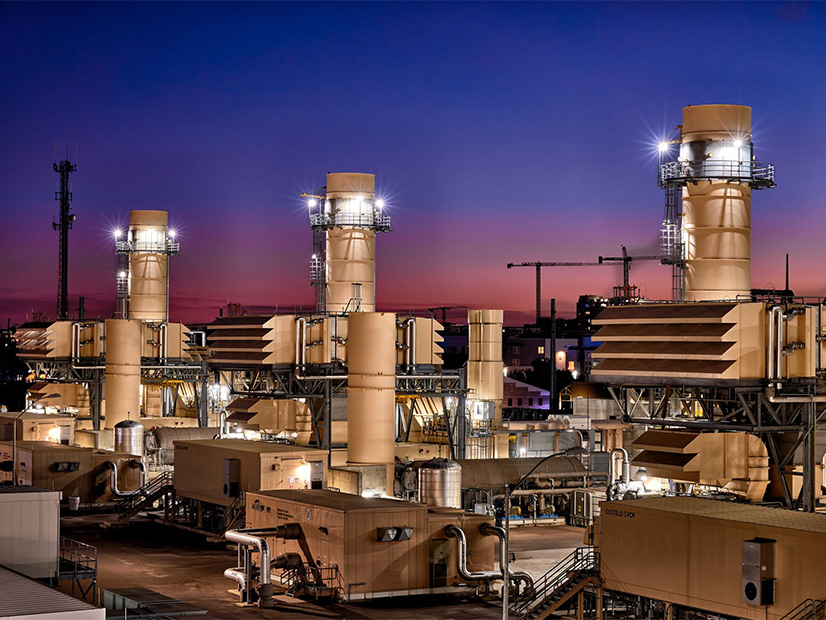
Arizona Public Service plans to build an up-to-2-GW natural gas power plant that would be paid for in part by large-load subscribers such as data centers.
The Desert Sun Power Plant would be built west of Gila Bend, Ariz., in two phases, APS announced Oct. 30.
Phase 1 would serve APS’ existing customers and “business as usual” growth. It would be paid for by ratepayers. In contrast, Phase 2 would be paid for by the extra-large customers who would use its output through a subscription model. APS defines extra-large customers as those needing 25 MW or more.
Extra-large users would sign long-term contracts covering capital costs and assuming development risks. APS calls the strategy “growth pays for growth.”
“Additional natural gas generation is essential to support our existing customers and to begin addressing unprecedented requests from extra-large energy users, such as data centers,” said Jacob Tetlow, APS executive vice president and chief operating officer.
APS has nearly 4.5 GW of committed extra high load factor customer demand, Ted Geisler, CEO of APS parent company Pinnacle West, said during a second-quarter earnings call in August.
In addition, there is almost 20 GW of uncommitted demand from customers that have “expressed serious interest in new projects within our system,” Geisler said.
Tetlow called the load growth “unprecedented.” And large-load customers seem interested in the Desert Sun project.
“We’ve had a good response,” Tetlow told RTO Insider in an interview.
Desert Sun’s Phase 2 customers would buy into a portfolio containing the new gas plant and other resources such as solar, storage or wind, Tetlow said. Phase 2 contracts would go to the Arizona Corporation Commission, most likely in a package, for approval.
The capacity of the two phases combined could be as much as 2 GW, though the amount in each phase isn’t yet known. Project costs are being worked out.
Phase 1 would include transmission upgrades, whose costs would be incorporated into base rates, Tetlow said. Phase 2 would come with additional transmission upgrades that the extra-large load subscribers would fund.
APS now offers an extra-high load factor tariff for large customers. The subscription model would be an alternative, Tetlow said.
Because customers using the subscription model would help pay to build new resources, they could get service sooner. The model would provide cost certainty to the large customers, while preventing cost shifts to smaller customers, Tetlow said.
Phase 1 of the power plant is scheduled to begin operations by late 2030. Phase 2’s operation date will be determined through discussions with the extra-large customers.
The new plant will come with advanced emissions controls to meet federal and county air quality standards. Using hydrogen as fuel for the new plant or deploying carbon capture may be considered in the future, Tetlow said.
APS intends to supply the plant with natural gas via the proposed Transwestern Pipeline’s Desert Southwest expansion project.
APS plans to add nearly 7,300 MW of new resources by 2028, to meet rising demand due to Arizona’s rapid growth. Natural gas complements APS’ renewable resources, while nuclear energy and coal make the system resilient, the company said.
Although APS had planned to exit the coal-fired Four Corners Power Plant in 2031, the company is reserving the option to continue using Four Corners through 2038.
Tetlow noted the importance of reliability in Arizona’s climate.
“It’s 118 degrees sometimes,” he said. “[Desert Sun] is a resource to ensure reliability in the desert.”