Here’s something you don’t see every day: a state asking communities to raise their hand and explain why they should be the site of a next-generation nuclear reactor.
The New York Power Authority has begun to sound out developers on how they would go about building a gigawatt or more of advanced nuclear generating capacity and sound out communities on why they would be the right place to do it.
The requests for information NYPA issued Oct. 30 will not result in a contract award or siting designation, but they will help shape the process by which those decisions are made.
Faced with the prospect of increasing power demand in New York state, the statutory requirement to reduce emissions and the slow pace of renewable energy development, Gov. Kathy Hochul (D) in June ordered NYPA to develop at least 1 GW of advanced nuclear capacity. (See N.Y. Pursuing Development of 1-GW Advanced Nuclear Facility.)
Caveats: It must be sited in a community that welcomes it and must be developed in partnership with the private sector.
So NYPA is looking for a site and is trying to line up potential private-sector partners with a track record of developing, constructing, operating and/or servicing nuclear energy facilities.
It defines advanced nuclear as large-scale or small modular reactors employing Gen III+ or Gen IV technologies. Microreactors are not under consideration.
NYPA requires that the project start construction before 2033 and enter operation by 2040.
NYPA is steering clear of first-of-a-kind projects, which can carry elevated risk of delay, technical hurdles and cost overrun, but it is not being strict about this — it asks merely that the first concrete have been poured for at least one similar project somewhere else in North America by early 2030.
Host Community
The host communities RFI defines “community” as anything from a village to a county to a multicounty region.
New York City, Long Island and all but one Hudson Valley county are excluded from consideration — NYPA is looking toward the less densely populated parts of upstate, and away from the crowded downstate areas where many viewed the now-closed Indian Point nuclear plant unfavorably.
NYPA seeks a site that has a clear path toward construction of nuclear generation, is large enough, has water access, is protected from hazards and has demonstrated support from key stakeholders within the community.
Respondents should describe their community’s high-level vision for nuclear and how it would advance the community’s goals.
NYPA wants to know about factors including the area workforce and workforce development programs; local supply chain; supportive institutions such as labor unions and community leaders; infrastructure; power-intensive industries the community hosts or is trying to attract; framework for local approvals; and development incentives that would attract and retain nuclear supply chain businesses.
Also important are details such as interconnection potential, transportation access suitable for heavy cargo, environmental issues and any efforts taken to gauge popular support.
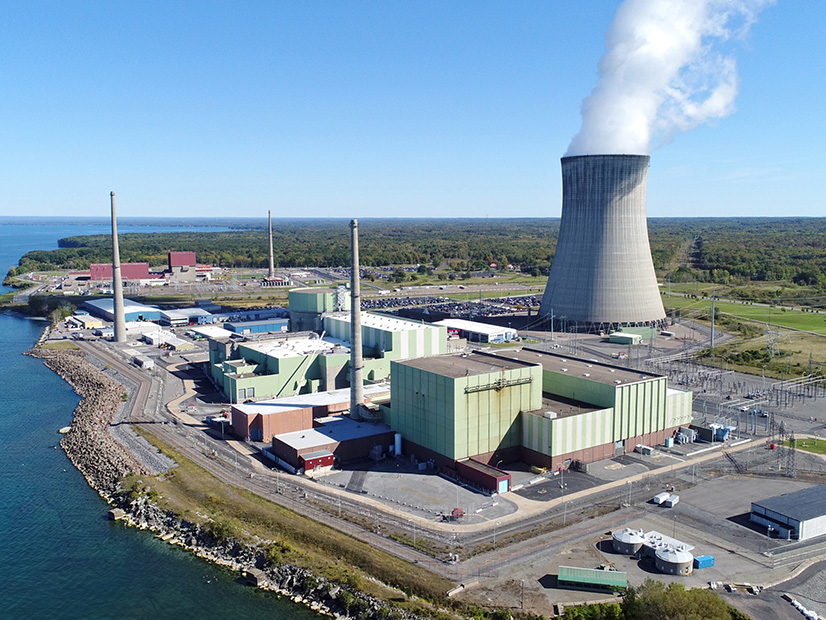
Interest has been expressed already. Officials in Oswego County, home to three of the state’s four operating commercial reactors, say additional reactors would be a nice fit there. Many in the lakeside city of Dunkirk, which suffered economically with the shutdown of NRG Energy’s coal-fired power plant, are lobbying for that site to host the state’s next reactor.
Development Partner
In the RFI issued to developers, NYPA seeks details about the technology they would use, siting considerations, cost and timeline assumptions, and potential ownership/partnership structures they see with NYPA.
And of course NYPA is looking for a demonstrated credible path to adding at least 1 GW of fission generation to New York’s grid as soon as possible.
NYPA asks respondents what experience they have with nuclear or other large-scale capital project construction and operation, details about those projects, their track record in securing state and federal funding, partnerships they would develop, what manufacturer and technology they would use in New York, supply chain considerations, fuel and waste management, design modularity and anticipated challenges.
NYPA also wants to know which site the respondents would propose for their project or know how they would identify a site if they have not already.
And it asks some questions that point to the central challenges of nuclear power development: describe your licensing strategy; provide your anticipated timeline up to commercial operation date; detail high-level levelized cost of electricity and overnight costs assumption; and give a directional level of maturity on those cost and time estimates, and on the assumptions underlying them.
Then there are the questions of equity, which New York retains as a guiding principle: Discuss your approach to workforce development; highlight your partnerships with labor unions and community organizations; and describe how your strategy supports job quality, equitable access for workers from disadvantaged communities and a skilled regional workforce.
The response deadline for both RFIs is Dec. 11. Participation is not a prerequisite for consideration in the future solicitation process.
Underlying Need
New York is likely to miss its statutory goal of 70% renewable energy in 2030, perhaps by a wide margin. As of 2023, its power mix was only 23.2% renewables, and increasing that percentage is only going to get more difficult during Trump 2.0.
Meanwhile, the existing fossil generation is aging, and new fossil generation may be needed to replace it if emissions-free resources cannot be brought online in time. So the state has embraced nuclear as a firm resource to complement intermittent wind and solar.
New York’s four commercial reactors are a crucial piece of the state energy portfolio, providing 22.2% of the electricity generated in the state in 2023 and nearly half of its emissions-free electricity. Despite their age, they are running at a capacity factor in the mid-90% range.
They have received $3.69 billion in the first seven years of New York’s zero emissions credit program, begun in 2017 to prevent their retirement for economic reasons.
The state is considering extending the ZEC program to 2049 to prevent retirement of the three oldest reactors, which began operating in 1960, 1970 and 1975 and are coming up on license renewals. (See N.Y. Makes Case for Extending Nuclear Subsidies to 2049.)
All four reactors are owned by Constellation Energy. In January, New York state joined Constellation in a proposal for a federal grant to support Constellation’s early site permit request for one or more advanced nuclear reactors to be co-located with two of the existing reactors in Oswego County.