The D.C. Circuit Court of Appeals upheld the Department of Energy’s efficiency standard for natural gas furnaces and water heaters against appeals from gas trade associations.
In a 2-1 decision issued Nov. 4, the three-judge panel found DOE was within its authority on the standard, which will end the sale of “non-condensing” furnaces and water heaters because they cannot meet the requirements.
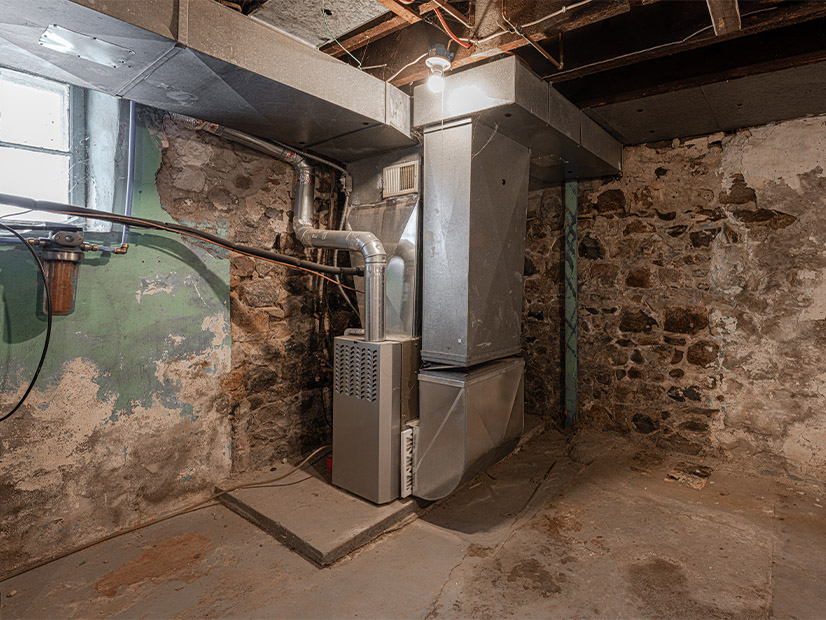
Non-condensing furnace or water heaters burn gas to heat air or water, and then the rest of the heated gas not used for the appliance is transferred out of the building via a chimney. Condensing units have a second powered heat exchanger that captures the excess heat, turns it into condensed water vapor and then transfers the cooler air out through a vent or the water through a drain.
“This added heat exchanger makes the condensing appliance more efficient overall as compared to its non-condensing counterpart,” the court explained in its decision.
The issue of whether non-condensing technologies represented a performance feature that cannot be eliminated under DOE’s authority to set efficiency standards has ping-ponged since the Obama administration, until the department under President Joe Biden was able to issue a final rule in 2023 that was appealed.
The parties in the case were split over whether Congress wanted to protect attributes — such as venting mechanisms, installation factors and how much space appliances take up — from being regulated away via DOE’s efficiency rules.
“Petitioners contend that non-condensing appliances, which use unpowered venting like vertical chimneys, offer performance characteristics to consumers that condensing appliances do not,” the court said. “According to petitioners, condensing appliances are incompatible with venting systems like chimneys because condensing appliances require a fan to generate enough pressure to push or pull gases outside.”
Condensing units also require drains and cannot use the same vents as their non-condensing counterparts.
The court noted that the American Gas Association, one of the petitioners, had asked Congress in 1986 to make it so “conventional, atmospherically vented furnace” were not impacted by its amendments to the Energy Policy and Conservation Act (ECPA), which was being amended. Congress did not include AGA’s language.
“At a certain level, it is obvious that consumers do not buy small furnaces or commercial water heaters because of how the appliance vents,” the court said. “In fact, venting is a quality that both condensing and non-condensing appliances share. It ‘is one of the basic components found in every gas-fired furnace.’”
The panel’s majority said the dissent, by Judge Neomi Rao, overlooked that aspect by claiming some consumers will be deprived of gas-powered appliances entirely. They will still have access to gas-fired condensing units, it said.
Rao argued that consumers under the standard could be forced to install a condensing model that often requires disruptive and expensive renovations to a building’s venting and plumbing systems.
“These standards run afoul of the careful balance Congress struck in the Energy Policy and Conservation Act between improving energy efficiency and preserving consumer choice,” Rao said. “While EPCA empowers the department to set efficiency standards, the statute also imposes a critical limit on that authority. The agency is prohibited from imposing an efficiency standard that will result in the ‘unavailability’ of a product with a ‘performance characteristic’ that consumers value.”
Many older homes and buildings only have a traditional chimney available for furnaces and water heaters, making a performance characteristic under the ECPA, she wrote.
In response to the ruling, the AGA, American Public Gas Association and National Propane Gas Association noted 55% of residential gas customers use non-condenser appliances.
“The D.C. Circuit Court failed the American people today, making a decision that removes choice and could force up to 55% of gas households into expensive home renovations and higher energy bills,” AGA President Karen Harbert said in a statement. “Longstanding U.S. law does not support this conclusion, and we strongly disagree with this decision. America’s natural gas industry will continue to fight to protect American consumers’ right to choose their appliances and energy sources.”
Efficiency advocates welcomed the court’s decision, which they said preserves the federal standards set to take effect in 2028 and are expected to save consumers $350 per unit over their lifetimes. The standards mandate furnaces that use 15% less energy than the least efficient models available today, and Canada has had a similar standard in effect since 2010, the Appliance Standards Awareness Project (ASAP) and the National Consumer Law Center said.
“This upholds long-awaited standards that will save households money on their heating bills while reducing pollution,” ASAP Executive Director Andrew deLaski said in a statement. “Ensuring new furnaces are more efficient may disappoint some gas utilities, but it’s a triumph for consumers.”