IESO will begin allowing corporate energy buyers to purchase power from off-site renewable generators next spring, giving loads another way to reduce their Global Adjustment (GA) charges.
The new policy will be effective for the 2026/27 base period (May 2026-April 2027) for determining loads’ GA charges.
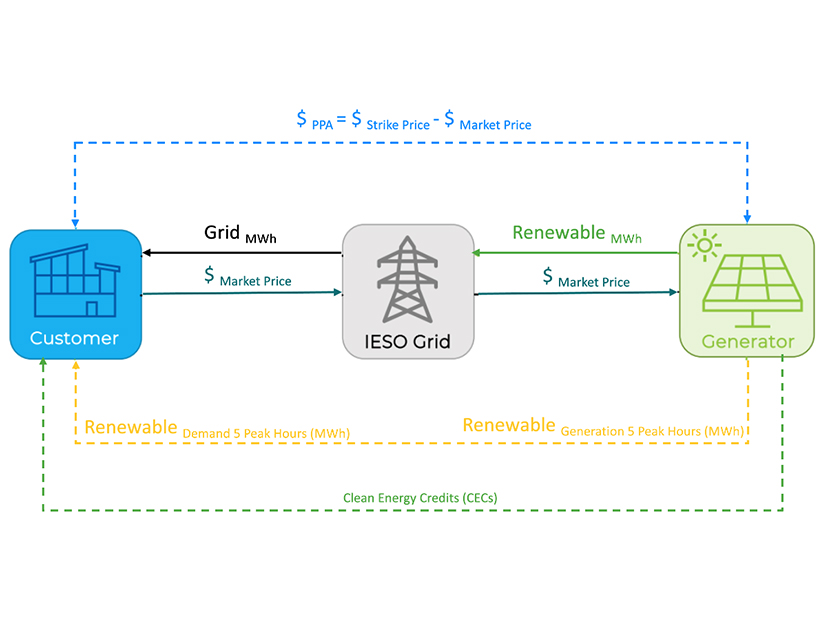
The C-PPA framework allows participants in the Industrial Conservation Initiative (ICI) to sign “virtual” power purchase agreements with renewable generators — defined as wind, water, biomass, biogas, biofuel, solar or geothermal — located anywhere in Ontario.
Before the June rule change by the Ministry of Energy and Mines (Regulation 429/04), the ICI program allowed only on-site PPAs, in which electricity is generated and consumed at the same location, behind the meter. ICI is designed to reduce large electricity users’ consumption during peak hours.
The revised regulation will help large consumers reduce their electricity costs and meet clean energy goals, while providing an additional revenue source for generators and supporting new generation investment, IESO said in an engagement session outlining the program Nov. 4.
Potential Global Adjustment Savings
C-PPAs handle financial settlements separately from the physical delivery of electricity, with the generator’s output offsetting the consumer’s demand during peak periods.
ICI participants that cut their usage during the top five peak hours over a 12-month base period (the peak demand factor) can significantly reduce their GA charges. The GA funds new grid infrastructure as well as maintenance and conservation programs.
Eligible Loads
ICI participants, called “Class A” customers, include:
-
- manufacturing and industrial loads, including greenhouses, with an average monthly maximum hourly demand between 500 kW and 1 MW;
- customers with an average monthly maximum hourly demand between 1 and 5 MW, which can opt in to the program; and
- customers with an average monthly maximum hourly demand greater than 5 MW, which are automatically entered into the ICI program unless they opt out.
Generator Eligibility
The program allows participation by generators and customers that are distribution-connected if they are registered as a market participant and settled in the IESO market.
New generation facilities are eligible to participate if they have a municipal resolution of support and are not located on Prime Agricultural Land.
C-PPA transactions must be settled through the IESO market.
‘Stacking’ OK
The new rules allow generating facilities and customers to “stack” multiple PPAs. But they limit the “eligible” electricity under the program to that which has not already been paid for or committed (“compensated” electricity), such as that procured through IESO contracts.
“The fundamental principle is that the regulation does not permit double recovery,” IESO’s Keigan Buck said. “A given unit of electricity can be either eligible electricity or compensated electricity. [It] cannot be both.”
‘Eligible’ Electricity
Generators must deliver to the IESO grid or distribution system “some volume” of eligible electricity in each hour of the base period without using temporary storage.
“Based on the IESO’s current interpretation, we understand the regulation’s requirement for generators to deliver … any non-zero amount of energy — essentially any volume above 0 MWh,” IESO spokesman Michael Dodsworth said.
The rules provide exceptions to the delivery requirement for facility outages, insufficient wind or sunlight, compliance with IESO dispatch instructions or circumstances beyond the generator’s control, such as delivery constraints.
Next Steps
IESO is accepting feedback until Nov. 18 at engagement@ieso.ca. It plans to post final documents on the program in December or January.
The C-PPA submission window opens Feb. 1, 2026, and closes March 30. Submissions must be sent by email to corporateppa@ieso.ca.
“We strongly encourage submitting early within the window, because some of the timelines are quite tight for approval of the documents, and it may require some back and forth between proponents and the IESO,” the ISO’s Greg Moore said.