New York is adding new leadership to its advanced nuclear energy initiative: Todd Josifovski, director of the $13 billion overhaul of an Ontario nuclear power facility, and Christopher Hanson, who chaired the U.S. Nuclear Regulatory Commission during the Biden administration.
The New York Power Authority announced the appointments Dec. 1.
Josifovski will become NYPA’s senior vice president of nuclear energy development Jan. 1. Hanson will serve as a senior consultant on financing and the federal permitting process.
New York Gov. Kathy Hochul (D) in June directed NYPA to develop at least 1 GW of new advanced nuclear generating capacity. (See N.Y. Pursuing Development of 1-GW Advanced Nuclear Facility.)
Popular acceptance of nuclear energy has increased in recent years, and President Donald Trump has ordered the federal regulatory process to be accelerated and streamlined, but the process of building a new commercial reactor remains potentially slow, expensive and complex. Josifovski and Hanson are expected to help New York with this.
Josifovski has worked in clean energy and nuclear power development for more than 20 years, including at Ontario Power Generation, where he was a senior manager and then director of the refurbishment of the four-unit Darlington Nuclear Power Station. That project is nearing completion at an expected cost of $13 billion CAD. Josifovski currently is vice president of development at Peak Power.
Hanson joined the NRC as a commissioner in 2020, during Trump’s first term, and served as chair from Jan. 20, 2021, to Jan. 20, 2025. He continued as a commissioner until Trump fired him June 13.
His NRC bio notes that he previously accrued three decades of public- and private-sector experience in the nuclear fuel sector.
NYPA President Justin Driscoll said Josifovski and Hanson would play important roles in moving the state’s nuclear initiative forward.
“Todd has managed the development and execution of more than 7 GW of clean energy and nuclear projects, and his approach integrates technical rigor with pragmatic risk management, stakeholder engagement and a strong commitment to operational excellence,” Driscoll said. “Additionally, Chris’ extensive experience on the federal level will prove invaluable to NYPA as we navigate this next chapter and form lasting partnerships that will deliver firm, emission-free generation for New York state.”
New York has a challenging path ahead as it tries to expand and upgrade its grid. Its renewable energy buildout was behind schedule even before Trump began his second term, and his policies are expected to further impede progress.
As a result, the aging fossil fleet that policymakers want to phase out remains indispensable: 25% of total statewide generating capacity is fossil-fired plants that are more than 50 years old.
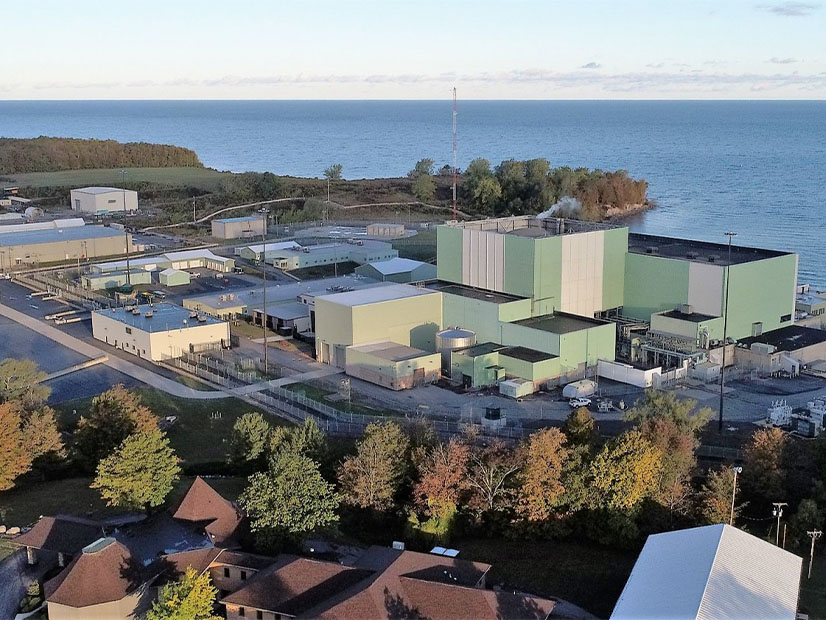
New York’s four commercial reactors — on the opposite shore of Lake Ontario from Darlington — are a combined 198 years old and draw half a billion dollars a year in ratepayer-funded subsidies to continue operation. The state expects to rely on their output into the middle of the century. Meanwhile, state policymakers expect to need more electricity as New York decarbonizes transportation and buildings.
The confluence of factors is such that NYISO opened its 2025-2034 Comprehensive Reliability Plan with this warning: “New York’s electric system faces an era of profound reliability challenges as resource retirements accelerate, economic development drives demand growth and project delays undermine confidence in future supply.”
The existing nuclear fleet provided 21% of the power produced in-state in 2024, NYISO said in the report issued Nov. 21; a scenario in which the four reactors are retired would create shortfalls in summer and larger shortfalls in winter.
The challenge facing NYPA — and now Josifovski and Hanson — is to move the advanced nuclear initiative forward not just quickly but safely and affordably, and with a politically acceptable siting mechanism.
NYPA has issued requests for information from potential developers and potential host communities on how best to do this. (See Wanted: N.Y. Community Eager to Host Nuclear Reactor.) Their responses are due Dec. 11.