ReliabilityFirst expects “normal risk” for the upcoming winter season thanks to positive developments across its territory, one of the regional entity’s engineers assured listeners during a webinar hosted by the organization.
Tim Fryfogle, RF’s principal engineer for resources, engineering and system performance, joined the Dec. 15 webinar to discuss the results of RF’s Winter Reliability Assessment, which the RE released Dec. 10 as a companion to NERC’s WRA.
The assessment is intended to provide a closer look at reliability risks in the RF footprint during the winter months of December through February, based on data from PJM and MISO; parts of both RTOs are in the RE’s service area.
NERC’s WRA found “pockets of elevated risk” across North America, indicating a “potential for insufficient operating reserves in above-normal conditions.”
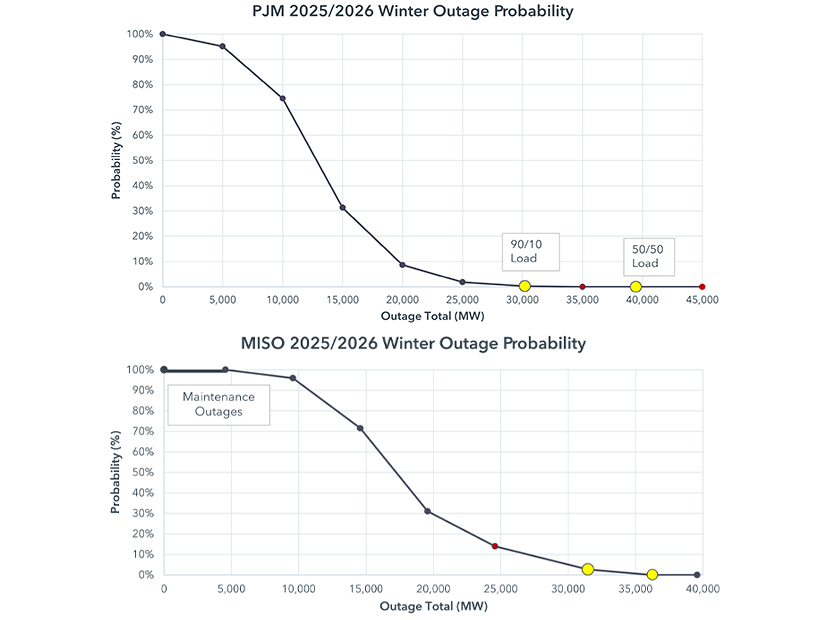
However, the WRA left PJM and MISO out of this group, assessing both areas under the “normal” classification. This means they possessed sufficient generating capacity to meet demand under both the ERO’s 50/50 load forecast, which denotes a 50% chance the actual load will be higher or lower than predicted, and the 90/10 forecast, meaning a 10% chance that the actual load is higher than predicted. (See NERC Winter Reliability Assessment Finds Many Regions Facing Elevated Risk.)
Fryfogle observed that RF’s assessment came to the same conclusion, despite using different analyses. Both assessments use the same data drawn from NERC’s Generating Availability Data System, which collects performance information from conventional, wind and solar plants.
The difference, Fryfogle said, is that RF’s analysis is based on historical GADS data covering December through February over a rolling five-year period, while NERC uses the average forced outages for weekdays in the same months over the past three years. Fryfogle did not describe either approach as superior but said the fact they reached similar conclusions is “a great way to provide some verification and validation with regards to the end result.”
Fryfogle observed that the assessment of MISO and PJM represents a significant change from last winter, when NERC’s WRA found both MISO and PJM faced elevated risk during extreme weather scenarios. He cited several reasons for the shift.
First, he pointed out that the 2024/25 winter risk determination factored in the impact of litigation over the Transco Regional Energy Access gas pipeline and potential constraints on its use. FERC’s reinstatement of the pipeline’s certification allowed the risk to be downgraded, Fryfogle said. Second, since last year’s assessment MISO has implemented a seasonal resource adequacy construct and unit accreditation, allowing the region to better assess resource availability.
The changes mean PJM has a less than 1% chance of being unable to serve load even in the 90/10 scenario, Fryfogle said, while MISO’s likelihood of being unable to serve its load under the same conditions is about 3%. However, he urged listeners to remain cautious because severe weather could develop quickly. He suggested utilities make use of resources such as RF’s winterization assistance visits. (See RF Presenter Plugs Winterization Assist Visits.)
“We have a great team that … will help you pinpoint any issues … but please continue to do your due diligence [and] please share best practices,” Fryfogle said. “We are continuously getting better, but that’s because of outreach, everyone sharing great ideas and thoughts on how to weather these cold winter storms.”