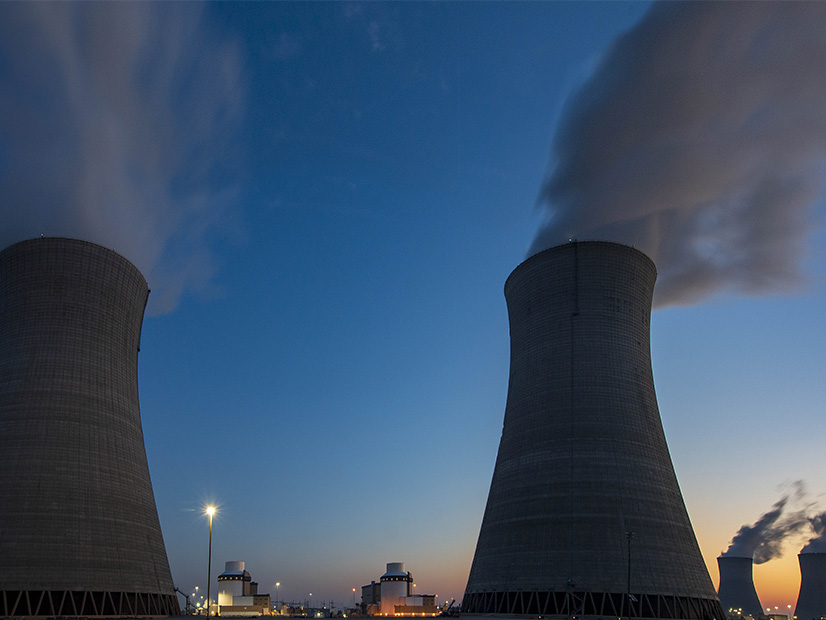
Commercial nuclear energy begins 2026 with strong momentum toward future expansion in the United States — “future” being the key word.
Restarts and uprates of existing nuclear plants notwithstanding, it will be years before new-build capacity comes online and possibly a decade or more before a significant amount of new gigawatts is added to the grid.
But 2025 was marked by a continual stream of announcements of technological advances and new offtake agreements for the power to be produced by future reactors employing those new technologies.
President Donald Trump jumped in with both feet as well, ordering regulatory streamlining to get new reactors built faster and setting aspirational goals for a nuclear generation buildout the likes of which the world has never seen.
The limited amount of nuclear construction attempted in the U.S. over the past three decades has been a train wreck of delays and cost overruns, but that has been due in no small measure to how few civilian reactors were being built in this country.
The expectation and hope now is that enough new reactors will be built that economies of scale and standardization can develop, bringing the levelized cost of nuclear power down to a point where it is a viable option for helping meet the expected surge in demand for electricity.
And there is even some hope of harnessing a unicorn that has eluded so many scientists and engineers for so long: commercially viable fusion power.
But much progress still needs to be made, particularly with the first wave of small modular reactors (SMRs) that are not merely next-generation versions of the large light-water reactors that make up the present-day U.S. fleet.
“2026 is too early for things to fully come to fruition,” said utility consultant Yavuz Arik of energytools. “I mean, we have still a long way to go to deployment of some of the new SMR technologies.”
But Arik said progress will be steady and significant in 2026.
“I think President Trump has set a lot of interesting things, great movements, in place. The regulatory oversight part has been expedited now. In my opinion, that doesn’t mean that we’re foregoing safety.”
He agrees with the urgency Trump has attached to new nuclear.
“Right now, we have a national priority that we need power and we need clean power. We can go dig for more coal and gas, but we need to get ahead of the curve, and we’re running behind both the Chinese and the Russians in many ways.”
Exhibit A in any discussion of slow and expensive nuclear construction is the expansion of Plant Vogtle in Georgia, but what often is overshadowed by the stunning price tag is the fact the project was in some ways a first of a kind, which almost always is more complicated and/or expensive than follow-up efforts.
Brattle Group principal Samuel Newell said the potential exists for the U.S. to move forward from Vogtle at lower cost and higher speed with subsequent projects using the same Westinghouse AP1000 reactor, eventually reaching Nth of a kind speed and economy.

“You can build on what we learned from Vogtle with an AP1000,” he said. “That has basically a complete design that now would be done before starting construction, which was one of the problems with Vogtle. We know how those plants work; there’s very little risk that it wouldn’t operate. … So we’re a little further along with that.”
Next-generation SMRs present a different set of issues. Designs such as the GE Vernova Hitachi BWRX-300 — the first SMR being deployed in North America — are smaller, more advanced versions of large-scale boiling water reactors. This could reduce the number of “first of a kind” factors.
But other SMR designs are starting with more unknowns and greater risks.
“They have even less developed supply chains, and really less developed supply chains for fuel,” Newell said, but added that he’s optimistic some of the dozens of SMR designs being pursued will reach widespread adoption.
“I hope this country pursues several of them and learns if some of them eventually make the most sense,” said Newell, who leads more than 50 electricity-focused consultants at Brattle. “But even if we do, Nth of a kind would still be the 2040s before we have them at any really substantial scale.”
Alexander Heil, a senior economist with The Conference Board, said there is some urgency to the effort: The existing fleet is decades old. The wave of retirements of functional but not economic reactors has halted, and the Nuclear Regulatory Commission signed off repeatedly in 2025 on extensions of operating licenses, but nothing lasts forever.

“On average they’re 40 years old,” Heil said. “You can probably stretch into 60 in terms of permit and design life. But that also means we do the math on this stuff, that in the next generation, without any serious additions, the U.S. is going to be out of the nuclear business. What currently still makes up 20% of the grid is going to be rapidly declining.”
Heil believes in the statistical safety of nuclear power, even having lived through a three-month stay-at-home order after the Chernobyl disaster. What concerns him more is the prospect of hundreds of new nuclear waste dumps around a nation that lacks a central repository for material that will remain dangerous for millennia to come.
Heil also is skeptical that nuclear generation will reach a point of speedy and economical construction and achieve a true renaissance.
“I just don’t see, in practical terms, how this is really going to happen at the scale that we would want this to happen if it’s supposed to be replacing what’s currently on the grid,” he said.
The “modular” in “small modular reactor” is the reason why many people are pinning such high expectations on SMRs: If they can be constructed on-site in serial fashion, or even factory-built and shipped to the site in containers, they should be able to achieve great economy of scale.
That does not address other potential stumbling blocks facing SMRs, notably fuel supply, but it should help reduce the cost and increase the speed of nuclear buildout.
But which SMRs?
The third edition of the Nuclear Energy Agency’s SMR Dashboard in July analyzed 74 SMR designs; 27 of the companies behind them are headquartered in the U.S. — more than in the next four countries combined.
Arik flagged X-energy’s Xe-100 design as one to watch in the crowded landscape. Along with electricity, it can produce industrial heat, and it has a high burn-up fuel cycle with less waste generated than earlier technologies.
“It’s probably going to go maybe 700 Celsius,” he said. “When you go that high, you can do a lot of industrial use heat as heat, and that provides a big advantage, too, because you’re not converting heat to electricity and then using electricity, you’re using heat as heat. And for X-energy’s design, it’s an 80-MW electric but 200-MW heat for each reactor.”
X-energy in November announced the start of above-ground construction of the nation’s first advanced nuclear fuel fabrication facility. The company is pursuing construction of a four-reactor complex that will provide electricity and industrial steam to a Dow plant in Texas and up to a dozen reactors in Washington state through an agreement with Amazon, an investor in X-energy.
Arik also is watching TerraPower. At 345 MW, its Natrium reactor is too big to meet the classic definition of an SMR — 300 MW or less per unit.
It instead is a small advanced reactor. It is sodium-cooled, which Arik noted has been proved to work, and it doubles as energy storage: The molten salt can provide gigawatt-scale backup to grids with a high percentage of intermittent renewable generation.
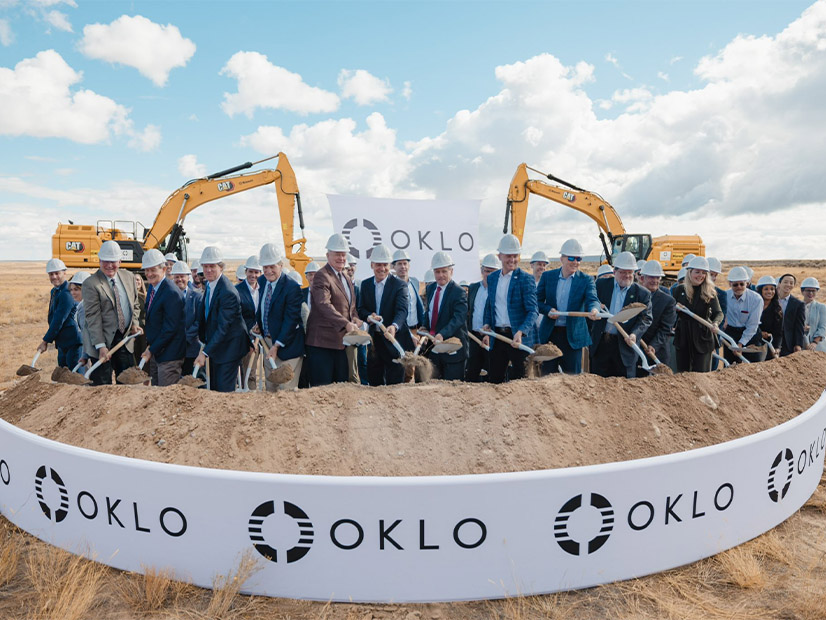
In March 2024, TerraPower was the first developer to submit a construction permit application for a commercial advanced reactor to the NRC. Later that year, it began site work for a Natrium demonstration project in Wyoming.
NRC in December 2025 completed its safety review, concluding there were no safety concerns that would preclude issuance of the construction permit. Further deliberations and review are needed, but NRC is trying to expedite such processes.
Arik expects it to come together.
“Now, there have been trials when you try to do [sodium cooling] bigger and bigger, then you get into different problems,” he said. “But TerraPower is trying to do it at this right size, this 345 MW, which I think they’re going to succeed at.”
Then comes the important part, not just for TerraPower and X-energy but the nuclear industry as a whole: Getting the first of a kind built, fine-tuning it and moving toward Nth of a kind.
“Once we get to mass production, we’re going to be able to turn out things much, much faster, and the U.S. is great at that,” Arik said. “So, I’m confident that things are going to get really faster, like we’re going to wrap this up within three years, once that design is set in stone.”