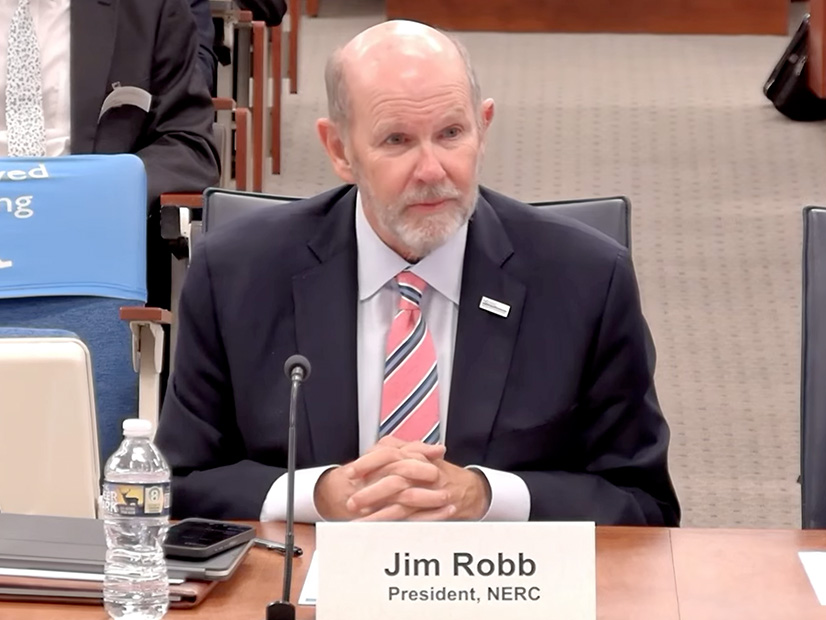
As 2025 dawned, the way ahead for NERC’s management seemed clear.
The ERO’s most recent three-year plan was set to expire in December, and NERC was set to develop a new one to begin in 2026 and carry the organization through 2028. But as the planning process got underway, ERO leaders began to realize the challenge they faced.
NERC was wrapping up the Interregional Transfer Capability Study, an unprecedented continent-wide examination of the transmission system with the potential to change how the ERO conducted reliability assessments. The second Trump administration had sowed major confusion about trade policy and other issues. The ERO’s Board of Trustees kicked off a review of the standards development process that wouldn’t be finished until February 2026. Multiple issues appeared to be in flux, a difficult environment for long-term plans.
With all this uncertainty in mind, NERC management decided that following through with the original goal would be “a fool’s mission,” as CEO Jim Robb told stakeholders in a May 21 webinar. (See 2026 to be ‘Bridge Year’ for NERC Budget.)
Instead, Robb and other executives agreed to treat 2026 as “a bridge year” in NERC’s budget and come back a year later to create a new three-year plan that would guide the ERO from 2027-2029.
Looking back on this decision near the end of 2025, Robb said he still believed it was the right call. The delay allowed NERC to get “a little bit more clarity on how we can make the most important difference possible” in the challenges facing the reliability landscape.
“We were just very early in our exploration of [large loads]. We’ve got a much clearer view now than we did a year ago,” Robb said. “Reliability assessments, same thing. … Gas-electric [coordination], I think we’re seeing a lot more progress than we would have guessed a year ago. So while there’s still a lot of uncertainty in the environment, I think a lot of it has resolved well enough for us to do a more thoughtful plan than we would have put in place [this] year.”
Cybersecurity Remains a Major Concern
In conversations with ERO Insider, Robb and other NERC managers described the organization as well-positioned to meet the year ahead, having overcome the uncertainty that characterized early 2025. One source of that ambiguity was the presidential transition, which left many crucial posts in government open — including the director of the Department of Homeland Security’s Cybersecurity and Infrastructure Security Agency.
Nearly a year after the inauguration, CISA still lacks a Senate-confirmed head. The agency has been led by Deputy Director Madhu Gottumukkala since his appointment in May 2025. President Donald Trump nominated Sean Plankey, formerly of the Department of Energy’s Office of Cybersecurity, Energy Security and Emergency Response, to head the agency shortly after taking office, but his nomination has stalled amid holds placed by multiple senators.
More disruption came during the 43-day government shutdown, accompanied by the expiration of the Cybersecurity Information Sharing Act of 2015 (CISA 2015), which set requirements for cybersecurity information sharing by the federal government and provided liability protections for voluntary information-sharing by private entities.
CISA’s operations were restored on Nov. 12 when Trump signed a continuing resolution that also renewed CISA 2015 through Jan. 30, 2026, but the episode sparked fears about the continuity of the federal government’s role in the cybersecurity ecosystem. (See Stakeholders Urge Cyber Info Sharing Act Renewal.)
Michael Ball, CEO of the Electricity Information Sharing and Analysis Center, acknowledged the turmoil of the past year and the concerns it created among stakeholders. However, he said that, despite outward appearances, the connection between the government and the ERO, including the E-ISAC, remains strong.
“There is a lot of concern about what that [relationship] looks like down the road. I can say with a lot of confidence, at least from the lens that I have, that we haven’t seen that really degrade,” Ball said. “We have great contacts within the different agencies. The changes haven’t degraded the objective and the goal.”
“Where my concern would be is the degradation over time in that [commitment], and my optimism [there] is pretty high,” he continued. “We know that when there’s administration changes, there tends to be [a shift] without stakeholders that we work through, and they tend to reconstitute and sometimes create new opportunities.”
Cybersecurity remains a critical focus for NERC and the E-ISAC in 2026. As Russia’s conflict with Ukraine continues, tensions between China and Taiwan intensify and other nation-state actors like North Korea and Iran jockey for advantage, the chance increases that those rivals will try to advance their interests by damaging U.S. infrastructure. Groups believed to be affiliated with China are known to have infiltrated U.S. telecommunications networks, and as they gain experience and confidence the threat is only expected to grow.
Risks also remain from straightforward criminal actors employing ransomware and other tactics to gain financial benefit. Ball said the growth of generative artificial intelligence is “enabling amazing capabilities, even for what would have been less sophisticated threat actors” to conduct social engineering campaigns and gain access to utilities’ computer networks. These criminals are further fueled by an industry that has grown up to market malware, information and other cybercrime tools.
“The bad guys are bad, but they’re not dumb. They’re very, very capable … well-financed and well-resourced, and persistent — you can’t let your guard down once, because they’ll [be] there to take advantage of it,” Robb said.
Standards Modernization, Large Loads Efforts to Continue
Cybersecurity is far from the ERO’s only iron in the fire; NERC has multiple efforts underway that are expected to hit milestones in 2026. One of the most prominent of these is the Modernization of Standards Processes and Procedures Task Force, which the ERO stood up following a directive from the Board of Trustees in February 2025.
NERC’s board started the MSPPTF to examine the ERO’s standards development process after trustees twice invoked their authority under Section 321 of NERC’s Rules of Procedure to break voting impasses over proposed standards that put NERC at risk of breaking a FERC deadline. Chair Suzanne Keenan urged the task force’s leaders to make sure the process remains “stakeholder-based, with reasonable notice, opportunity for public comment, due process [and] openness.” (See NERC Leaders Highlight Canada-US Collaboration.)
NERC has called the resulting work one of the biggest outreach efforts in the ERO’s history, with presentations reaching more than 5,000 stakeholders over the last year. The task force is expected to deliver its final recommendations at the board’s February meeting in Savannah, Ga. NERC will then work on updates to the ROP, which must be submitted to FERC for approval.
“We’re still quite a ways away from implementation of a new process, but the team did a great job in living up to what we asked them to do,” Robb said. “It hasn’t been a smoke-filled room; there’s been a lot of engagement, and … the task force has taken what they heard in those engagements and used it to make the process better [and] more palatable. … So [we’re] very pleased with that.”
Large loads are expected to be another major area of focus for the ERO in 2026. NERC’s Large Loads Task Force has been operating since 2024 to study the impacts of data centers, hydrogen fuel plants and other emerging large loads on grid reliability, along with multiple simultaneous other efforts.
The organization also issued a Level 2 alert in September 2025. The alert provided recommendations for registered entities to mitigate risks associated with integration of large loads into the grid while requiring responses to a series of questions on their experience with large loads, their understanding of the risks associated with large loads and their current efforts to address those risks. Responses to the alert are due Jan. 28, 2026.
Robb described the ERO’s large loads work as “doing stuff in parallel that we would normally do in sequence.” Along with the LLTF and the Level 2 alert, NERC is developing a reliability guideline on risk mitigation with emerging large loads and recently commented on an Advance Notice of Proposed Rulemaking at FERC discussing potential changes to NERC’s registry criteria and standards actions on large loads.
“We won’t get ahead of our skis, but we’re going to be prepared to move as quickly as we can on each of these initiatives,” Robb said.
Changes to LTRA Process
NERC will be carrying out its plans at a time when the ERO receives a growing amount of attention from lawmakers and the general public. As a sign of how NERC’s profile has grown, Robb observed that at a 2024 meeting of the Senate Energy and Natural Resources Committee, both Chair Joe Manchin (I-W.Va.) and ranking member John Barrasso (R-Wyo.) used maps produced for NERC’s reliability assessments. The CEO also mentioned a recent appearance on NBC’s Today to speak about risks facing the energy grid.
“The CEO of NERC’s not supposed to be on the Today show. Just think about that — that the stuff that we’re doing is reaching a mainstream audience, not just the nerds in the corner planning the electric grid,” Robb said. “People are paying attention, and they’re using our materials to inform decisions.”
The increased attention to NERC’s assessments forms part of the backdrop for the ERO’s work to update its reliability assessments, particularly the Long-Term Reliability Assessment, which is published each year. The 2025 LTRA is due in January.
John Moura, NERC’s director of reliability assessments, said ongoing changes in the electric grid — including rapid shifts from traditional generation to inverter-based resources like wind and solar, along with the growth of large loads — meant the ERO’s previous approach to the LTRA was no longer valid. He described the former approach as “very much … ground-up,” involving collecting data directly from utilities which the ERO would “piece together at the end.”
Moura said recent experiences have demonstrated that “each system is more reliant on neighbors than we ever have been in the past … and so coming together earlier on in the process to make sure assumptions and scenarios and base cases are … modeled in unison [is] essential.” NERC began a pilot program in 2025 to establish common platforms and standardized assumptions for the Eastern, Western and Texas interconnections, enabling interconnection-wide energy assessments.
That effort has been productive, Moura said, although not ready to be used in the 2025 LTRA. He explained that the Interregional Transfer Capability Study, filed with FERC in 2024 in accordance with a mandate in the Fiscal Responsibility Act of 2023, provided a “foundation” for the wide-area assessments by pushing NERC to develop tools and processes for information gathering and storage that could then be used for the LTRA.
“The ITCS gave us that step change. It kind of elevated our capability,” Moura said. “If we had not had the ITCS … we would have [eventually] said, ‘Wait, we need to understand the interregional transfer capability between the regions.’ … But the ITCS actually gave us a step change up … allowing us now to do things in a simultaneous manner.”
The most important task for NERC in the coming years, Robb said, will be to preserve its reputation for independence and fact-based analysis, and to avoid any perception of favoring one side or another in the increasingly polarized political climate.
“We’ve had as good a conversation with the current committees of jurisdiction in the House and Senate that we would have had two years ago, [and] our relationship with DOE is as strong today as it was two years ago, because we’re not partisan,” Robb said. “We’re kind of the truth tellers. And while not everybody likes what we have to say, they at least respect it and pull it into their own thinking. I think that’s really important … that we don’t let ourselves ever be turned into a tool or start telling people what they want to hear, because once we do that, we’ve lost our power.”