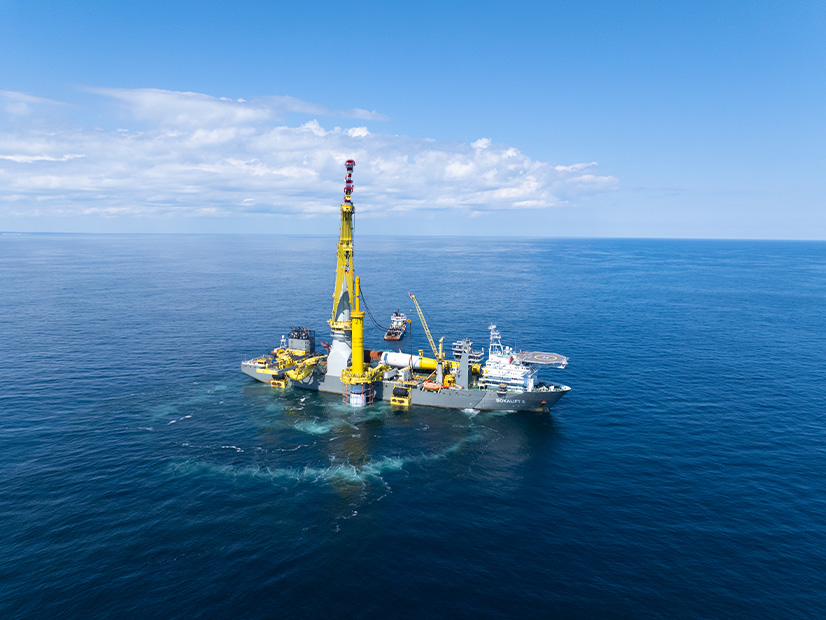
Three of the four developers building wind farms in U.S. waters are challenging the Trump administration’s Dec. 22 order suspending all such construction.
Some light soon may be shed on the reasoning for the stop-work order, although not publicly: The federal government said it should, during the week of Jan. 5, be able to provide classified information bearing “secret” or higher classification to a judge hearing the first of the challenges.
Coastal Virginia Offshore Wind (CVOW) developer Dominion Energy sought a preliminary injunction Dec. 23 in U.S. District Court for the Eastern District of Virginia.
Revolution Wind, a joint venture of Skyborn Renewables and Ørsted, challenged the suspension Jan. 1 in U.S. District Court for the District of Columbia.
Empire Wind developer Equinor challenged the suspension on Jan. 2, also in U.S. District Court for the District of Columbia.
Avangrid and Copenhagen Infrastructure Partners have not announced any response to the suspension of Vineyard Wind 1, which is in late stages of construction and already generating power with some of its turbines.
The only other wind farm being built in U.S. waters is Sunrise Wind, which is in earlier stages of construction. Developer Ørsted said it is considering its options for how to respond to the Sunrise suspension.
The direction of the greatly diminished U.S. offshore wind sector rides on these challenges, as no other projects appear likely to start construction during the Trump administration.
After 11 months of actively working to thwart offshore wind development, the Trump administration paused all offshore wind leases Dec. 22 on national security grounds, saying the towers and spinning blades interfere with military radar. (See All U.S. Offshore Wind Construction Halted.)
The Department of the Interior said the pause would give all relevant government agencies time to work with the leaseholders and state governments to mitigate those risks.
But the pause also will cause the developers to incur millions of dollars in unbudgeted expenses per day.
Dominion was first in line to fight back.
It said it has spent $8.9 billion of CVOW’s projected $11.2 billion cost to date and already begun recovering that money from ratepayers. It called the order by the U.S. Bureau of Ocean Energy Management arbitrary and illegal, as well as inconsistent with BOEM’s previous actions during its “extraordinarily thorough” reviews of the CVOW proposal during a yearslong permitting process.
Interior indicated its Dec. 22 pause came in response to a situation that evolved after the BOEM permitting and said some of the explanation for this was classified.
Judge Jamar Walker on Dec. 28 converted Dominion’s request for a temporary restraining order to a motion for a preliminary injunction and set a Jan. 16 hearing on the motion. He gave Interior until Jan. 9 to provide the classified information that he called critical to evaluating the case.
‘Patently Unlawful’
The complaint filed Jan. 1 by Revolution Wind is another chapter in its running battle with Interior over the stop-work order the department had slapped on it Aug. 22.
Judge Royce Lamberth ordered that stop-work order lifted Sept. 22, and Revolution is asking him to do the same with the Dec. 22 order, saying it too is “patently unlawful” and violates the Administrative Procedure Act (APA), the Outer Continental Shelf Lands Act (OCSLA) and the U.S. Constitution.
In its news release, Ørsted said Revolution is 87% complete, with 58 of 65 turbines installed. It had been set to start generating power later in January.
The Danish company said Aug. 25 that total investment in Revolution and Sunrise was expected to be approximately $15.6 billion.
Empire Wind also is a two-time target of the Trump administration, which slapped a stop-work order on it in April but lifted it a month later without court intervention.
Empire said in its Jan. 2 filing that the April stop-work order cost it $200 million in delay costs and drove the project to the brink of cancellation. It said this new stop-work order likely will result in project cancellation if it lasts 90 days — the developer cannot draw down on construction financing and the complex, highly choreographed schedule would be thrown off.
Empire said the project is approximately 60% complete at a cost of more than $4 billion so far, $1.5 billion of it since the April stop-work order was lifted.
Empire asks the court to vacate the suspension and to declare it unlawful, arbitrary and capricious, an abuse of discretion, and a violation of APA and OCSLA. It seeks a preliminary injunction as the case proceeds through the legal system.