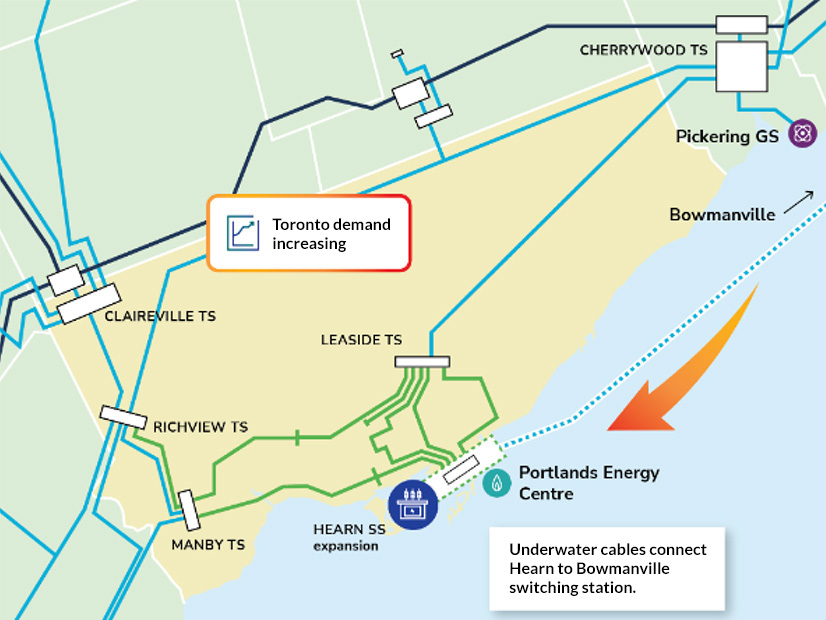
Ontario has approved IESO’s proposed $1.5 billion HVDC line under Lake Ontario, which planners say is needed to meet a potential doubling of Toronto’s electricity demand by 2050.
IESO recommended the 65-kilometer, 900-MW line in September, saying it would be more “future proof” than two cheaper options. (See Planners Pick $1.5B Underwater HVDC Line for Toronto’s ‘Third Supply’.)
IESO says Toronto’s electricity demand could increase 70 to 100% by 2044 due to new housing and commercial development, data centers and electrification of heating and transportation.
Electricity demand is expected to exceed the capacity of the two transmission lines currently supplying Toronto — from Manby Transmission Station (TS) west of the city and Leaside TS from the east — creating a “reliability need” by 2038. Closure of the 550-MW gas-fired Portlands Energy Centre (PEC) would create that need by 2034.
“Without a new transmission line, Toronto would have to turn down job-creating investments and reduce housing, which is simply unacceptable,” Minister of Energy and Mines Stephen Lecce said in a statement announcing the line’s approval.
The ministry said the new line between the Darlington transmission station and downtown Toronto also will support the province’s plans to refurbish the Darlington Nuclear Generating Station and build the first small modular reactors in the G7, the Darlington New Nuclear Project.
1st Competitive Transmission Procurement
The ministry said it will take seven to 10 years to design, construct and energize the line.
The government asked IESO to select the builder of the line through what would be the grid operator’s first competitive transmission procurement. In July, IESO opened enrollment in its Transmitter Selection Framework Registry, a prequalification mechanism for future procurements. (See IESO Removes Credit Requirement for Transmission Registry.)
The underwater line was one of three options planners considered for Toronto’s “Third Supply,” including an overland route from Cherrywood TS to Leaside TS in Toronto, estimated at $800 million, and a hybrid of overland and underground segments from Cherrywood TS to the Port Lands in Toronto, estimated at $900 million.
IESO said the underwater cable is “the most future proof” option, supporting forecasted demand beyond 2044.
The ministry said an underwater line also would be less vulnerable to flooding and ice storms that have resulted in outages and more than $100 million in costs and lost productivity. The line also would save $100 million to $300 million in bulk system reinforcements elsewhere in the Greater Toronto Area, the ministry said.
The HVDC line from Bowmanville to the Port Lands in downtown Toronto would require expansion of the Hearn station in the Port Lands.
Reaction
Toronto Mayor Olivia Chow lauded the approval of the new line. “Toronto is the fastest-growing city in North America, and that growth means we need more power to fuel our homes, transit and businesses,” she said.
Scott Andison, CEO of the Ontario Home Builders’ Association, said the new line is essential to addressing the region’s need for new housing. “Communities across Ontario are approaching real electricity capacity constraints, and without new transmission investments, the ability to deliver housing at scale will be compromised,” he said.
“By securing Toronto’s future as a global economic hub and creating good-paying jobs and opportunities for suppliers and service providers throughout Ontario, this initiative delivers benefits far beyond the city’s core,” said Stephanie Crilly, executive director of the Economic Developers Council of Ontario.
Some climate activists, however, have criticized IESO for not adequately considering non-wires alternatives to meet the city’s needs.
“It is premature to consider a third line which would further tie Toronto to a nuclear future,” wrote members of Toronto East Residents for Renewable Energy in September. “Before a decision is made by Toronto City Council, IESO or the province, there must be an evidence-based examination of ALL of Toronto’s options, including energy efficiency investments, commercial and institutional demand response, rooftop and parking lot solar generation, energy storage, and wind power.”
The group also called for consideration of an alternative third line that would bring power from an offshore wind farm.
The new line was included in IESO’s Integrated Regional Resource Plan (IRRP) for Toronto, which several environmental groups have criticized for ignoring Toronto City Council’s call for closing the Portlands Energy Centre by 2035 and achieving net-zero emissions by 2040.
“The IESO’s proposal takes the city in the opposite direction,” the groups, including Environmental Defence Canada and the Ontario Clean Air Alliance, said in November. “Instead of investing in local, renewable solutions such as energy efficiency, rooftop and community solar and offshore wind, the plan entrenches reliance on centralized gas and nuclear power, keeping Toronto tied to outdated, high-cost energy sources that delay real climate action and local job creation.”
In addition to the third line, the IRRP recommends battery energy storage systems and incremental electricity demand side management, including residential solar/storage systems. “With or without the supply contributions from PEC, meeting the significant need identified for eastern Toronto due to the significant forecasted growth requires a large-scale wires solution,” the ISO said.