SPP says it is pursuing inter-market optimization of energy transfers between its two Western Interconnection markets, mirroring a process it has developed in its existing RTO footprint.
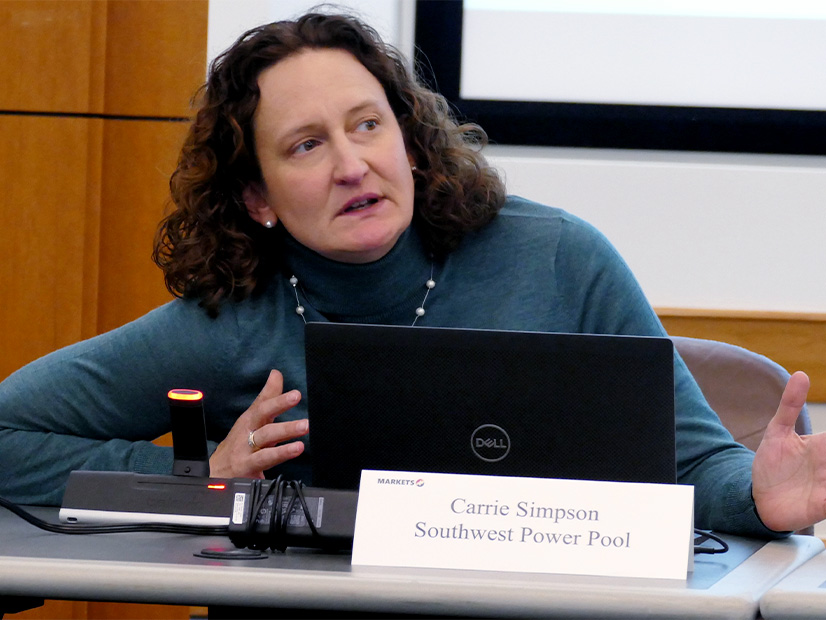
Carrie Simpson, the grid operator’s vice president of markets, told Markets+ leadership and stakeholders Jan. 6 that staff are working on a solution that could provide an automatic, coordinated real-time market-clearing process that would initiate energy transfers between the two markets.
“There’s nothing like it that I’m aware of,” Simpson said during a conference call with the Interim Markets+ Independent Panel (IMIP). “It’s something that we’ve been researching and there’s different levels of it. It’s not going to be full blown intra-market optimization, but we see it as a helpful step forward that will help both Markets+ and the RTO footprint in the West.”
SPP published an analysis paper in 2025 on its study of a potential inter-market optimization (IMO) framework with MISO. The study found the more efficient use of the existing transmission system components and decreased production costs could reduce operating costs by about $20 million per year.
Simpson said SPP is targeting IMO’s deployment in the West in October 2028, one year after Markets+ is to begin operations.
The grid operator’s RTO expansion (RTOE) into the Western Interconnection is on track to go live April 1, 2026. When it does, Xcel Energy’s Public Service Company of Colorado, a Markets+ participant, will find itself surrounded by RTOE members.
Simpson said Western utilities will have opportunities to import and export from the RTO, using dispatchable transactions and other methods to buy and sell. When Markets+ is live in 2027, both markets will be able to take import and exports “pursuant to their respective rules.”
SPP staff already have begun RTOE’s congestion-hedging process, Simpson said. When the market is fully operating, SPP’s current Western Energy Imbalance Service market will cease operations and its members join the RTO or work toward other markets, “Like Markets+,” she said.
“It’s a really big deal that Markets+ and RTO Expansion are allowing economic dispatch of imports and exports at the borders,” said The Energy Authority’s Laura Trolese, who chairs the Markets+ Participant Executive Committee guiding the market’s development. “We are hoping that with CAISO and [its Extended Day-ahead Market], we can also get to a place where there can be economic, and not just fixed or self-scheduled, transactions. I think that’s an important aspect that will help allow those transfers to be optimized and more efficient.”
IMIP Approves Protocols, Tariff Revisions
During the call, the IMIP approved the first version of Markets+ protocols developed by stakeholders and SPP staff and approved by the MPEC in December. (See Markets+ Stakeholders Approve Baseline Protocols.)
The protocols’ first version will provide the operational framework needed to implement the market’s tariff and establish a baseline for implementation. Future refinements will be made through the normal stakeholder processes.
IMIP approved 32 tariff cleanup items recommended by MPEC. The revisions address minor grammatical updates, clarify defined terms and align language with the protocols to ensure consistency and readability. The revisions don’t modify the market design or operations.
The committee also approved four other revisions to the tariff, which were filed in 2024 and approved in early 2025:
-
- Establishing how SPP recovers the administrative and implementation costs necessary to operate Markets+ after staff executed finalized Phase 2 funding agreements.
- Updating boilerplate language outlining SPP’s responsibility to accurately calculate real-time balancing prices during system outages lasting more than 12 dispatch intervals.
- Aligning the tariff with the protocols in calculating local prices and settlements using mitigated offers to ensure fair outcomes within the isolated area. Flexibility reserve products are not cleared in an island, preventing costs for services that cannot provide systemwide reliability value.
- More definitively classifying when a market storage resource is self-charging in the day-ahead and real-time markets to settle any withdrawal that is considered self-charging as load.
Legal staff said the protocols and revisions will be filed with FERC within several months, once it’s determined there are no appeals to SPP’s Board of Directors. They will ask the commission for an effective date “well into the future.”
MSC Priorities for 2026
Arizona Commissioner Nick Myers, chair of the Markets+ State Commission, said Western regulators want to ensure they’re as “educated and as informed as possible on all matters Markets+” as the market’s 2027 go-live date approaches.
It’s part of the MSC’s priority to have commissioners and staff continue to engage and collaborate with stakeholders as they build the market’s design and systems. Myers said the committee’s members will work with WEIB and SPP to host various educational sessions on tariff review, greenhouse gas accounting and other issues.
The MSC, composed of Western state regulators, is increasing its staff capacity to maintain continuity as commissioners “come and go,” Myers said. He said this will compensate for regulators’ lack of experience with organized markets in the Western Interconnection.
“A lot of our commissions don’t have staff dedicated to do this kind of stuff and they don’t have any kind of foundation or backgrounds or anything like that,” Myers said. “We thought that it would be prudent to have some staff members that were able to come in and step in and maintain some continuity between those commissioners. Many of our staff have already kind of been following along, but this is a way to kind of get them more formally engaged.
The MSC will work with a larger budget in 2026 following IMIP’s approval of its $437,923 request. That’s a 12.4% increase from the 2025 budget of $389,680 that covered only the past nine months.
Attendance Capped for Seams Symposium
SPP staff said attendance has been capped and they are working off a wait list for its Feb. 26 Western Seams Symposium in Tempe, Ariz.
“So, packed house,” Simpson said. “It’s pretty exciting that there’s that much interest right now.”
She said the agenda is being developed but that the symposium will focus on education and the existing seams challenges in the West.
Markets+ stakeholders have developed a seams strategy and road map designed to identify focus areas for policies, and governing documents related to seams issues with neighboring areas. FERC in November 2025 published a policy paper urging SPP and CAISO to get ahead of seams issues before their Western markets go live in 2026 and 2027. (See FERC Report Urges West to Address Looming Market Seams Issues.)
“SPP and Markets+ sees a vision of mitigating those seams, managing and making them better,” Simpson said.