The task force developing recommendations for updating NERC’s standards development process is preparing to post its final recommendations for industry comments, the last opportunity for stakeholders to submit feedback before a formal presentation to the ERO’s Member Representatives Committee in February.
Leaders of the Modernization of Standards Processes and Procedures Task Force presented an overview of their recommendations at the MRC’s pre-meeting conference call Jan. 22. Task force Chair Greg Ford said the proposal would be posted on or before Jan. 26, with comments due by Feb. 5. The MRC will discuss the recommendations at its open meeting Feb. 12 in Savannah, Ga., with the Board of Trustees deciding what action to take, if any, at its open meeting the same day.
NERC leaders launched the MSPPTF in February 2025, saying the rapidly revolving risk environment has made it increasingly difficult for the ERO’s consensus-based standards development approach to keep up with new threats to grid reliability. (See NERC Leaders Highlight Canada-US Collaboration.) The challenge was put on display in late 2024, with the board invoking Section 321 of the ERO’s Rules of Procedure to shorten the normal process in order to meet a FERC deadline twice in less than six months. (See NERC Board Invokes Section 321 Authority for Cold Weather Standard.)
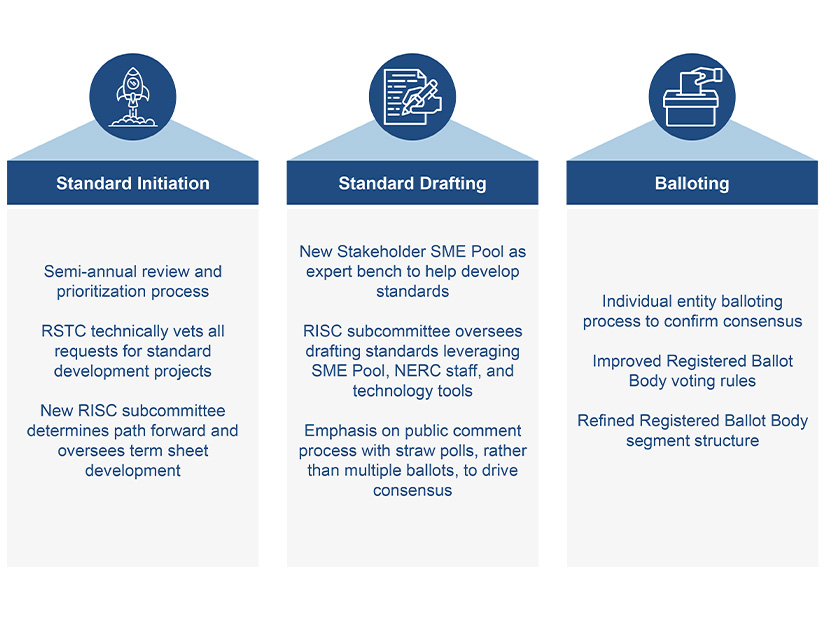
The task force’s final recommendations propose an overhaul of the standards drafting process, with changes across all stages of the development cycle and the addition of two new groups to help create new standards. Leaders presented the changes according to the phase of development to which they apply: standard initiation, standard drafting and balloting.
Per the proposal, the initiation process would now take the form of a review and prioritization process conducted by the Reliability and Security Technical Committee. Todd Lucas, the task force’s vice chair, said stakeholders would have the opportunity to submit standard initiation requests throughout the year. The RSTC would review requests twice a year and determine the appropriate action, which could mean creating a new standard or other steps like developing a nonbinding guideline or technical reference document.
If the RSTC determines that a new standard is needed, it would hand the proposal to a newly created subcommittee of the Reliability Issues Steering Committee. The subcommittee would consult with industry to determine a plan for development, and NERC staff would work with a newly created pool of on-staff subject matter experts to create a term sheet outlining the goals of the proposed standard, which would guide the standard development phase.
Lucas said the task force also envisioned a “fast track” process for urgent projects, such as a directive from FERC or the board. This process would bypass the general intake and review stages and begin with term sheet development. He emphasized stakeholders still would have the opportunity to provide comments and influence development in the standard drafting phase.
Ford took over the presentation of the standard drafting updates, which are intended to eliminate the multiple comment and ballot periods that are part of the current process. Under the MSPPTF proposal, NERC staff and the SME pool would develop a “version zero” draft standard to be taken up and modified by the project team, rather than requiring the team to write a new standard itself.
The project team would conduct informal industry outreach to shape the standard, then post their draft for stakeholder comment and a straw poll. Further revision periods would be followed by a confirmation ballot.
The task force’s proposals for the balloting stage would introduce new rules for the registered ballot body, including the consolidation of large and small electricity end users (Segment 7 and 8, respectively) into a single segment, and doing the same for segments 5 (electric generators) and 6 (electricity brokers, aggregators and marketers). Segment 10, regional entities, would be removed from the RBB entirely, while other segments would see their weighting in the ballot body revisited.
Ford expressed optimism the board will accept the MSPPTF’s recommendations and that NERC will be able to implement the proposal by the end of 2026.
“We’ve got to change the Rules of Procedure [and] Standard Processes Manual, [and] committee charters need to be worked on. … There’s a lot of opportunity for us, I’m sure, as we go through this process, but the focus is going to be on starting with [ROP] and then move forward on that as we go through the year,” Ford said.