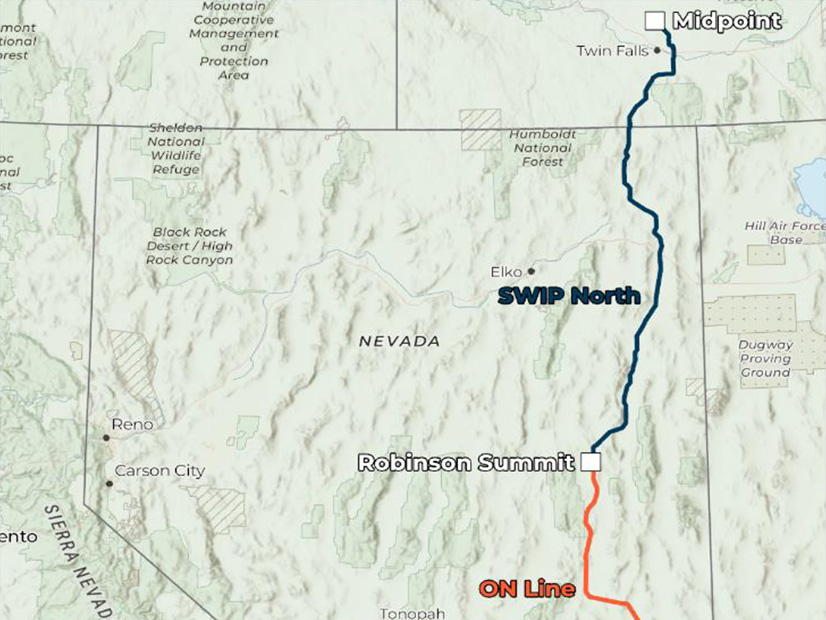
Nevada regulators approved a construction permit for the Southwest Intertie Project-North transmission line, keeping the project on track for a 2028 operation date.
The Public Utilities Commission of Nevada (PUCN) voted 3-0 on Jan. 27 to approve the permit for the project, also known as SWIP-North.
The 285-mile, 500-kV line is being developed by LS Power subsidiary Great Basin Transmission for an estimated $1 billion. It will run from the Robinson Summit substation in eastern Nevada to Idaho Power’s Midpoint substation near Twin Falls. Most of the line — 208 miles — will be in Nevada.
Mark Milburn, senior vice president of LS Power, said the PUCN permit is the final major approval needed for the transmission line.
“We continue to make steady progress on SWIP-North,” Milburn said in an emailed statement. “We plan to begin construction in 2026 and be placed in operation by 2028.”
SWIP-North is one piece of the larger Southwest Intertie Project corridor. At its southern end, SWIP-North will connect to the 231-mile One Nevada (ON) line that ends near Las Vegas. The ON line in turn connects to Desert Link, also known as the Harry Allen-to-Eldorado line, which ends at Southern California Edison’s Eldorado substation.
NV Energy will be entitled to free rights for about 1,000 MW of SWIP-North capacity, or roughly half, according to Great Basin’s November 2025 application to the PUCN. CAISO and Idaho Power will have rights to the remainder.
“NV Energy can use those capacity rights to access new generation resources, support more efficient network service operations, increase participation in Western Energy Imbalance Market (WEIM) transactions, or support wholesale wheeling transactions, which can generate additional revenue or offset current charges,” Great Basin said in the application.
The completion of SWIP-North also will increase the capacity of the ON line, which has been limited by northern Nevada’s 345-kV transmission system, Great Basin said.
The PUCN approval of the SWIP-North construction permit follows FERC approval in November 2025 for incentives and a transmission owner tariff for the project. (See FERC Approves Incentives, Tariff for SWIP-North.)
In December 2025, the Idaho Public Utilities Commission granted the project a certificate of public convenience and necessity.
On its website, Idaho Power, which owns 23% of SWIP-North, recapped project benefits identified by Idaho PUC staff. Those include relieving transmission congestion in the region and delaying the need for other grid projects.
Idaho Power said SWIP-North will allow it to meet winter demand by importing electricity from the Desert Southwest, where cooler weather in winter reduces electricity demand and prices.
Idaho Power emphasized that the purpose of its SWIP-North ownership is not so it can send energy to California.
“Idaho Power’s ownership in SWIP-North only allows us to import energy from south to north,” the company said. “Our ownership stake does not involve selling energy to California or anywhere else.”