New York has notched a tiny step forward on its path to a cleaner grid: Renewables provided 23.6% of the electricity provided by load-serving entities in 2024, up from 23.2% in 2023.
But after a decade of intensive policy work and billions of dollars expended, the state’s grid was more reliant on carbon-based fuels in 2024 than in 2014, when renewables accounted for 25.3% of the fuel mix, a new report indicates.
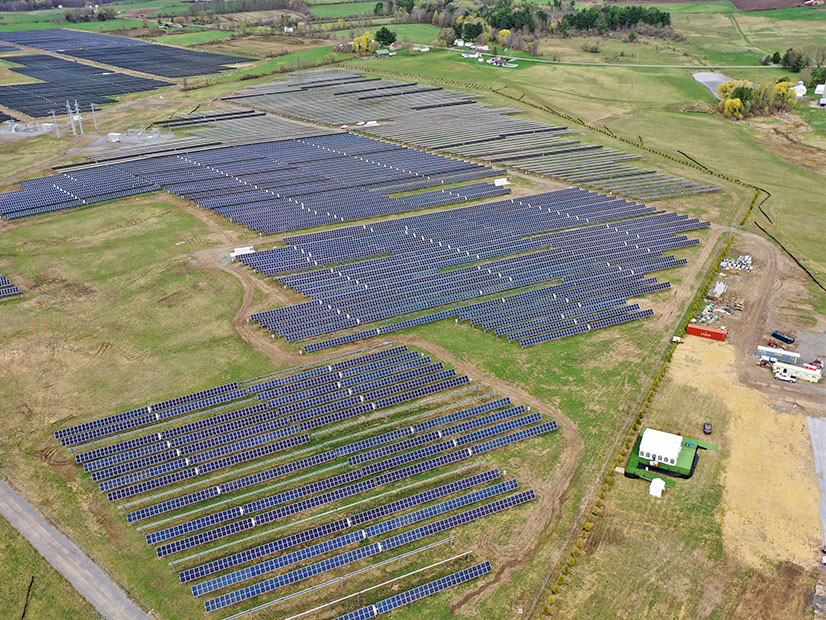
A key difference is that hydroelectric output in 2024 was 28.6% less than in 2014. Solar output was 898.2% higher in 2024 after that decade of intense policy and financial support, but at 6.8 TWh, it constituted only 4.5% of the system mix.
The largest source of carbon-free (though not renewable) electricity for New York is the four commercial nuclear reactors within its borders, which provided 21% of the state’s power in 2024.
But there again, progress to a cleaner grid has been elusive: As recently as 2019, there were six operating reactors, and they provided 32.4% of the state’s electricity.
As a result, combustion remains indispensable to New York’s grids. Natural gas provided 50.5% of the state’s electricity in 2024. Trash incineration and imported coal-fired generation each provided 2.1%, while oil, biomass and biogas combined for 0.73%.
The statistics are in the “Clean Energy Standard Annual Progress Report,” which the New York State Energy Research and Development Authority (NYSERDA) submitted Jan. 30 to the state Public Service Commission (PSC).
The PSC’s “Proceeding on Motion of the Commission to Implement a Large-Scale Renewable Program and a Clean Energy Standard” (15-E-0302) dates to 2015. The 2,200-plus documents and 23,000-plus public comments in the case record trace the development of what state leaders would often call a nation-leading clean energy and climate protection vision.
Among those records are multiple indications that following through on the vision has become more difficult than expected, such as when NYSERDA and the Department of Public Service conceded in 2024 that the state’s statutory goal of 70% renewables by 2030 had likely fallen out of reach. (See NY Expects to Miss 2030 Renewable Energy Target.)
More recently, the PSC began taking public comments on a Jan. 6 petition by a coalition of industry groups urging that the PSC temporarily suspend or modify the targets or provisions of the state Renewable Energy Program under Section 66-P of state Public Service Law.
A PSC spokesperson told RTO Insider that the commission has made no decision about the petition — it is seeking perspectives and information from different sources on the issues raised in the petition, which is not an uncommon step for it to take.
Underlying the petition and the 2024 NYSERDA report on the Clean Energy Standard is the fact that New York is running short of clean and affordable options for its grid:
-
- NYISO is projecting reliability violations in the New York City and Long Island zones starting in mid-2026.
- Existing transmission and generation assets are aging and need to be expanded if the state is to electrify buildings and transportation and attract industry.
- The governor has directed development of new nuclear generation, which has no recent track record in the United States as a financially acceptable or timely new-build grid asset.
- Solar, which in some ways is a success story in New York’s renewable portfolio, presents shortcomings for a state expecting to shift to a winter-peaking grid — winter days here are short and cloudy, and the sun’s rays come at a low angle. Large-scale photovoltaic capacity factor drops to single digits in December and January; behind-the-meter solar, which accounts for more than 90% of the state’s photovoltaic output, is in the single digits in November and in February.
- The renewable power project pipeline imploded in late 2023 amid soaring construction prices; it has been rebuilt only partly.
- Batteries provided just 6,840 MWh in 2024, or 0.0045% of the total 152.1-TWh load.
- The Trump administration and its allies in Congress are working to limit renewables development; the impact already is felt, even as New York fights back on multiple fronts in federal court.
- The state has been counting on offshore wind as a significant component of its carbon-free grid; the two projects under construction off the New York coast have been halted a combined three times by the Trump administration, and developers likely will think long and hard about starting any future projects.
- The state has some of the highest electricity rates in the nation, and there is pressure to not load ratepayers with further costs to support policy goals.
- New York is a slow and expensive place to develop energy, even after progress through streamlining initiatives.
Beyond all this, the NYSERDA report does offer some optimism: Significant new renewable generation came online in 2024, it said, and these facilities’ contributions will be reflected more completely in the 2025 report.
More is coming: Seven large-scale projects with a total 1,197 MW of capacity were in some stage of construction in 2024, and work started on 10 projects with a combined 683 MW of capacity in 2025.
Hundreds of jobs and millions of dollars in economic impact resulted from this work.
And there are environmental benefits to decarbonization: The state Department of Environmental Conservation in December 2025 reported that energy-sector greenhouse gas emissions were 24% lower in 2023 than in 1990.