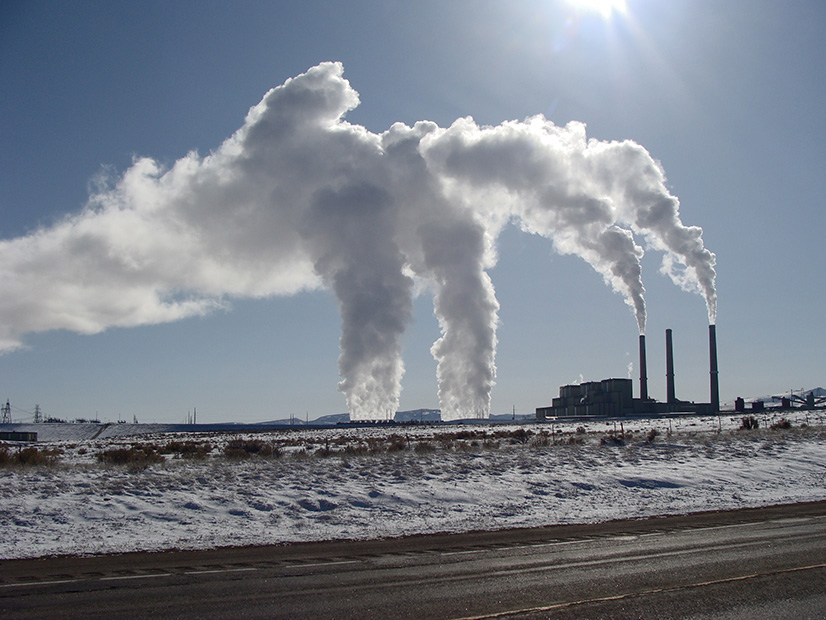
WASHINGTON — A federal order to keep Unit 1 of the coal-fired Craig Generating Station operational past its planned retirement date seems “completely disconnected from any of the actual realities on the grid,” a Colorado state energy official said at a conference.
“It really does feel like it’s sort of unprecedented times as we try to figure out how, as a state, we can meet the needs of our residents, while trying to figure out how to work with new realities at the federal level,” said Will Toor, executive director of the Colorado Energy Office. Toor spoke Feb. 4 during the National Association of State Energy Officials’ Energy Policy Outlook Conference in Washington, D.C.
The U.S. Department of Energy on Dec. 30 ordered Tri-State Generation and Transmission and other Craig Station co-owners to keep Unit 1 operational through March 30. Unit 1 had been slated for retirement on Dec. 31. The DOE order, issued under Section 202(c) of the Federal Power Act, said emergency conditions existed due to increasing demand and shortages from the accelerated retirement of generating facilities. (See DOE Blocks Retirement of Another Coal-fired Plant.)
Challenges to the DOE order have been filed separately by Tri-State, the Colorado attorney general and a coalition of environmental groups. The DOE has 30 days to respond; if there’s no response, the request is deemed denied.
Although the DOE order was for 90 days, some are concerned that it will be extended through additional emergency orders, as has been the case at locations including the J.H. Campbell coal-fired plant in Michigan. (See DOE Issues 3rd Emergency Order to Keep Michigan Coal Plant Open.)
Toor noted that the Unit 1 retirement had been planned for 10 years. Recent assessments have shown that the Rocky Mountain region has no elevated energy risks through 2035, “so there’s no energy emergency here,” he added.
Coal Supply Issues
At the time of the order, Craig Unit 1 had been out of service since Dec. 19 due to the mechanical failure of a valve. The Craig Station co-owners took steps to repair the valve, and the unit was available to operate by Jan. 20, according to a Tri-State release.
But Toor pointed to other issues for Craig Station, where the other two units are scheduled to retire in 2028.
Tri-State has “just enough coal left” in its mine to run the units until their retirement date, Toor said. Because they’re not set up for rail delivery of coal, it would be difficult and expensive to buy coal elsewhere.
“They can’t actually produce 1 kWh of additional electricity because they have to use the same coal supply,” Toor said.
Although the faulty valve at Unit 1 has been repaired and the unit has been available to operate, it has not actually been in operation, a Tri-State spokeswoman told RTO Insider.
Tri-State declined to provide details of the cost to keep Unit 1 available. Toor estimated the cost would be around $80 million a year.
Tri-State is a not-for-profit power supply cooperative, and concerns about costs to its members prompted it to request a rehearing of the DOE order on Jan. 29. Platte River Power Authority, one of the Unit 1 co-owners, joined Tri-State in the filing the petition.
“We have planned for the retirement of this resource for over a decade and have proactively replaced the capacity and energy from new sources,” Platte River General Manager and CEO Jason Frisbie said in a statement. “While Platte River will continue to comply with federal law, we disagree with the need to keep the plant open.”
The petition claims that the order is an uncompensated taking of the parties’ property and disrupts their “carefully considered reliability planning.” The order also failed to consider reasonable alternatives, the petition said.
‘Fake Emergency’ Alleged
Tri-State’s filing came a day after requests for rehearing from Colorado’s Attorney General Phil Weiser and a coalition of environmental groups.
Weiser’s petition argues that Section 202(c) does not give the DOE general regulatory authority over resource adequacy, which is the purview of the states and FERC.
The order provides “no facts that would support a determination that Craig Unit 1 is the ‘most advantageous’ way to address the alleged emergency,” Weiser’s petition said.
A petition for rehearing filed by environmental groups Jan. 28 makes similar arguments, and says the DOE order doesn’t address shortcomings of Craig Unit 1 including an unreliability that will likely worsen. The petitioners include the Sierra Club, GreenLatinos, Vote Solar, Public Citizen and the Environmental Defense Fund.
“The federal government has manufactured a fake emergency to revive a coal plant that was literally broken at the time DOE claimed the plant is needed,” Colorado Sierra Club Director Margaret Kran-Annexstein said in a statement. “Trump’s actions benefit coal executives at the expense of everyday people.”
The environmental groups said they plan to challenge the order in court if DOE denies the rehearing request.