SAVANNAH, Ga. — NERC Director of Reliability Assessment and System Analysis John Moura acknowledged recent criticism of NERC’s Long-Term Reliability Assessment but emphasized the report is “not a prediction of outages [or] a forecast of impending blackouts.”
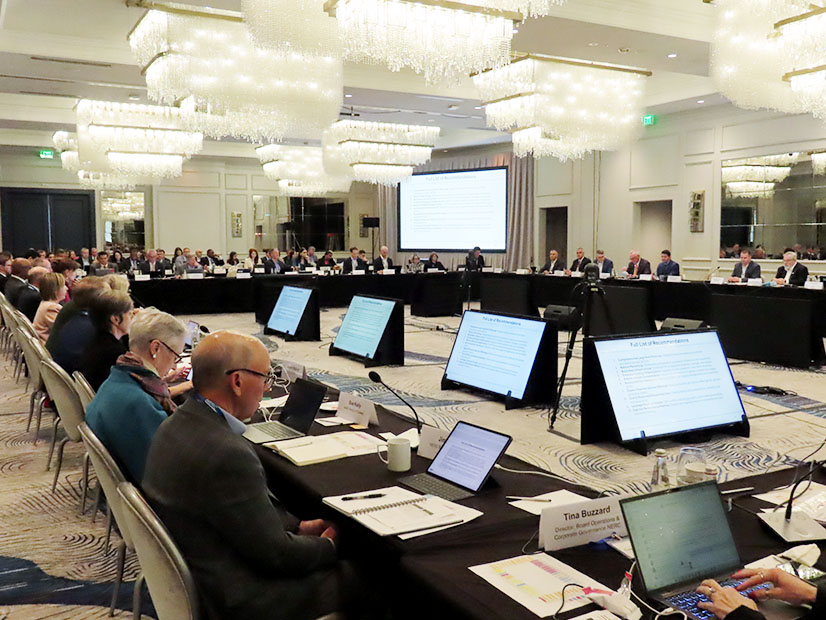
Speaking at the ERO’s quarterly technical session Feb. 12, he also discussed some of the ways the ERO’s approach to the assessment is changing in light of ongoing changes to the electric grid.
Moura’s remarks came the same week as his appearance, along with NERC CEO Jim Robb, at the Feb. 9 board meeting of the Organization of MISO States to discuss objections by OMS members to the ERO’s 2025 LTRA, which rated five assessment regions, including MISO, as having the potential to develop into high risk between 2026 and 2030.
The assessment means that planned resources as of July 2025 would lead to energy shortfalls in excess of resource adequacy targets or baseline criteria for unserved energy or loss of load.
OMS members disputed this label in a letter that argued NERC should have counted resources in MISO’s fast-track interconnection queue. The organization argued that the 11 GW of natural gas generation and battery storage proposals to come online by mid-2028 should make up for the 7-GW shortfall projected in the LTRA. (See MISO States Dispute ‘High Risk’ Designation from NERC.)
It was the second time in as many years that MISO objected to NERC’s assessment of the region’s risk. In 2025 MISO’s Independent Market Monitor pointed out that NERC had committed an error in rating the region as high-risk in the previous year’s LTRA. After a back-and-forth, NERC agreed to downgrade MISO to “elevated” risk.
At the technical session, Moura explained — as he did at the OMS board meeting — that NERC’s deadline for including energy projects passed in mid-July 2025 and MISO’s fast-track projects “were only approved in September, [so] were unable to be included in the energy analysis.” (See NERC to OMS: Long-term Assessment not a Predictor of Risk.) He added that the resources might not have been included in the assessment anyway because of changes to how NERC assesses the impact of generation additions.
“Counting capacity is really a thing of the past. Energy adequacy cannot be determined by counting capacity,” Moura said. “These projects weren’t left out because we missed them. The issue is really modelability, deliverability and certainty.”
Moura explained that modelability refers to whether any constraints could apply to a resource — for example, if a gas generator is coming online without firm gas arrangements — that could make it “difficult or impossible for that new generator to get gas on peak winter days.”
Deliverability means the ability of electricity generated in one area to reach load centers in other areas, which Moura observed could be an issue for the 7 GW of fast-track resources “south of the well-known MISO South to MISO North interconnection constraint.”
Finally, Moura defined certainty as the assurance that projected resources will be available as expected, an important question “given the supply chain challenges … in our assessments showing delays of up to 50% of planned generation not meeting their in-service dates.”
Avoiding Panic
Along with the difficulty assessing new generation, NERC Trustee Ken DeFontes observed that in previous LTRAs, NERC staff have also had problems predicting generation retirements because they “tended to only count retirements that had been announced [when] the reality was … it was likely more were coming.” He asked how the team behind the 2025 assessment had accounted for the issue.
Mark Olson, NERC’s manager of reliability assessments, replied that the ERO aims to account for both the “certain level of retirements in terms of being announced and in the process to be deactivated, versus a more speculative industry projection of potential retirement.” Moura added that NERC also must consider retirements as “a dial that can be turned … where states and other policy makers can take action to keep units online [or] have the ability to throttle those resources.”
Karen Onaran, CEO of the Electricity Consumers Resource Council, reminded attendees of the growing influence of NERC’s reliability assessments on lawmakers and policy makers, and warned that without proper context the reports could be “used as ammunition [to] saddle consumers with costs that may not be necessary.”
“At least within the last couple of years, when these reports come out, [they raise] some panic, and [hurt] some feelings. And we take it, and we try to take the lessons learned and figure it out,” Onaran said. She suggested that NERC’s Engagement and Outreach Committee, launched in December 2025 to handle external communications, work on a plan for conveying “what this report really says … and what risks it’s identifying … to all levels of government and to the industry.”