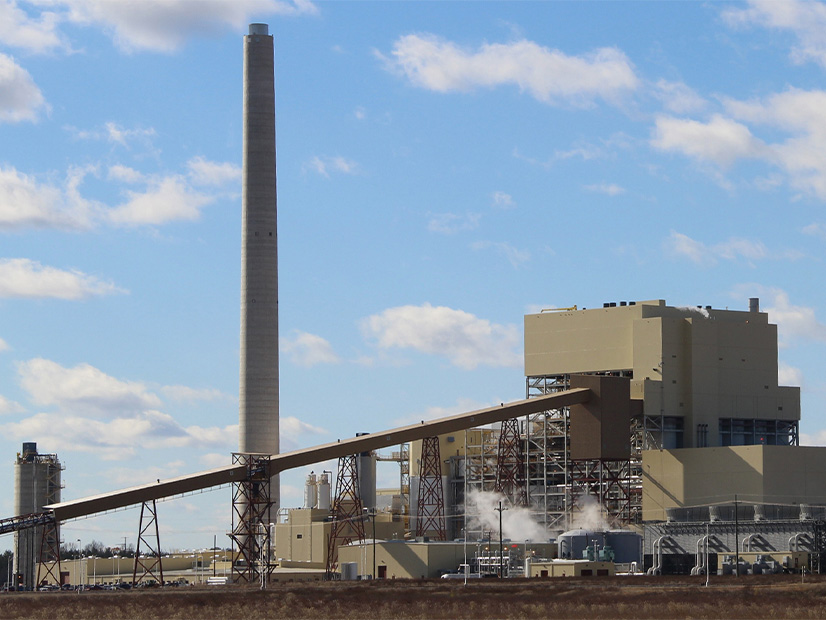
EPA Administrator Lee Zeldin traveled to the Mill Creek coal plant in Kentucky to announce the agency is reversing 2024 amendments that expanded the scope of the Mercury and Air Toxics Standards (MATS), saying the change is expected to save $670 million.
“The Biden-Harris administration’s anti-coal regulations sought to regulate out of existence this vital sector of our energy economy,” Zeldin said in a statement accompanying the Feb. 20 announcement. “If implemented, these actions would have destroyed reliable American energy. The Trump EPA knows that we can grow the economy, enhance baseload power, and protect human health and the environment all at the same time. It is not a binary choice and never should have been.”
The reversal restores as the law of the land the 2012 MATS rule, a regulation that pushed many plants to retire, along with cheap shale gas that made older coal-fired plants less competitive in the markets.
“The Obama administration’s 2012 MATS rule was one of the biggest blows against West Virginia in the war on coal, putting an indescribable strain on our dedicated coal miners, their families and communities and our entire state,” Sen. Shelley Moore Capito (R-W.Va.) said in a statement. “The Biden administration only made matters worse when it included an even more stringent MATS rule in its package of regulations aimed at eliminating coal from our nation’s energy mix.”
The 2024 revisions to MATS established more stringent standards for non-mercury emissions from coal generators and mercury emissions from lignite-fired generators and required all generators to install continuous emissions monitoring systems for particulate emissions.
EPA said that by 2021, the 2012 MATS rule had cut mercury emissions by 90%, acid gas pollutants by more than 96% and emissions of non-mercury metals such as arsenic and lead by 81%.
“EPA has re-evaluated the 2024 final rule and, after considering public comments, finds that the revisions to the emissions standards were not ‘necessary’ because they impose unwarranted compliance costs or raise potential technical feasibility concerns,” the agency said in its repeal.
Reactions to EPA’s announcement varied, with environmental organizations lamenting that the repeal will allow coal- and oil-fired power plants to emit more brain-damaging mercury, other harmful metals and soot. That pollution puts the public at greater risk of cancer, premature deaths, and heart and lung disease, according to a joint statement from the Clean Air Task Force, Earthjustice, Environmental Defense Fund, Environmental Law & Policy Center, Natural Resources Defense Council and Sierra Club.
The eliminated requirement to install monitoring systems on power plants deprives communities of a powerful tool ensuring that the facilities comply with emissions standards, they added.
“This repeal is an unprecedented, unlawful and unjustified reversal that flies in the face of congressionally mandated efforts to reduce hazardous air pollution from industrial facilities,” Clean Air Task Force attorney Hayden Hashimoto said in a statement. “EPA’s repeal puts polluters’ interests over public health by loosening the limits on emissions of air toxics from power plants, which the agency has previously recognized as the largest domestic emitter of mercury and other hazardous air pollutants. Allowing more emissions of air toxics puts Americans at greater risk for the benefit of a small number of particularly dirty coal plants.”
Coal trade group America’s Power welcomed the reversal, saying it will help power plants stay online at a time when they are needed for reliability. More than 55 GW of coal generators are currently scheduled to retire in the next five years as demand continues to rise, CEO Michelle Bloodworth said.
“In combination with other EPA rules, the 2024 MATS rule would have helped accelerate coal plant retirements, ignoring the critical role these facilities play in providing dependable, baseload power,” she added. “Utilities have already invested more than $2.5 billion to comply with the original 2012 MATS rule, and the 2024 update would have required roughly $1 billion in additional costs that ultimately would have been borne by ratepayers.”