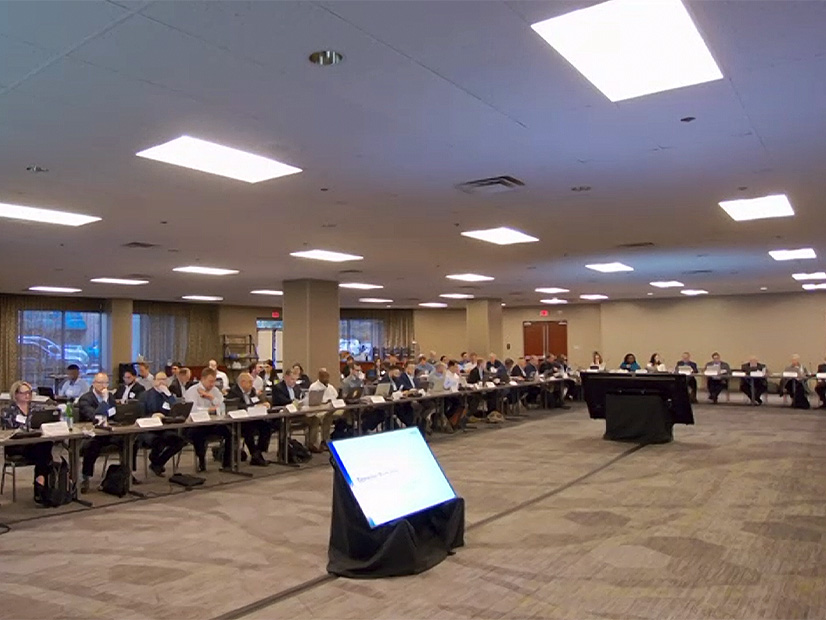
The quarterly meeting of NERC’s Reliability and Security Technical Committee in Phoenix saw updates and progress on key ERO initiatives, as NERC leaders confirmed that big changes are coming.
NERC Trustee Sue Kelly, who has served as liaison between the ERO’s Board of Trustees and the committee for the past two years, told members that “management is already hard at work” preparing to implement the recommendations of the Modernization of Standards Processes and Procedures Task Force. Trustees voted to accept the recommendations at their most recent meeting in February, and NERC’s management said it hopes to finish the transition by the end of 2027. (See NERC Board Accepts MSPPTF Recommendations.)
Implementing the MSPPTF’s proposals would put the RSTC at the center of NERC’s standards development process and “require a collective change in mindset” from members, Kelly said. The committee would be in charge of vetting all standard initiation requests twice a year to determine the appropriate action.
“This committee will definitely be in the mix as things move forward, [and] I will do all I can to support that effort,” Kelly said. “Your role in SIR review is going to have to take place in a substantially shorter time frame than you all are used to working under, and we’re all going to need to adjust our time expectations accordingly.”
Kelly and NERC Chief Engineer Mark Lauby highlighted the importance of the committee’s work on large loads, which Kelly called an “incredibly high-profile” topic that “we do not have a moment to lose … to address.”
Lauby told attendees that NERC is “moving swiftly toward” a Level 3 alert on large loads that will identify “essential actions” for recipients to follow. It follows a Level 2 alert in 2025 that provided recommendations on large loads; Lauby said NERC will release a report on the responses to that alert “soon.”
Action on Large Loads, DERs
The discussion of large loads continued as committee members approved a proposed policy paper on challenges integrating large loads into the electric grid. NERC’s Large Loads Working Group developed the paper, which includes topics on the interconnection process, planning and resource adequacy, modeling, security and resilience, disturbance ride-through and load balancing; industry provided comments June 16-July 17, 2025.
Members also approved a technical reference document from the System Planning Impacts from Distributed Energy Resources Working Group, created in response to industry comments on a standard authorization request relating to the role of DERs in operational planning analysis and real-time assessments. SPIDERWG members developed the document to suggest possible resolutions to stakeholders’ comments and to “demonstrate the current industry practices associated with modeling DERs.”
Also approved was a security guideline on voluntary best practices for physical security protection at electric facilities. NERC’s Security Working Group proposed the guideline as a replacement for an existing document based on input from asset owners and operators. It emphasizes a layered defense approach incorporating physical security controls, electronic systems, security personnel and effective corporate security policies.
The last document approved by RSTC members at the meeting was an implementation guidance document for reliability standard PRC-023-6 (Transmission relay loadability). The paper applies to requirement R1 of the standard, which concerns protective relay settings, and clarifies the criteria by which asset owners can evaluate phase protective relay element settings.
The RSTC also accepted several documents to post for industry comments, including reliability guidelines on operating reserve management and on modeling of aggregate DERs, and a security guideline on DER aggregators and inverter-based resources. A policy paper on the use of artificial intelligence and machine learning also was accepted for comment by RSTC members, as was a technical reference document on supply chain risk mitigation strategies.